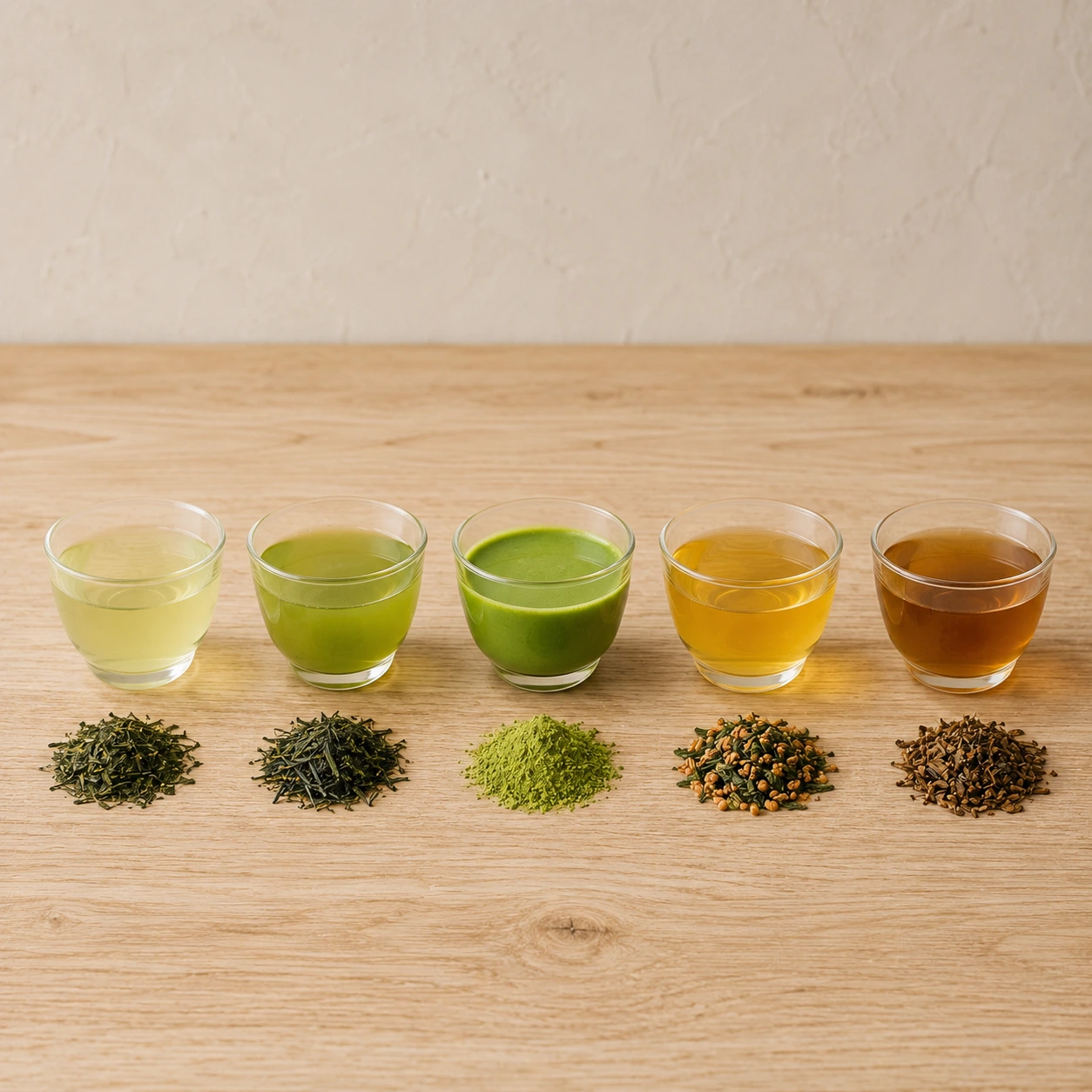
Sencha, Hojicha, Genmaicha, Matcha: A Guide to Japanese Green Tea
Every Japanese green tea comes from the same plant — the difference is shade, roast and grind. Here is what separates the five you will actually drink, and how to brew each one.
Every green tea in this article comes from the same plant: Camellia sinensis. No exceptions, no special varieties. What makes a grassy sencha taste nothing like a toasty hojicha is entirely what happened after the leaf was picked — how long it sat in the shade, how hard it was steamed, whether it was roasted over charcoal, whether it was stone-ground into powder.
That is genuinely good news for anyone standing in front of a Japanese tea shelf for the first time. You do not need to learn a hundred products. You need to learn about five processes, and after that the labels read themselves.
The other thing worth knowing up front: Japanese green tea is steamed, while Chinese green tea is usually pan-fired. Steaming halts oxidation faster and keeps more chlorophyll in the leaf, which is why Japanese tea brews that vivid jade colour and tastes of fresh grass, seaweed and sweet umami rather than toasted chestnut. It is the single biggest reason the two traditions taste so different.
Sencha — the everyday standard
Roughly three-quarters of all tea grown in Japan is sencha, and it is what "green tea" means to most Japanese households. Leaves are grown in full sun, steamed, rolled into thin needles and dried. The result is bright and brisk: grassy up front, a clean astringency in the middle, a sweet finish.
Within sencha, the label to watch is fukamushi (深蒸し), or "deep-steamed." Steaming for two to three times longer breaks the leaf down further, so the tea brews faster, pours a cloudy deep green, and tastes noticeably rounder and less sharp. If regular sencha has ever struck you as thin or bitter, fukamushi is the fix.
Brew it: 80°C, one minute. Boiling water is what makes green tea bitter — more than the leaf, more than the steeping time.
For a straightforward, everyday leaf without the deep-steam character, the standard version of the same tea is the easier introduction and the more forgiving brew.
Matcha — shaded, stone-ground, whisked
Matcha starts diverging from sencha weeks before harvest. The plants are covered for about twenty days, which starves them of light and forces them to produce more chlorophyll and more L-theanine — the amino acid behind matcha's savoury depth and its oddly calm, non-jittery lift. The shaded leaves are steamed, dried, destemmed, and stone-ground into a powder fine enough to feel like silk.
Because you drink the whole leaf rather than an infusion of it, matcha delivers considerably more catechins, caffeine and L-theanine per cup than steeped tea. It is also the only tea here that is whisked rather than brewed.
We have a separate walkthrough of grades, tools and technique in how to choose and whisk matcha at home — worth reading before your first tin, because the difference between ceremonial and culinary grade decides whether your first bowl tastes sweet or punishing.
Genmaicha — green tea with toasted rice
Genmaicha blends sencha or bancha with roasted brown rice, some of which puffs like popcorn during roasting. The story that it began as a wartime economy measure — rice bulking out expensive tea — is probably true, but it long ago stopped being a compromise. The toasted grain rounds off the tea's astringency and adds a warm, nutty, almost savoury note.
It is the most food-friendly tea on this list. Low in caffeine, comforting rather than bracing, and the standard pour alongside a rice-based meal. The matcha-dusted version adds a layer of shaded-leaf sweetness on top of the toast.
Brew it: 85–90°C, thirty seconds. Genmaicha is one of the few Japanese teas that tolerates near-boiling water — the rice wants the heat.
Hojicha — roasted, low caffeine, evening tea
Hojicha is sencha or bancha roasted in a porcelain pot over high heat until the leaves turn reddish-brown. Roasting burns off much of the caffeine and nearly all of the astringency, leaving a tea that is toasty, caramel-sweet, and almost completely without bitterness.
This is the tea served to children and to elderly relatives in Japan, and the one poured after dinner. It is also the most forgiving tea in this guide: you can brew it with boiling water, leave it too long, and it will still taste good.
Brew it: boiling water, thirty seconds to a minute. Genuinely hard to ruin.
Gyokuro — the shaded luxury
Gyokuro takes matcha's shading trick and applies it to a leaf tea, covering the plants for around three weeks before harvest. The result is the most intensely umami tea Japan produces: thick, sweet, almost broth-like, with barely any astringency at all.
It is brewed completely differently from everything else here — around 50–60°C, a large amount of leaf, and a long two-minute steep producing a tiny, concentrated cup. Cooling the water that far sounds fussy until you taste what happens when you do not.
Gyokuro is a special-occasion tea and priced like one. Start with fukamushi sencha; come back to gyokuro when you want to understand what the shading does.
Water temperature is the whole game
If you take one thing from this guide, take this table. Nearly every "I don't like green tea" experience traces back to water that was too hot.
| Tea | Temperature | Time |
|---|---|---|
| Gyokuro | 50–60°C | 2 min |
| Sencha | 70–80°C | 1 min |
| Fukamushi sencha | 70–80°C | 30–40 sec |
| Genmaicha | 85–90°C | 30 sec |
| Hojicha | 95–100°C | 30–60 sec |
No thermometer needed: boil the kettle, pour the water into your cup, then into the pot. Each transfer drops it roughly 10°C.
Which one should you start with?
- Never had loose-leaf Japanese tea: fukamushi sencha — forgiving, fast, unmistakably Japanese.
- Want it caffeine-light for evenings: hojicha.
- Drinking it with food: genmaicha.
- Want the health headline (catechins, L-theanine): matcha.
- Already love sencha and want the next step: gyokuro.
Frequently asked questions
How long does loose-leaf green tea keep? Unopened, roughly a year. Opened, aim for one to two months — green tea does not spoil, but it fades, and the fresh-grass note is the first thing to go. Keep it sealed, cool, and away from light and strong smells. Matcha is the most fragile of all; refrigerate an opened tin and use it within a month.
Can I re-steep the leaves? Yes, and you should. Sencha gives two or three good infusions; each subsequent one goes shorter and slightly hotter. The second steep is often the sweetest.
Is Japanese green tea high in caffeine? Sencha sits well below coffee. Hojicha is lower still. Matcha is the exception — you are consuming the leaf itself — but its L-theanine content produces a noticeably smoother, longer lift than an equivalent hit of coffee.
What is bancha? Leaves from the later harvests, coarser and lower in caffeine than sencha. It is the base for most hojicha and much genmaicha, and worth drinking on its own if you want something plain and everyday.
All of these ship direct from Japan in their current season's packaging. Start with one leaf tea and one roasted tea — that pair covers a whole day.