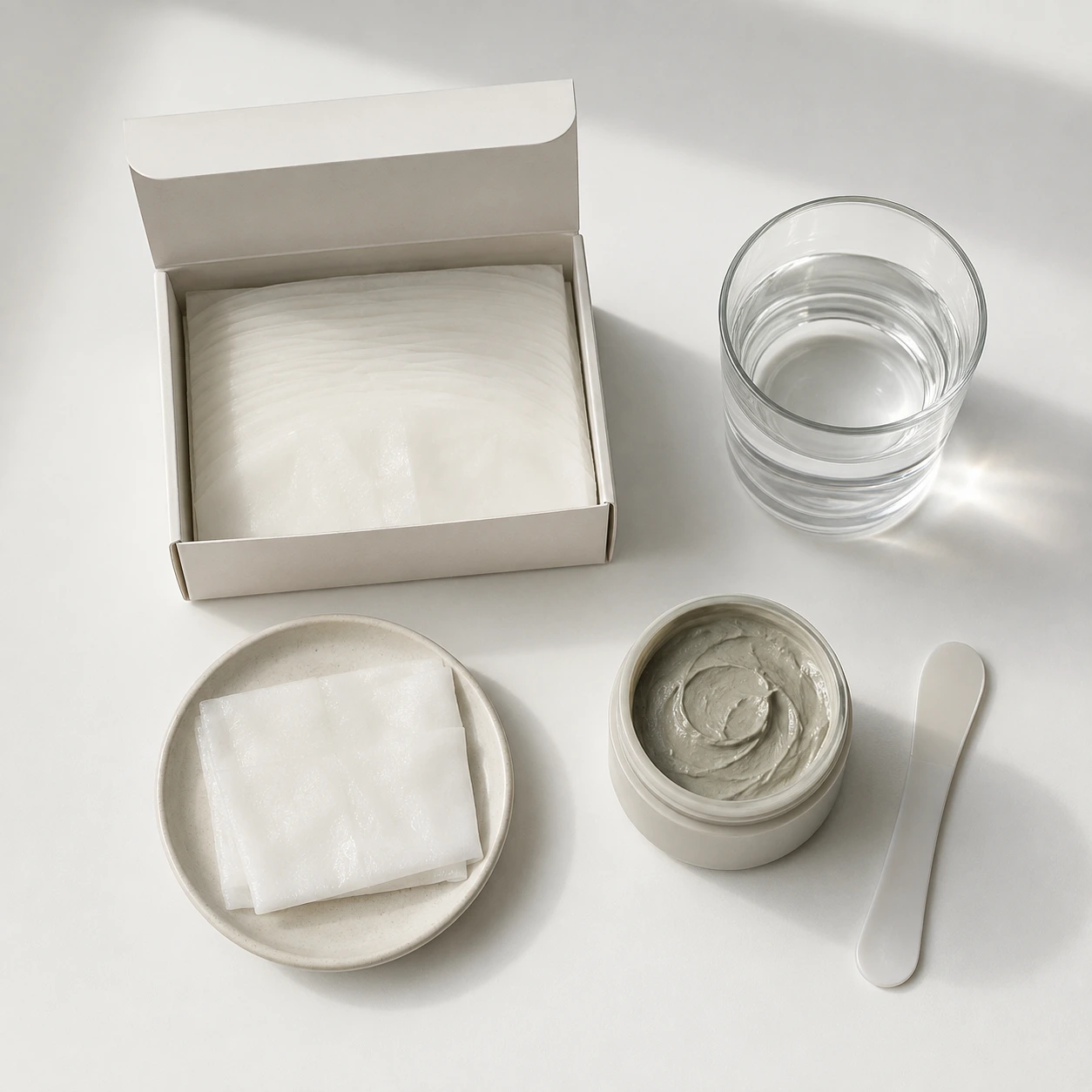
Japanese Face Masks Explained: Daily Sheet Packs, Wash-Off Masks and How to Use Them
Why Japan sells masks in boxes of 32 rather than single foil sachets, how long to leave one on, where it sits in the routine, and the mistakes that waste the serum.
In Japan a face mask is not an occasion. It is sold in a box of 32 with a resealable lid, kept on the bathroom shelf next to the lotion, and used the way most people use a toner — every evening, without ceremony.
That single fact explains most of the differences between Japanese masks and the ones the rest of the world learned from Korean beauty: the sheet is thinner, the serum is a hydrating base rather than a concentrated treatment, and the price per sheet is closer to a cup of coffee than a bottle of wine.
Four formats, four jobs
| Japanese | Reading | What it is | Leave on |
|---|---|---|---|
| シートマスク | shīto masuku | Cotton or rayon sheet soaked in serum | 5–15 minutes |
| 洗い流すパック | arainagasu pakku | Wash-off cream, clay or gel mask | 5–10 minutes, then rinse |
| 塗るパック / スリーピングマスク | nuru pakku / surīpingu masuku | Leave-on gel or cream worn overnight | All night |
| 朝用マスク | asa-yō masuku | Morning sheet that replaces cleansing and toner | 60 seconds |
Wash-off packs (パック, pakku, is the older Japanese word for any mask) are the texture-and-pore category. Sleeping masks are a heavier moisturiser in a jar and behave like one. Morning masks are a time-saving device rather than skincare in the strict sense.
The wash-off rice pack is the traditional Japanese format that predates sheets entirely: a rice-derived paste left on for a few minutes to soften and refine texture, then rinsed. It does a different job from a sheet and the two are not interchangeable.
Daily boxes versus the single-sachet habit
Korean masks arrived in the West as individually wrapped sachets, each promising a different active and priced to be used once or twice a week. Japanese drugstore masks went the other way: a thin, pliable sheet, a lotion-like serum built around hyaluronic acid or glycerin, and a box of 7, 20 or 32 sheets intended for daily use.
The daily Japanese mask is best understood as a wearable toner, not a treatment. It replaces the lotion step for that evening and gives the skin ten minutes of uninterrupted hydration. The luxury single-sheet approach is closer to a serum booster used occasionally.
Lululun's 32-sheet boxes defined the daily category. The sheet lifts out of a wide-mouth pack, the serum is light enough that nothing needs rinsing, and the paper packaging is designed to sit on a shelf for a month.
Kosé's Clear Turn box is the other household name, with a higher-adhesion sheet that clings closer to the face than older cotton types.
Vitamin C boxes such as Derma Laser's 20-sheet pack sit between the two philosophies: still a box, but with a concentrated active most people will use two or three times a week.
The morning mask is a purely Japanese invention. Saborino's sheet combines cleansing, toning and a primer layer into one 60-second step for people who would otherwise skip skincare before work.
Where it goes in the routine
A sheet mask is a lotion step. Treat it as one.
- Cleanse as usual. Pat the face damp, not bone dry.
- Unfold the sheet and align the eye and mouth holes before pressing it on. Smooth outward from the nose.
- Leave it on for the time on the box — typically 5 to 10 minutes for daily masks, 15 for jelly or thick-serum types.
- Remove and press the remaining serum in with the palms. Do not rinse.
- Seal with an emulsion or cream within a minute or two. Serum with no occlusive layer over it evaporates and takes moisture with it.
Wash-off packs go straight after cleansing and before everything else. Sleeping masks replace the night cream as the final step.
For dry or reactive skin, a ceramide-based sheet like Curél's makes the most sense at step 3, and the tear-off strips it comes with cover the eyelids and sides of the nose where standard sheets gap.
How long, and how often
The most common mistake is leaving the sheet on until it dries: once it is drier than the skin, it pulls moisture back out. Ten minutes is almost always enough.
Frequency by type:
- Daily hydrating sheets: every night is fine, and is how they are designed. Every other night is the practical rhythm for most people.
- Vitamin C, niacinamide or acid masks: two to three times a week, and not on the same night as a retinol.
- Wash-off clay or enzyme packs: once or twice a week.
- Jelly, high-serum or sleeping masks: once or twice a week.
Jelly masks carry far more serum than a daily sheet — Premium Puresa's holds 33 g — so they belong in the once-a-week column.
Reading the ingredient cues
Japanese mask boxes lead with the hero ingredient in large type. These are the ones worth knowing.
| Japanese | Reading | Cue | What it targets |
|---|---|---|---|
| ヒアルロン酸 | hiaruron-san | Hyaluronic acid | Surface hydration, plumpness |
| セラミド | seramido | Ceramide | Barrier repair, dryness, sensitivity |
| ビタミンC誘導体 | bitamin C yūdōtai | Vitamin C derivative | Dullness, pores, uneven tone |
| ナイアシンアミド | naiashin-amido | Niacinamide | Texture, oil balance, tone |
| コラーゲン | korāgen | Collagen | Surface moisture and a smoother feel |
| 米 / コメ | kome | Rice extract or ferment | Softness, mild brightening |
Rice-serum sheets are the Japanese answer to a heritage ingredient: unglamorous, inexpensive, and a good first box for someone who has never masked and wants to see whether the habit sticks.
Mistakes that waste the box
- Masking on unwashed skin. The serum sits on top of sebum and sunscreen and does nothing.
- Letting the sheet dry out. Set a timer.
- Rinsing afterwards. Unless the box says 洗い流す, leave the serum where it is.
- Skipping the cream on top. This is the step that makes masking visible the next morning.
- Treating a daily mask like a treatment. One sheet does very little; a month of sheets does a great deal.
Frequently asked questions
Can I reuse the serum left in the pouch? Yes, on the same day. Press it into the neck, chest or backs of the hands. Do not store an opened pouch.
Are Japanese masks safe for sensitive skin? The fragrance-free ceramide types are among the gentlest masks available. Check the box for 無香料 (mukōryō, fragrance-free) and 無着色 (muchakushoku, colourant-free), and patch test any vitamin C or acid mask first.
Why does my skin feel tight after a mask? Either the sheet dried on the face, or nothing was applied over the serum. Both are fixed by the timer and the cream.
A box of daily sheets, ten minutes, a cream on top — that is the whole Japanese method. The hydration layering guide covers where lotion and emulsion fit around it, and Japanese vs Korean skincare explains why the two markets built such different mask habits.