The Japanese Snack Aisle, Decoded: What to Buy on Your First Order
Japan's snack shelf runs from rice crackers older than the country's convenience stores to chocolate sticks sold in a hundred markets. Here is what each category tastes like and where to start.
The Japanese snack aisle is a genuinely different shape from a Western one. There is far less of the salt-and-fat monoculture and far more variety of texture: puffed, baked, fried, glazed, cracker-crisp, airy, chewy. Portions are smaller, individual wrapping is near-universal, and the flavour range extends comfortably into savoury territory that most markets never attempt — seaweed, cod roe, wasabi, grilled beef tongue.
It also moves fast. Limited editions and regional flavours rotate constantly, which is why "what should I try?" is such a persistently hard question. This is the version of the answer organised by category, so you can pick by what you actually like rather than by packaging.
Rice crackers (senbei and kaki no tane)
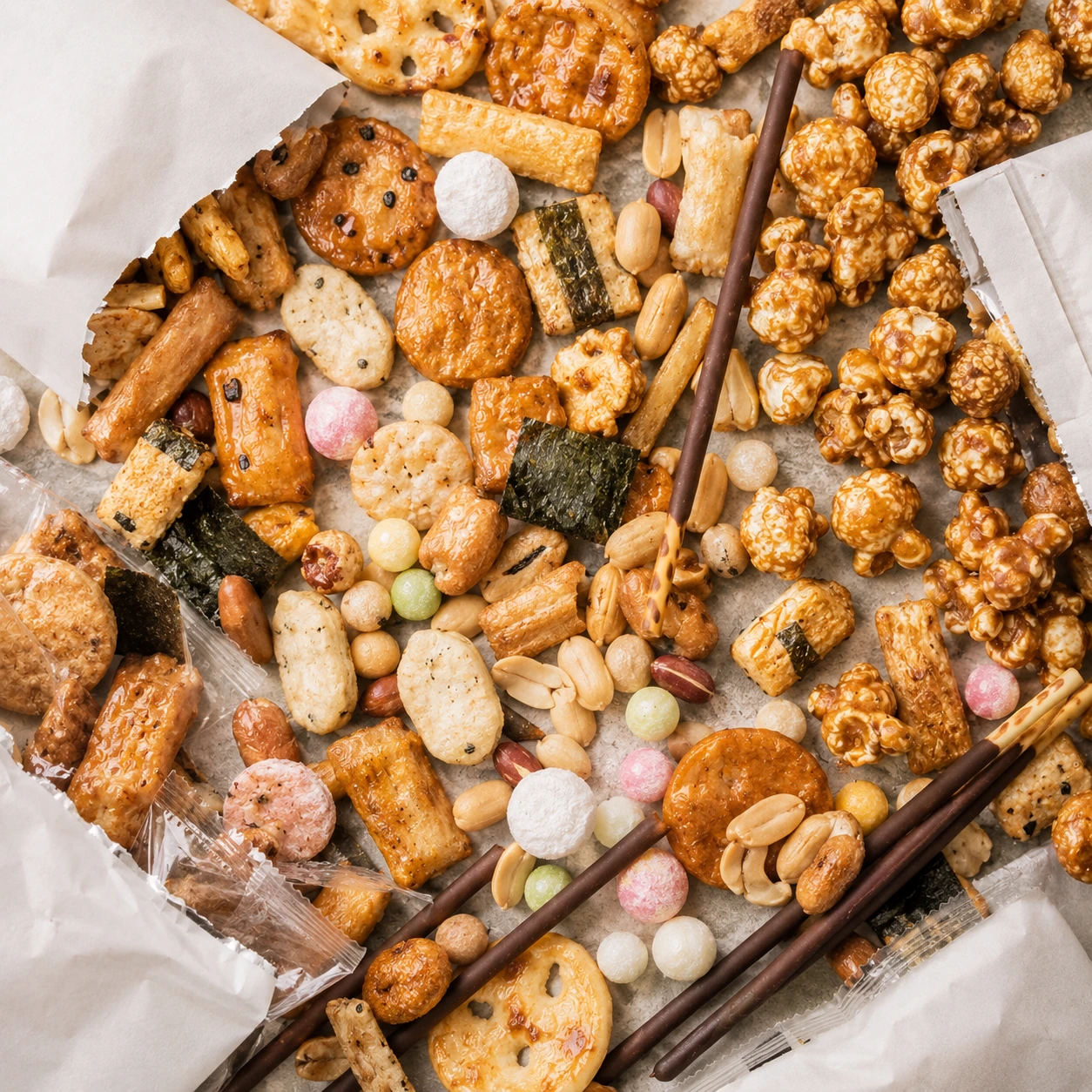
The oldest category, and the one most people underrate. Rice crackers are baked or fried from rice flour and glazed with soy sauce, and they run from thin and shatteringly crisp to thick and chewy.
Kaki no tane ("persimmon seeds") are the definitive Japanese beer snack: small, curved, soy-glazed and chilli-spiked rice crackers, almost always packaged with peanuts. The 6:4 cracker-to-peanut ratio is a matter of genuine national debate — the manufacturer ran a public vote on it in 2019.
For a lighter, milder introduction, glazed puffed rice snacks deliver the soy-and-rice profile without the heat:
Savoury snacks and chips
Japan's potato snacks are more textural than the Western flat crisp. Jagariko is the format worth knowing: potato sticks packed into a cup, fried until dense and hard rather than crisp, with a distinctive crunch that turns creamy as you chew. The salad flavour — despite the name, it is a savoury vegetable seasoning — is the standard.
The other pillar is Kappa Ebisen, a shrimp-flavoured puffed stick in continuous production since 1964. Real shrimp is ground shell-and-all into the dough, which gives a savoury depth that no seasoning powder achieves. It is the snack most Japanese adults grew up on.
And Baby Star takes the idea to its logical conclusion: seasoned instant-noodle pieces eaten dry as a snack, which is exactly as good an idea as it sounds.
Caramel corn and the sweet-savoury middle
The category Japan does better than anyone: snacks that are simultaneously sweet and salty. Tohato's caramel corn is a puffed corn snack with a caramel coating, packaged with roasted peanuts at the bottom of the bag — the peanuts are there deliberately, as a salt-and-crunch counterweight to the sweetness.
Chocolate and biscuit sticks
Pocky needs no introduction in most markets, but the Japanese domestic version is worth ordering specifically: the chocolate is formulated for Japan's climate and palate, less sweet and with a cleaner snap than many export versions.
Kinoko no Yama ("mushroom mountain") is the other pillar — a biscuit stem with a chocolate cap, and one half of Japan's longest-running confectionery rivalry with its bamboo-shoot-shaped sibling. Meiji has run national votes on which is better since 2001.
Alfort is the grown-up option: a whole-wheat biscuit with a thick chocolate slab moulded with a sailing ship on top. It is the snack most often bought as a small gift rather than for oneself.
And matcha chocolate is a category in itself. The Japanese domestic KitKat range is famous for a reason — the dark matcha version uses genuine Uji tea and is bitter enough to taste like tea rather than green-coloured sugar.
Chewy sweets
Hi-Chew is Japan's most successful chewy candy export, and the reason is textural: it is made with a taffy process that produces something firmer and less sticky than a Western chew, with fruit purée rather than just flavouring. The assortment pack is the right way in.
Milky is the nostalgic counterpoint — a soft milk candy made with condensed milk, in production since 1951, with a mascot most Japanese people can draw from memory.
Dagashi: the ten-yen shelf
Dagashi are cheap children's sweets, historically sold for coins at small neighbourhood shops. They are tiny, individually wrapped, aggressively flavoured, and often extremely savoury — this is where you find grilled-eel-flavoured fish sheets and wasabi seaweed strips sold as candy.
They are also the best value in the entire aisle, and the most fun to hand around. Nobody's first reaction to eel-flavoured snack paper is neutral.
What to put in a first order
If you are building a starter box rather than buying one thing:
- One rice cracker: kaki no tane. Non-negotiable.
- One savoury: Kappa Ebisen or Jagariko.
- One sweet-savoury: caramel corn.
- One chocolate: Pocky or Alfort.
- One matcha item: dark matcha KitKat.
- One chewy: Hi-Chew assortment.
- Two dagashi: whichever sound strangest.
That is a spread across every texture the aisle offers, and it will tell you quickly which direction to go deeper.
Frequently asked questions
How long do Japanese snacks keep? Typically four to eight months from manufacture. Japan labels most snacks with a best-before (賞味期限) rather than a use-by date — it is a quality date, not a safety one.
Why is everything individually wrapped? Humidity. Japanese summers destroy crisp textures, and individual wrapping is the standard defence. It also reflects a strong cultural norm around sharing snacks at work and in groups.
Are these suitable as gifts? Extremely — Japan has an entire gift-giving economy built around packaged sweets. Alfort, Pocky and boxed matcha items travel and present well; dagashi are better as a fun extra than a formal gift.
Anything to watch for with allergies? Wheat, soy, milk and peanuts are common, and shrimp appears in several savoury snacks including Kappa Ebisen. Japanese packaging lists the seven major allergens in a boxed section on the back.
Snacks are the lowest-risk way to start ordering from Japan — small, light, cheap to ship, and they tell you a lot about what else on the shelf you will like.