Daruma and Maneki-neko: Japan's Lucky Charms, from Painting the Eye to the Beckoning Paw
What engimono are, why a daruma has one blank eye, which paw a beckoning cat should raise, what every colour means, and how to place, gift and look after papier-mache and ceramic charms.
Walk into a Japanese restaurant, a family-run shop or a politician's office and you will meet the same two objects: a round red figure with fierce eyebrows and one eye missing, and a ceramic cat with a paw raised in greeting. They are the most recognisable members of a large family of 縁起物 (engimono, lucky objects), and each carries rules that Japanese people absorb without being told.
This guide explains where the daruma and the 招き猫 (maneki-neko, beckoning cat) come from, what the colours, paws and eyes mean, where to put them, and what to do with them when the year ends.
Engimono: how luck works in Japan
縁起 (engi) means an omen or the origin of a fortunate outcome, and an engimono is any object that carries a wish forward: a daruma bought at a new year fair, a cat placed by a till. They are sold at temple markets and stationers alike, and belong to folk custom rather than doctrine.
That distinction matters for anyone buying from abroad. Owning a daruma commits you to nothing religious; it is closer to a resolution you can see. Nobody in Japan will think it strange that a non-Buddhist household keeps one.
Daruma: the monk who would not fall over
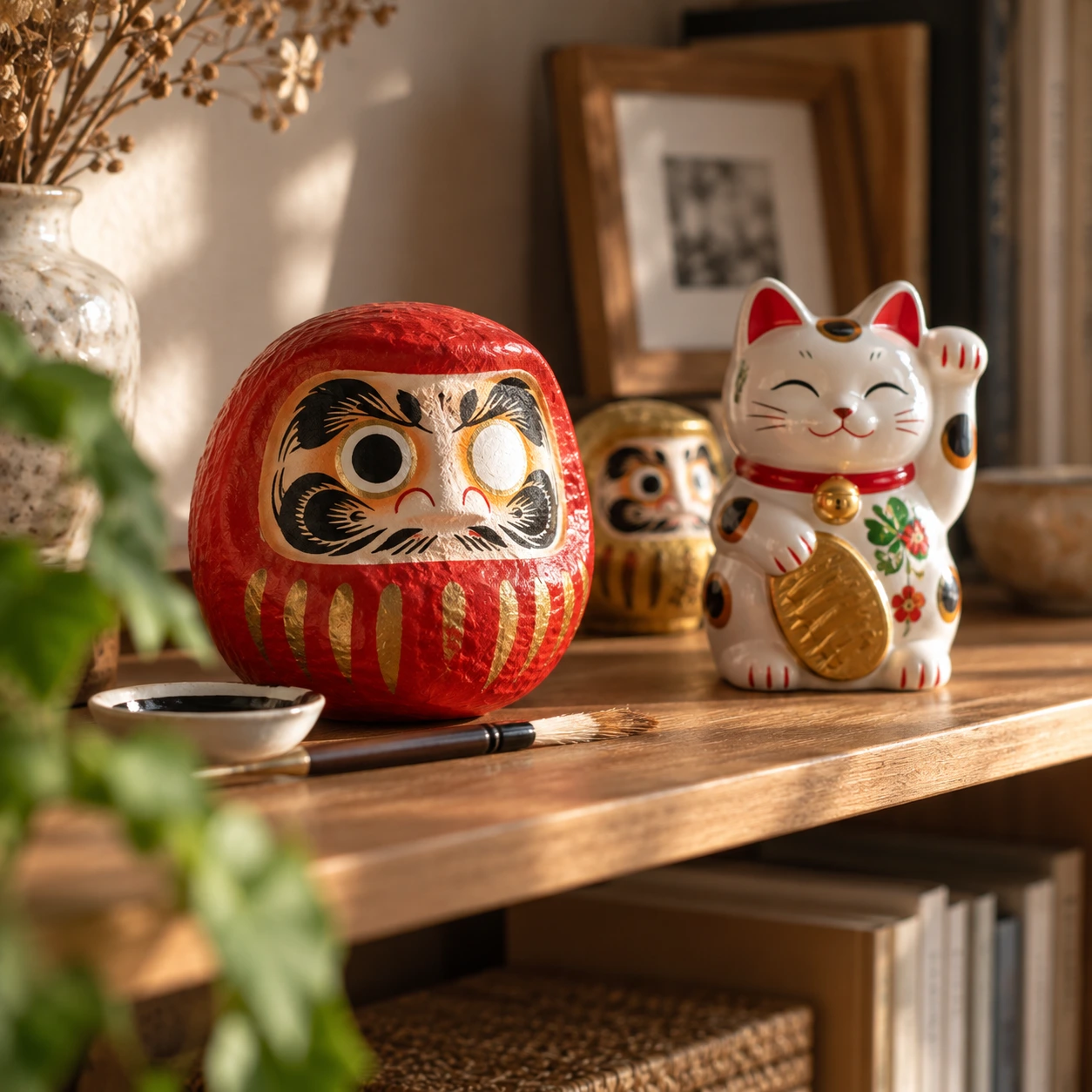
The daruma is a portrait of Bodhidharma, the Indian monk credited with bringing Zen to China in the sixth century. Legend says he meditated facing a wall for nine years until his limbs withered, hence the limbless dome. It is also weighted at the base so that it rights itself when knocked over, illustrating the proverb 七転び八起き (nanakorobi yaoki): fall seven times, get up eight.
Around 80% of Japan's daruma come from Takasaki in Gunma, where silk farmers began making them in the late Edo period as a winter sideline. The Takasaki style has eyebrows shaped like cranes and whiskers like tortoises, both symbols of long life, and the character 福 (fuku, good fortune) on the belly. The body is 張り子 (hariko, papier-mache) over a mould, which is why it is so light.
Daimonya's Fuku Daruma is the traditional form done properly, painted by hand and sized for a desk or bookshelf.
The 12 cm Mandara version covers the whole body in a mandala pattern and is bought for new starts, a first job or a move.
The 15 cm golden daruma carries gold powder, 福 on the belly and the phrase 大願成就 (taigan jōju, fulfilment of a great wish) on the cheeks, the version for a business goal.
Painting the eye and choosing a colour
A new daruma has two blank white eyes. The ritual is 目入れ (me-ire):
- Decide on one specific goal. Not a mood, a goal.
- Paint the left eye (the daruma's left, on your right as you face it) with a brush and black ink while you state the goal.
- Keep the daruma where you will see it daily.
- When the goal is achieved, paint the right eye. Politicians do this on television the night an election is won.
Paint one eye only, and paint the second only when the goal is done. Both eyes filled on day one makes a decoration, not a ritual.
| Colour | Japanese | Traditional meaning |
|---|---|---|
| Red | 赤 | General luck, protection from illness; the original |
| White | 白 | Purity, fresh starts; given at weddings |
| Gold or yellow | 金 | Money, prosperity, business |
| Black | 黒 | Business success, warding off misfortune |
| Green | 緑 | Health and calm |
| Blue | 青 | Study and work; exam years |
| Pink | 桃 | Love and relationships |
A 12–15 cm daruma is the household norm; shop pieces run past 60 cm, and tradition says each year's should be a little bigger than the last.
Maneki-neko: which paw, which colour
The beckoning cat dates from the late Edo period and has several origin stories. The best known belongs to 豪徳寺 (Gōtokuji) in Setagaya, where a temple cat is said to have beckoned the lord Ii Naotaka in from under a tree moments before lightning struck it; the grateful lord endowed the temple.
The raised paw is not a wave but the palm-down Japanese beckoning gesture. The left paw invites people, so it belongs in shops and restaurants. The right paw invites money and good fortune, so it belongs in the home. The gold coin held to the chest is a 小判 (koban, Edo-period coin).
Colour follows the daruma logic. Calico 三毛 (mike) is the classic and the luckiest; white is purity, black wards off evil, gold is wealth, red is health, pink is love. Two ceramic towns make almost all of the good ones: 常滑 (Tokoname), whose sleek glazed cats are the modern default, and 瀬戸 (Seto), where 薬師窯 (Yakushigama) and its parent studio hand-paint the ornate 錦彩 (nishikisai, brocade-coloured) style.
The right-paw chirimen cat is the classic household choice: fortune rather than customers, dressed in crepe-fabric patterns and painted by hand in Seto.
The Fukusuke cat borrows the topknot of 福助 (Fukusuke), the bowing merchant figure of business prosperity, and surrounds him with kittens dressed as the 七福神 (Shichifukujin, Seven Lucky Gods).
The larger size 16 version of the same design is the one bought for a shop opening or a restaurant counter, where it needs to be seen from the door.
Placement and gifting
A daruma goes high, above eye level, facing into the room: a shelf, a 神棚 (kamidana, household altar), or the top of a bookcase. A maneki-neko in a shop faces the entrance so the paw beckons customers in; at home, a living room shelf or the entrance hall is right.
Both are standard gifts for a shop opening, a new job, an exam year, a wedding (a white daruma pair) and the new year. A puzzle box makes a good companion gift, because a coin or a wish note can be hidden inside.
The Hakone yosegi puzzle box opens in ten set moves and plays a sound when the inner drawer is drawn, which turns a small gift into a small ceremony.
Care and the year end
Papier-mache dislikes humidity and direct sun. Dust with a soft brush, never wash, and keep it away from radiators. Ceramic cats are simpler: a damp cloth, and no dishwasher for hand-painted glazes.
In Japan a daruma is traditionally kept for one year, then returned to a temple to be burned respectfully at どんど焼き (dondo-yaki) in mid-January, with a new one bought at the daruma fair. Abroad, keeping a two-eyed daruma on the shelf is perfectly acceptable, and the incense guide describes the kind of quiet shelf it suits.
Frequently asked questions
Which eye first? The daruma's left eye, on your right as you face it. Right eye on completion.
What if I never achieve the goal? Keep it, or thank it and let it go at year end. A one-eyed daruma is not a failure; it is a reminder.
Can I gift a maneki-neko to a non-Japanese friend? Yes. Explain the paw and the colour on the card, and choose right-paw for a home.
Will papier-mache survive shipping? Daruma are light and travel well in tissue; ceramic cats need careful boxing. The shipping times guide explains what to expect.
One eye, one goal, one paw pointed at the door. Set the daruma up high, put the cat where it can see the entrance, and let the year decide whether the second eye gets painted.