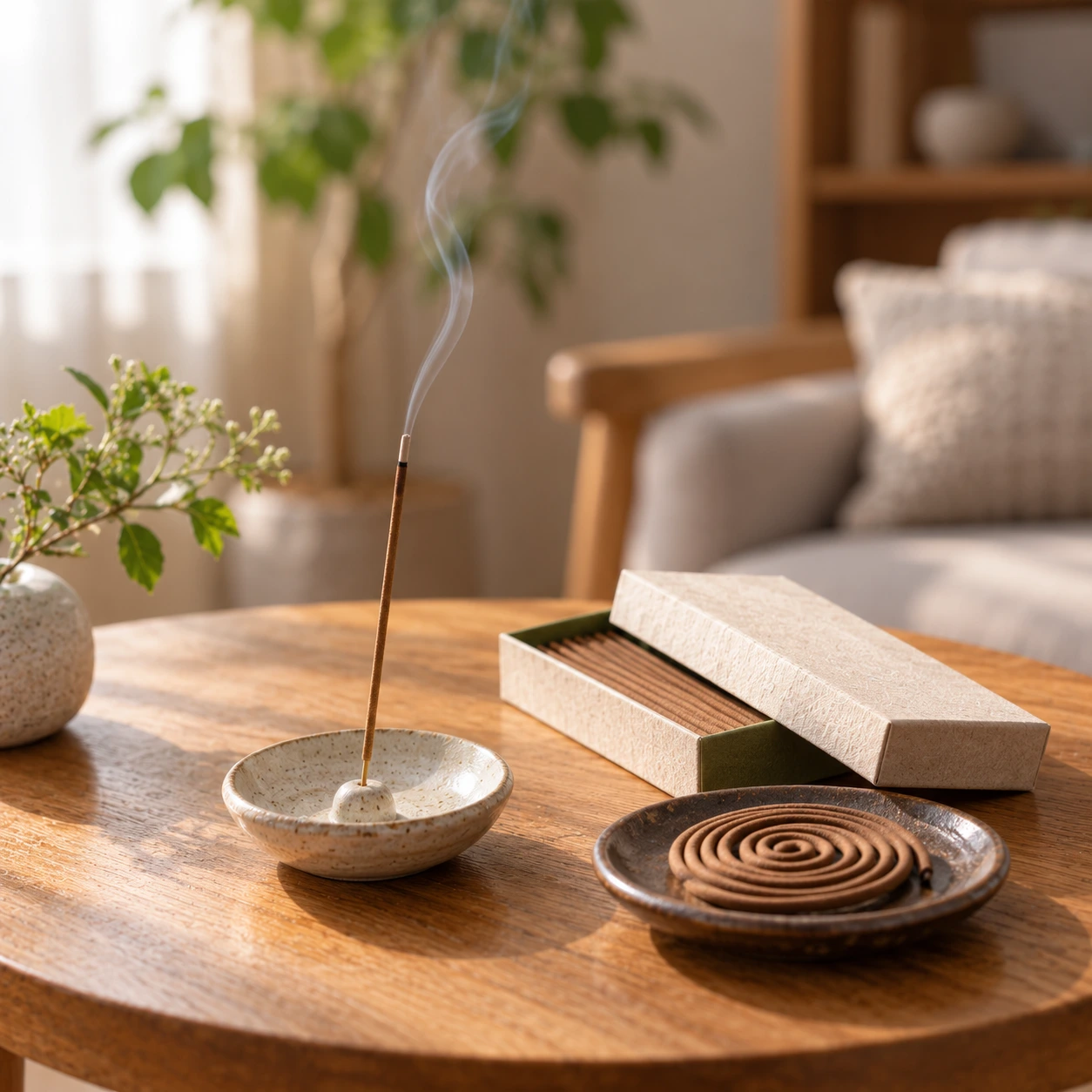
Japanese Incense Explained: Senko Sticks, Coils, the Great Kyoto Houses and How to Burn Them Well
Sandalwood, agarwood, hinoki and the modern low-smoke lines, from Shoyeido to the Awaji Island workshops. Which form to buy, how long a stick burns, and how to use holders, ash and ventilation properly.
Japanese incense is quieter than most people expect. It drifts rather than announces itself, settles into fabric and wood, and leaves a room smelling faintly of a temple an hour after the stick has gone out. The word for it is 香 (kō), and the everyday stick form is 線香 (senkō).
The craft is old, concentrated in a few cities, and built on a short list of raw materials that have not changed in centuries. What has changed is the range: alongside classic sandalwood sticks there are now low-smoke lines for small flats, citrus and hinoki blends, and coils that burn for hours. This guide covers the forms, the houses, the materials and the mechanics of burning it well.
Sticks, cones, coils and kneaded incense
| Japanese | Reading | Form | Burn time | Best for |
|---|---|---|---|---|
| 線香 | senkō | Thin stick, no bamboo core | 14 cm stick, roughly 25–30 min | Daily use, study, a single room |
| コーン | kōn | Small cone | 10–15 min | Short bursts of scent, quick rooms |
| 渦巻 | uzumaki | Flat coil | 2 to 12 hours | Entrances, large or draughty spaces |
| 練香 | nerikō | Kneaded pellet | Warmed, not lit | Traditional kōdō ceremony, winter |
Japanese sticks differ from Indian ones in one important way: there is no bamboo core. The whole stick is a paste of powdered wood and resins bound with 椨 (tabu) bark, so it burns cleanly with nothing to add a charred note. It is also brittle, and snaps if pressed into a holder carelessly.
For a first purchase, buy a box of short sandalwood sticks from one of the major houses. They are inexpensive, consistent, and set the reference point for everything else.
The ten-coil Horikawa box is the practical entry to the coil format because it ships with an unglazed ceramic holder, so there is nothing to work out before the first burn.
The great houses
松栄堂 (Shōeidō) has made incense in Kyoto since 1705 and is known for warm, sweet, sandalwood-forward blends. 日本香堂 (Nippon Kōdō) is the largest producer and the one most likely to be found abroad. 梅栄堂 (Baieidō), founded in Sakai in 1657, is the connoisseur's choice for pure agarwood and sandalwood with little added perfume.
Awaji Island, in the Inland Sea, produces roughly 70% of all incense made in Japan. Its westerly winds are said to suit the drying process, and houses such as 薫寿堂 (Kunjudō) make both traditional sticks and the newer low-smoke and aroma lines.
Shoyeido's sixty-coil Horikawa box is the same mellow sandalwood in bulk, with a stated burn of about two hours twenty minutes per coil, hence entryways and large rooms rather than a bedside table.
What it is made of
Two woods anchor the tradition. 白檀 (byakudan, sandalwood) from India and Indonesia gives the soft, creamy, slightly sweet base that most people picture when they think of Japanese incense. 沈香 (jinkō, agarwood) is the resin-soaked heartwood of Aquilaria trees, dark, complex and increasingly expensive.
Around those sit the supporting materials: clove, cinnamon, star anise, borneol camphor, benzoin and patchouli, blended in proportions each house keeps private. Modern lines add hinoki cypress, yuzu and green tea, and many are labelled 微煙 (bien, low smoke) for flats where a full sandalwood stick would be too much.
A very cheap stick labelled agarwood or sandalwood is mostly fragrance oil on a neutral wood base, which is not wrong, but it is a different product.
Holders, ash and burning safely
- Stand the stick upright in a holder with a proper ash-catching dish, or lay it at an angle across a long tray. A stick held in a bare pinhole drops hot ash onto the table.
- Light the tip, let it flame for a second or two, then blow it out so it glows.
- Place the holder on a heat-proof surface, away from curtains and paper.
- Let it burn out on its own, and never leave it lit when you go to bed.
- Keep a little fine ash in a bowl-type burner: it insulates the base and lets a stick burn fully to the end.
The Iwachu burner is Nambu cast iron with a lid: iron takes heat without marking a table, and the lid contains stray ash while letting smoke through.
For coils, use a wide dish with a pin or the supplied ceramic stand so the coil sits clear of the surface; laid flat on a plate it goes out where it touches.
Room size, ventilation and timing
A single 14 cm stick is enough for a room of 10–15 square metres; in anything smaller, burn half a stick or choose a low-smoke line. Crack a window while it burns, then close it so the scent settles.
Timing is a matter of purpose. For study, light a stick at the start of a session and let its 25–30 minutes act as a timer. For sleep, burn it in the hour before bed and let it finish before you lie down, so you fall asleep in a scented room rather than a smoky one; sandalwood and hinoki suit this, citrus and clove less so. The ofuro guide explains the evening sequence it belongs to.
Candles and the wider aroma corner
Candles and incense sit together in a Japanese room. 大與 (Daiyo), in Shiga, has made 和蝋燭 (warōsoku, Japanese candles) since 1914 from rice bran wax.
The MORPHE candle is the sculptural end of that tradition, low in odour and drip, and the right choice for a dining table where incense would compete with food.
Rice bran wicks need trimming to about 5 mm before each lighting, and the brass and cherry trimmer is designed to rest with its tip raised so the cut wick does not mark the table.
A snuffer is the correct way to put a Japanese candle out; blowing scatters wax and leaves a smoking wick.
Everyday incense and altar incense
Everyday fragrance incense is burned for pleasure, for guests and to mark the start of an evening. Altar incense, 仏壇線香 (butsudan senkō), is offered at the household Buddhist altar and at graves, and is chosen for its long, steady burn rather than complexity. The sticks look alike and often come from the same houses, but the intention differs, and it is polite to keep them separate when buying a gift for a Japanese home.
Storing it
Keep sticks in their paper box inside a tin or drawer, away from sunlight and the kitchen, and use a box within a year of opening. Agarwood sticks improve slightly with age; fragrance-oil lines do not.
Frequently asked questions
Is Japanese incense safe to breathe? In a ventilated room, in normal amounts, yes for most people. Anyone with asthma or a smoke sensitivity should choose a low-smoke line, burn less, and keep a window open.
Why does my stick keep going out? Damp incense, a draught, or a holder that smothers the base.
How do I put a stick out early? Press the glowing tip gently into the ash or dip it in water, then let it dry before relighting.
What scent should I start with? Sandalwood. It is the centre of the tradition and the one you will recognise afterwards in temples and shops.
A box of sandalwood sticks, a burner with a lid and a window opened for the first ten minutes: that is the whole practice. For the evening it fits into, see the caffeine-free evening teas and the forest bathing guide.