Beyond KitKat: A Guide to Japanese Chocolate and Biscuits
Why Japanese chocolate tastes lighter, which classics have survived fifty years on the shelf, and what to buy when you want a gift rather than a snack.
Japanese chocolate is engineered around a different assumption than European chocolate. It is not trying to be intense. It is built to be light, crisp, restrained in sugar, and — above all — texturally interesting. Almost every famous Japanese confection is chocolate wrapped around something crunchy rather than chocolate on its own.
That is why a first taste can read as "thin" to someone raised on dense dark bars, and why the same person is usually back for the second box a day later.
The texture principle
Look at the classics and the pattern is unmistakable: a wafer, a biscuit, a puffed cereal, a pretzel stick, a cookie shell. Solid slabs of chocolate exist in Japan but occupy a small corner of the aisle.
There are practical reasons. Japanese summers are hot and humid, so a confection that survives a commute needs structure. Portions are small and individually wrapped, so each piece has to deliver a complete experience. And the domestic palate genuinely prefers less sugar and less cocoa mass than northern Europe does.
Once you stop expecting a bar and start expecting a construction, the whole category makes sense.
The flavours Japan does better
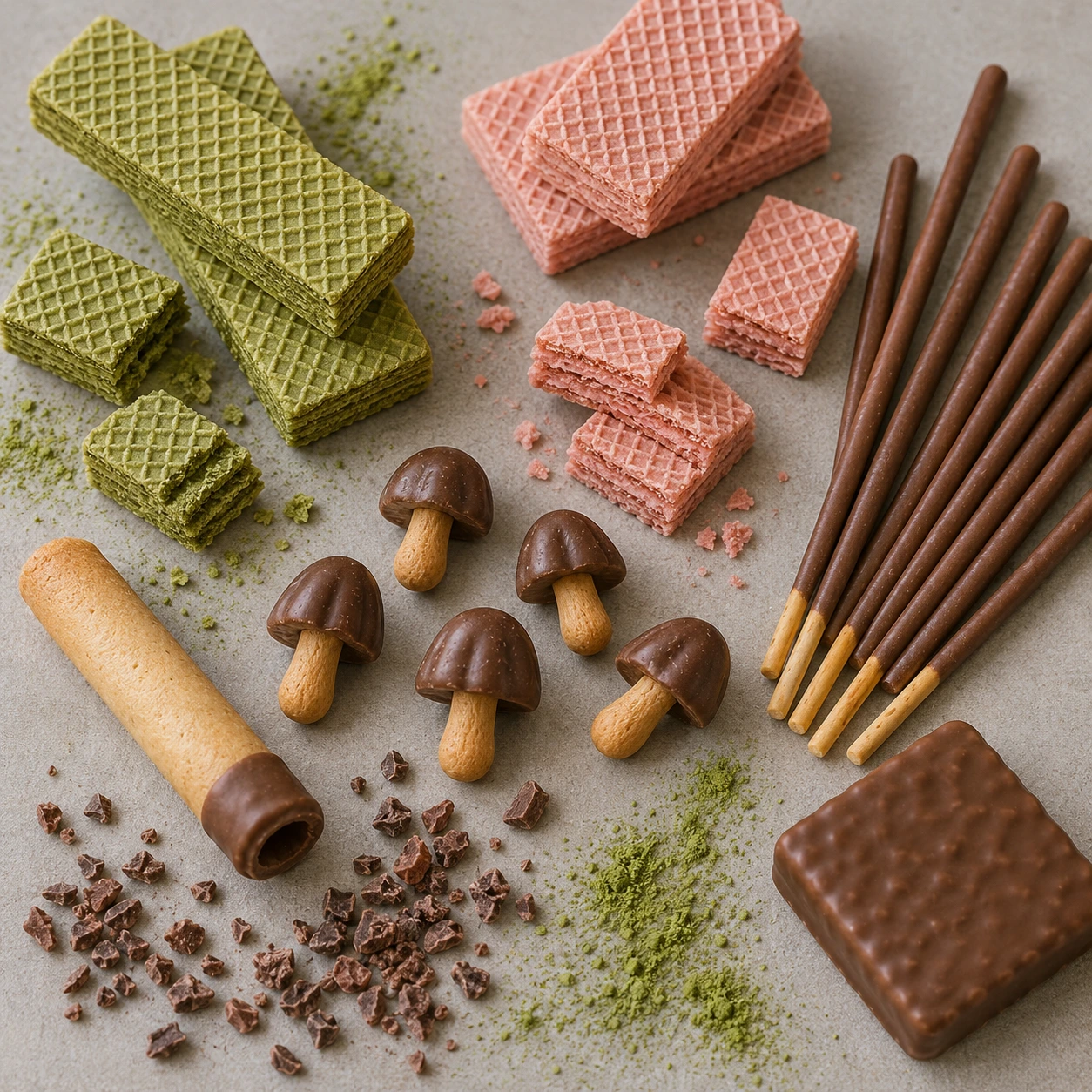
Matcha chocolate is the flagship, and the "rich matcha" tier is the version worth buying — enough real tea powder to taste bitter and grassy against the white chocolate rather than merely green and sweet. Japan has produced hundreds of regional and limited KitKat flavours over the past two decades, and matcha is the one that stopped being a novelty and became a permanent line.
Strawberry is the other pillar of Japanese confectionery flavour, and it behaves differently from Western strawberry: tarter, less candied, usually built on freeze-dried fruit powder rather than syrup.
Pocky launched in 1966 and effectively invented the "hold the bare end" format. The plain chocolate version remains the reference point — thin biscuit, thin coating, deliberately unimpressive on its own and impossible to eat only one of.
The strawberry version is not a variant so much as a separate institution, and the small multipack bags are how they are actually sold in Japan — portioned, not poured.
Kinoko no Yama — "mushroom mountain" — is a biscuit stem with a chocolate cap, and it is one half of Japan's longest-running confectionery rivalry (the other being Takenoko no Sato, the bamboo-shoot version). Japanese people hold real opinions about which is superior. There is no correct answer and asking is a reliable way to start a conversation.
The biscuit tier
Japan's biscuit makers operate at a level that has no direct equivalent in most supermarkets abroad — partly because the gift culture demands it.
Alfort is a whole-wheat biscuit with a thick chocolate slab pressed on top, embossed with a sailing ship. It is the most-copied format in the category and still the best-executed.
Lumonde is a rolled crêpe-cookie in cocoa cream, and it shatters into flakes the moment you bite it. It is over fifty years old, unchanged, and reliably in the top ranks of Japan's favourite snack polls.
Yoku Moku's Cigare sits at the top of the domestic gift ladder: a thin rolled butter cookie with a very high butter content and nothing else going on. This is what gets carried to someone's house when the occasion is formal.
Gâteau Festa Harada's Gouter de Roi is a rusk — twice-baked bread — glazed in butter and sugar. It sells at Japanese department store gift counters in volumes that are hard to believe for what is, technically, toast.
And at the everyday end, Choco Ball is the small boxed chocolate with a peanut or caramel centre that most Japanese adults grew up with, complete with a decades-old prize mechanic printed on the box.
Buying for a gift versus buying for yourself
This is the distinction that trips up first-time buyers, because both sit in the same shop at very different prices.
Everyday confectionery comes in soft bags, is priced for daily purchase, and is meant to be eaten within days. Pocky, Alfort, Choco Ball, KitKat multipacks.
Gift confectionery (omiyage) comes in rigid boxes or tins, with each piece individually wrapped, often with a regional identity attached. The wrapping is not padding — in Japanese gift convention, presentation is a functional part of the product. Yoku Moku, Harada, boxed regional sweets.
If you are sending something to someone, the boxed tier travels better and reads as a real gift. If you are exploring flavours, the bagged tier gets you far more variety per unit of money.
A note on shipping chocolate
Chocolate and heat are a straightforward problem, and one worth planning around:
- Summer shipping carries real risk of melting in transit, particularly through hot transit hubs. Bloom (the pale streaking) is cosmetic and safe, but a fully melted-and-reset bar loses its snap permanently.
- Biscuits, rusks and wafer products travel far better than solid chocolate.
- If timing matters, order chocolate in cooler months and send biscuit-based gifts in summer.
Frequently asked questions
Why does Japanese chocolate taste less sweet? Lower sugar and lower cocoa mass than typical European formulations, plus more of the flavour coming from the biscuit or wafer component. It reads as lighter, not blander, after a couple of pieces.
Are the seasonal flavours worth it? Often, yes — Japan's seasonal releases are genuine reformulations rather than colour changes. Sakura in spring, chestnut and sweet potato in autumn, and regional fruit versions are frequently better than the standard line.
Do these contain alcohol? Some premium chocolate and adult-oriented lines do (rum, brandy, sake). It will be on the label, and it matters for shipping restrictions to some countries.
Are any of them vegetarian or halal? Most contain dairy; gelatine appears in gummy and marshmallow-centred products rather than chocolate. Japanese labelling lists the mandatory allergens clearly, but halal certification is rare — check per product.
How long do they keep? Typically several months. Japanese packaging prints a best by (賞味期限) date, which is quality-based rather than a safety deadline.
Start with a matcha bar, a box of Alfort and a bag of Pocky. If you want to understand why Japan takes its confectionery seriously enough to build department-store counters around it, add one tin from the gift tier — and see our Japanese snack guide for everything savoury sitting on the next shelf.