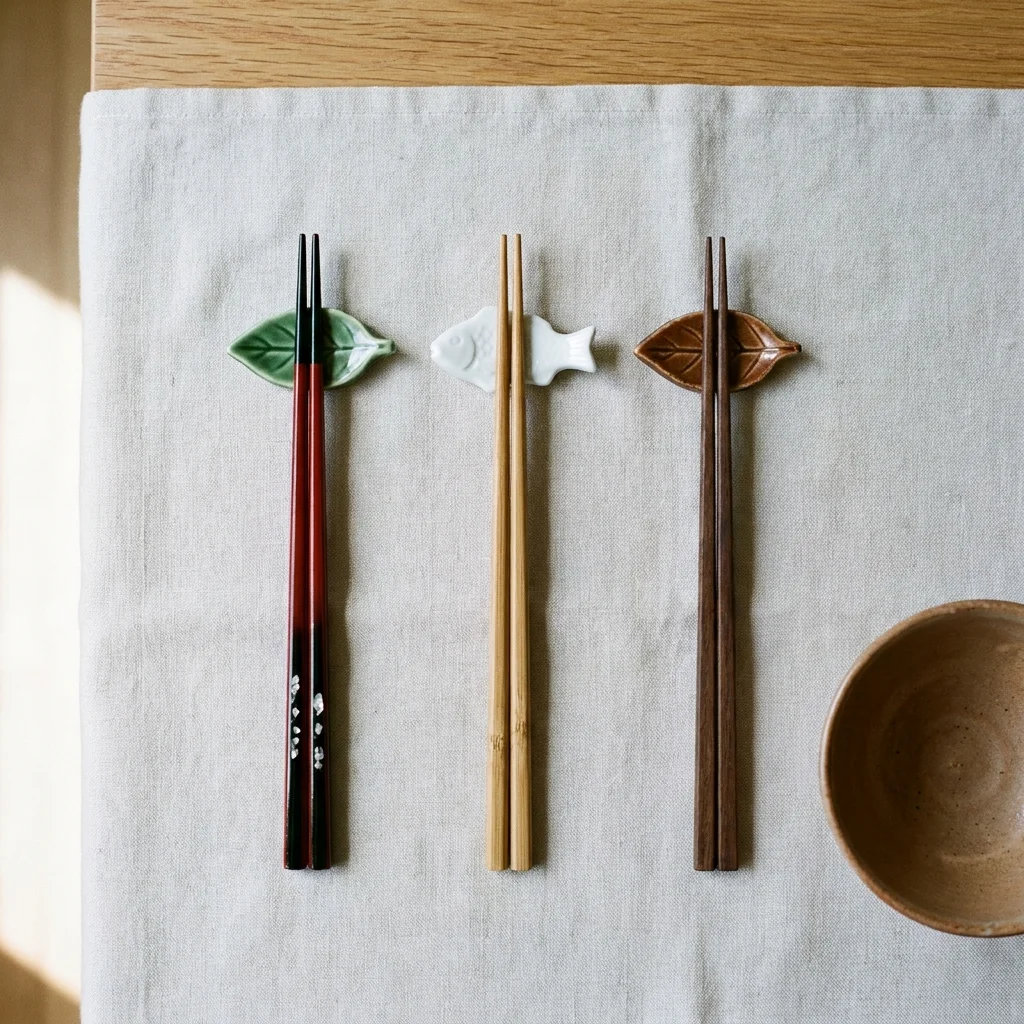
Japanese Chopsticks: How to Choose, Hold and Use Them Politely
Japanese chopsticks are shorter and finer than Chinese ones for a reason. How to pick the right length, hold them properly and avoid six etiquette mistakes.
Chopsticks look universal until you put three pairs side by side. Japanese chopsticks are shorter, lighter and taper to a fine point; Chinese ones are long and blunt; Korean ones are flat and made of metal. Each shape fits the food and the table it was made for.
This guide covers how Japanese chopsticks differ, how to choose the right length and material, how to hold them properly, and the etiquette mistakes that make Japanese diners wince, along with how to look after a good lacquered pair.
Japanese vs Chinese vs Korean chopsticks
| Japan | China | Korea | |
|---|---|---|---|
| Length | Shorter | Longest | Medium |
| Tip | Fine, tapered point | Blunt, often squared | Flat, slim |
| Common materials | Lacquered wood, bamboo, wood | Wood, bamboo, plastic | Stainless steel |
| At the table | Individual dishes, personal pairs | Shared dishes across a large table | Used with a metal spoon |
The pointed Japanese tip is usually explained by fish. Japanese meals have long featured grilled fish served whole, and fine tips make it easier to lift flesh away from small bones. Shorter chopsticks also suit a table of individual bowls held close to the mouth, rather than reaching across a shared spread.
In Japanese homes, each person traditionally has their own pair, and children get theirs in a smaller size.
How to choose the right chopstick length
The traditional rule is hitoata-han (一咫半), "one and a half spans". Hold your hand out with thumb and index finger at a right angle and measure the distance between their tips. That is one ata. Multiply by 1.5 and you have your ideal chopstick length.
In practice, adult Japanese chopsticks are commonly sold from about 21 to 23.5 cm, with children's sizes shorter. If in doubt, slightly too long is easier to manage than too short.
Lacquer, bamboo or wood: which material?
Lacquered wood is the classic Japanese chopstick. Layers of lacquer are applied over a wooden core and polished, sometimes with flecks of eggshell, shell or gold leaf set into the surface. Obama, in Fukui Prefecture, is the main production centre for lacquered chopsticks, and its Wakasa-nuri (若狭塗) style is known for its layered, polished patterns. A good lacquered pair is smooth, warm in the hand and lasts for years with care.
Bamboo is light, strong and slightly textured, which helps with grip. It is a sensible everyday choice and a good one for learners, because food slides less.
Plain wood, unlacquered or oil-finished, is simple and warm, though it marks more easily. Disposable split chopsticks, waribashi, are what you get with takeaway and at casual restaurants.
Browse our lacquerware and bamboo collections for more.
How to hold chopsticks properly
- Fix the bottom chopstick. Rest it in the crook between your thumb and index finger, with the lower end resting against the side of your ring finger. This one does not move.
- Hold the top chopstick like a pencil, between the tips of your thumb, index and middle fingers.
- Move only the top chopstick. It pivots up and down against the fixed bottom one.
- Keep the tips level. If they cross or one sticks out, adjust your grip rather than forcing it.
- Hold them about a third of the way from the top, not near the tips.
Practise by picking up a peanut or a dried bean. Once that works, rice is easy, especially sticky Japanese rice, which forms small clumps.
Chopstick etiquette in Japan: six things not to do
Most chopstick taboos in Japan come from funeral rites, which is why they provoke a stronger reaction than simple bad manners.
| Name | What it is | Why it is avoided |
|---|---|---|
| Tate-bashi (立て箸) | Standing chopsticks upright in rice | Resembles the rice offered to the dead at funerals |
| Hashi-watashi (箸渡し) | Passing food from chopsticks to chopsticks | Echoes the funeral rite of passing bones |
| Sashi-bashi (刺し箸) | Stabbing food | Treats chopsticks like a skewer; considered crude |
| Yose-bashi (寄せ箸) | Dragging a dish towards you | Use your hands to move dishes |
| Mayoi-bashi (迷い箸) | Hovering over dishes, undecided | Seen as greedy and indecisive |
| Neburi-bashi (ねぶり箸) | Licking the chopsticks | Self-explanatory |
Two more points. When taking from a shared plate, use the serving chopsticks provided. And when you split disposable chopsticks, do not rub them together to remove splinters in front of your host; it suggests the chopsticks are cheap.
Chopstick rests: what a hashioki is for
A hashioki (箸置き) is a small rest that keeps chopstick tips off the table between bites. They are often ceramic and shaped as fish, leaves, flowers or seasonal motifs, and swapping them with the seasons is a small domestic pleasure.
Resting chopsticks across the top of your bowl is common at home, but at a more formal meal the rest is the polite place for them.
Caring for lacquered chopsticks
- Wash by hand with a soft sponge and mild detergent.
- Do not soak them, and do not put them in the dishwasher or microwave.
- Dry them straight away with a cloth.
- Keep them out of strong direct sunlight, which can fade lacquer over time.
Looked after this way, a good pair lasts years. Matched meoto-bashi, a slightly different-sized pair for a couple, are a traditional wedding present, and good chopsticks make a thoughtful gift; see our Japanese gift ideas for more.
Frequently asked questions
How long should chopsticks be? Use the hitoata-han rule: one and a half times the span between your outstretched thumb and index finger. For most adults that is roughly 21 to 23.5 cm.
Is it rude to stick chopsticks in rice? Yes, in Japan. Upright chopsticks in a bowl of rice recall funeral offerings. Lay them on a rest instead.
Are Japanese chopsticks dishwasher-safe? Lacquered and natural wooden ones are not. Some resin and stainless pairs are; check the label.
Why are Japanese chopsticks pointed? The fine tips make it easier to pick delicate food apart, especially fish served on the bone.
What do you do with chopsticks when you have finished? Place them together on the chopstick rest, or back in their paper sleeve at a restaurant.
Start with one good pair at the right length and a set of rests. For more tableware, browse our tableware section or see what goes inside the box in our bento guide.