Japanese Bento Boxes Explained: Magewappa, Enamel and How to Pack One
Bent cedar, enamel or plastic — which bento box to buy, and the food-safety rules that decide whether lunch is still good at midday.
A bento box is not a lunchbox with compartments. It is a system with rules — about material, about packing density, and above all about temperature — and the rules exist because a bento is traditionally packed in the morning and eaten hours later at ambient temperature, with no refrigeration and no reheating.
Get the material right and lunch is better. Get the food-safety part right and it is safe. Both are straightforward once someone explains them.
The materials, and what each one is for
| Material | Strengths | Limits |
|---|---|---|
| Magewappa (bent cedar) | Light, strong, beautiful; bare wood absorbs excess moisture so rice stays fluffy | Hand wash only, no microwave, needs drying, highest price |
| Enamel (steel + glass coating) | Non-reactive, no odour retention, very hygienic, body is oven-safe | Heavier, no microwave, lids rarely oven-safe, chips if dropped |
| Plastic (PP) | Cheap, light, microwave-safe, sealed lids | Absorbs odour and oil stains over time |
| Stainless | Effectively indestructible, no odour | No microwave, poor insulation, rarely leakproof |
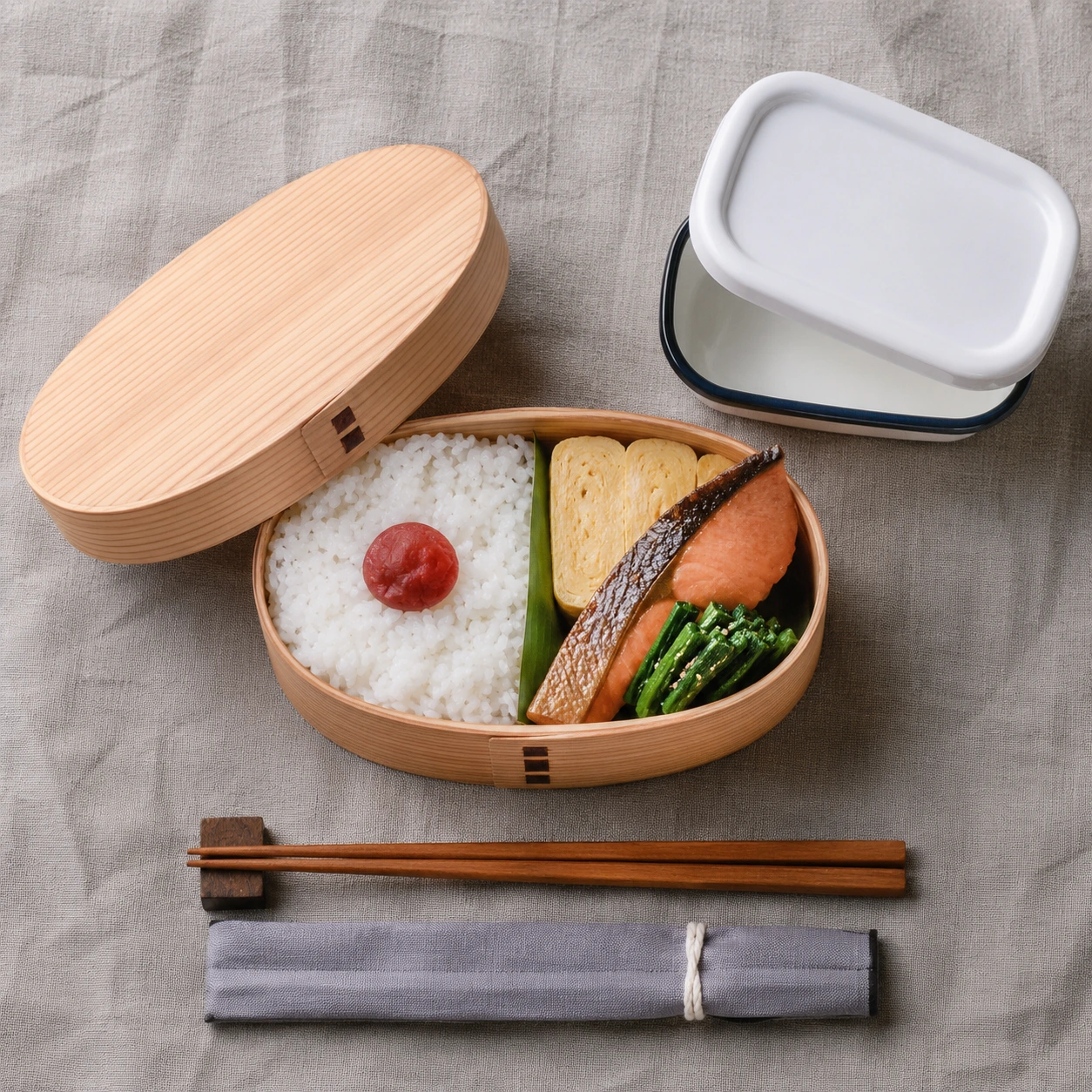
Magewappa is the traditional form: a thin sheet of cedar or hinoki steamed, bent into shape, and stitched with cherry bark. Akita's Odate district has produced them for centuries and the craft holds a national traditional-craft designation.
The romance is real, but so is the function. Cedar is hygroscopic — bare wood draws moisture out of the air inside the box, so rice packed warm doesn't sweat and go gluey by lunchtime.
There is one fork in the road worth understanding before you buy:
- Bare (unlacquered) magewappa gives you the full moisture-regulating effect and the cedar aroma. It also stains, absorbs oil, and demands careful drying.
- Urethane-coated magewappa — like the two-tier mess-tin shape here — seals the surface, so fried chicken, fried rice and anything oily go in without a second thought and washing up is far easier. You trade away some of the moisture absorption for a box that tolerates real life.
Neither is the "correct" one; the coated version is the sensible daily driver, the bare one is for people who eat rice-centred lunches and enjoy the ritual.
Care, either way: wash by hand immediately with a soft sponge and minimal detergent, rinse, wipe, and air-dry face-down for several hours before closing. Never soak, never dishwasher, never microwave. Bare wood darkens and stains over years; that is normal.
Enamel deserves more attention than it gets. It is steel with a fused glass coating — completely non-reactive, so it holds acidic, salty and strongly flavoured food without absorbing or transferring anything. Japanese kitchens have used it for a century for exactly the food that ruins plastic: miso, pickles, umeboshi, marinades. A container that has held kimchi for a year will still smell of nothing once washed, and the steel body takes freezer and oven temperatures (the lid usually does not — check the line before you put one in an oven).
How to pack a bento that keeps
The rules below are not fussiness. Room-temperature food is a genuine bacterial risk, and Japanese bento convention is designed around it.
1. Cool everything completely before the lid goes on. This is the single most important rule. Warm food creates condensation, condensation creates a warm humid box, and that is exactly what bacteria want. Spread rice out to steam off before packing.
2. Pack tightly. Gaps let food shift and collapse in a bag. Fill spaces with something small — a blanched vegetable, a rolled omelette, a pickle.
3. Use the 3:2:1 rule. Roughly three parts rice or carbohydrate, two parts protein, one part vegetable. It produces a balanced box without any calculation.
4. Keep wet things out, or contained. Sauce goes in a separate tiny container, or on the side. Anything dressed goes in silicone cups.
5. Use the traditional preservatives.
An umeboshi in the centre of the rice is not only decorative — the salt and acidity genuinely inhibit bacterial growth, which is why the hinomaru bento has survived as a format. A splash of rice vinegar in the rice does similar work.
6. Season the rice, not just the toppings.
Furikake is the standard answer, and individually sealed sachets keep better in a bag than an opened jar. See the rice topping guide for the wider shelf.
7. In summer, use an ice pack. Below about 10 °C or above 60 °C is the safe zone; a lunch bag with a frozen gel pack keeps a bento comfortably in the first. Avoid raw or lightly cooked items entirely in hot weather.
Onigiri: the simplest bento there is
If a box seems like a commitment, start with rice balls.
Pre-cut onigiri nori removes the only awkward part. Wet your hands, salt them lightly, press about 100 g of warm rice into a triangle around a filling — umeboshi, tuna mayo, grilled salmon — and wrap the nori on just before eating, not before packing, or it goes limp.
Instant pack rice makes this a five-minute job on a weekday morning. More on the rice itself in the rice guide.
Choosing a size
Japanese bento boxes are sold by volume in millilitres, and the convention is roughly one millilitre per kilocalorie:
- 500–600 ml — children, or a light adult lunch
- 700–800 ml — the standard adult box
- 900–1000 ml+ — a large appetite or a physical job
Buying too large is the common mistake: a half-empty bento shifts in transit and arrives looking like a landslide.
Frequently asked questions
Can I microwave a bento box? Plastic marked microwave-safe, yes. Wood, enamel, stainless and lacquerware, no — enamel and stainless will arc, and heat damages wood and lacquer.
Are wooden boxes leakproof? No. Magewappa is for dry-packed food. Anything saucy needs a plastic or sealed container.
Can I put oily food in a magewappa? In a urethane-coated one, yes — that is exactly what the coating is for. In a bare cedar box, oil soaks into the wood and stains it permanently.
How long does a bento keep unrefrigerated? Packed cool and properly, roughly four to five hours in mild conditions. In hot weather, use an ice pack and eat sooner.
Is a bento box worth it if I don't cook Japanese food? Yes — the packing principles work for any cuisine. The box does not care what is in it.
Why is magewappa so expensive? It is hand-made from selected cedar, steam-bent and stitched with cherry bark by a small number of workshops. You are buying a craft object that also happens to keep rice fluffy.
Can I put a wooden box in the dishwasher? No. It will crack, warp and lose the surface that makes it work.
Cool the food, pack it tight, and put an umeboshi in the middle. Everything else is preference — including whether you spend on cedar or start with the plastic box you already own.