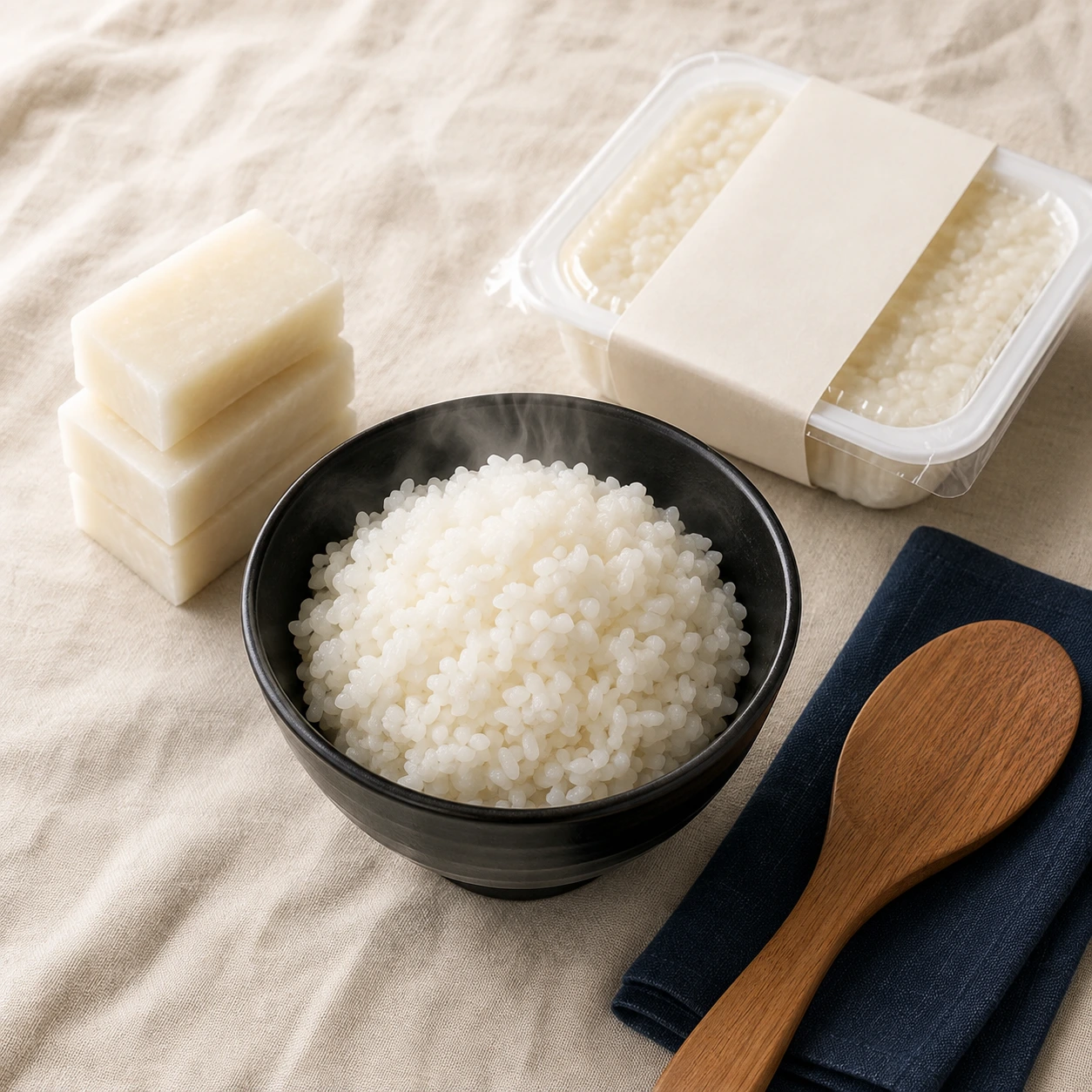
Japanese Rice Explained: Koshihikari, Instant Pack Rice and Kirimochi
Why Japanese short-grain rice behaves differently from every other rice, which variety to buy, and how instant pack rice and kirimochi actually work.
Japanese rice is a different ingredient from the long-grain rice most kitchens are built around, and treating them as interchangeable is why imported rice so often disappoints. It is short-grain japonica: rounder, higher in amylopectin starch, and engineered by centuries of breeding to be slightly sticky, faintly sweet, and glossy enough to eat plain.
That stickiness is not a defect to be rinsed away. It is the entire point. It is what lets rice be picked up with chopsticks, pressed into onigiri, hold a curry sauce without washing out, and sit under a piece of fish without collapsing.
Here is what to buy, how the shortcut formats work, and the two mistakes that ruin an otherwise good bag.
The varieties that actually mean something
Japan grows hundreds of rice cultivars and ranks them publicly every year. Four names carry most of the reputation:
| Variety | Reading | Character |
|---|---|---|
| コシヒカリ | Koshihikari | The benchmark — sweet, sticky, strongly aromatic |
| ゆめぴりか | Yumepirika | Hokkaido's flagship; very soft, high moisture, glossy |
| ななつぼし | Nanatsuboshi | Firmer, cleaner, less sticky — good with strong sauces |
| こしいぶき | Koshiibuki | A Koshihikari descendant bred to hold up in a bento |
Koshihikari from Niigata is the default prestige pick, and Uonuma — a specific mountain district within Niigata — is the single most expensive origin in the country. The difference between ordinary Koshihikari and Uonuma Koshihikari is real but subtle: more aroma, a slightly cleaner sweetness. It is a connoisseur's upgrade, not a beginner's one.
Hokkaido rice deserves more attention than it gets abroad. Yumepirika in particular went from nowhere to top-tier in barely a decade of breeding work, and it is softer and glossier than most Koshihikari.
Instant pack rice is not a compromise
The sealed plastic tray of cooked rice — pack gohan — is one of the most quietly impressive things in a Japanese supermarket. It is not dried, not freeze-dried, and contains no preservatives. Rice is cooked and sealed in a sterile tray, then heat-treated so nothing can grow inside. The result keeps unrefrigerated for months and takes about two minutes in a microwave.
This is the standard: Niigata Koshihikari, one bowl, shelf-stable. If you cook rice rarely, or cook for one, it is genuinely better than a bag of rice that sits open in a cupboard slowly going stale.
The Uonuma version is the same format at the top of the varietal ladder — worth trying once purely to taste what the fuss is about.
Hokkaido Yumepirika in pack form is the softest, glossiest of the common trays and the one most likely to convert someone who thinks all rice tastes the same.
There is also a germinated brown rice version — hatsuga genmai, where the grain is soaked until it just begins to sprout. This one blends about 30% of it into ordinary white rice, which is the sensible way to eat it: nuttier and higher in fibre than plain white rice, without the heavy chew that puts people off cooking brown rice at home.
How to cook a bag of it properly
Two mistakes account for almost every bad pot of Japanese rice.
Not rinsing enough. Put the rice in a bowl, cover with water, stir with your fingers, and pour the cloudy water off immediately — surface starch dissolves fast and the grain will drink it back in if you leave it. Repeat three to four times, until the water runs merely hazy, not milky. This is 60 seconds of work and it is the difference between fluffy and gluey.
Not resting it. Soak the rinsed rice for 30 minutes before heating. Cook it. Then leave it covered, off the heat, for a further 10 to 15 minutes before you touch it. The grains finish absorbing water from the inside out during that rest — lifting the lid early gives you a wet base and dry tops.
Ratio: 1 cup rice to roughly 1.1 cups water by volume for white short-grain, adjusted for taste. Fluff with a cutting motion, never a stir.
If you want to do this properly rather than electrically, a clay rice pot is the traditional answer — see our donabe guide for the method and the care routine it needs.
Mochi, and the rules around it
Kirimochi are hard white blocks of pounded glutinous rice. They are not a snack in their raw state — they are an ingredient that transforms completely when heated, going from chalky brick to molten, stretching, faintly sweet dough in about four minutes.
The slit-top design is a genuinely good piece of engineering: the scoring lets the block swell evenly in a toaster oven instead of bursting out of one corner, and it snaps cleanly in half by hand.
At the premium end, single-origin Koganemochi glutinous rice from Uonuma is noticeably richer and stretchier — the mochi equivalent of buying Uonuma Koshihikari.
Packaging matters more with mochi than with almost anything else in the pantry: individually sealed blocks with an oxygen absorber inside both the wrapper and the outer bag stay close to freshly pounded texture for months, while loosely packed mochi hardens and cracks.
Three standard ways to eat it:
- Isobeyaki — grill until puffed, dip in soy sauce, wrap in a strip of nori. The default.
- Zoni — dropped into a clear dashi or miso broth. This is the New Year's Day soup, and the recipe changes by prefecture.
- Kinako mochi — grilled, then rolled in roasted soybean flour and sugar.
A real safety note: mochi is a choking hazard, and Japan reports deaths from it every New Year. Cut heated mochi into small pieces, chew thoroughly, and take particular care with children and elderly guests. It is worth knowing before it appears at your table, not after.
Storing rice so it stays worth eating
Uncooked rice is not shelf-stable in the way most people assume. It oxidises, loses aroma, and in warm kitchens attracts insects.
- Keep it airtight and cool — a sealed container in the refrigerator is ideal in summer.
- Buy in sizes you will finish in one to two months, not six.
- Cooked leftover rice freezes far better than it refrigerates. Portion it warm, wrap flat, freeze, and microwave straight from frozen — refrigerating cooked rice makes the starch go hard and grainy.
Frequently asked questions
Can I use Japanese rice for other cuisines? For risotto and paella, yes — the starch behaves similarly enough. For pilaf, biryani or anything meant to be fluffy and separate, no. Use long-grain.
Do I need a rice cooker? No. A heavy pot with a tight lid produces excellent rice with the soak-and-rest method above. A cooker mostly buys convenience and timing.
Is instant pack rice as good as fresh? It is very good — better than day-old refrigerated rice, and better than badly cooked fresh rice. A perfect fresh pot still beats it.
Is mochi gluten-free? Yes, in itself — it is glutinous rice, which contains no gluten despite the name. Check any flavoured or coated product separately.
How long does opened mochi keep? Individually wrapped blocks keep for months sealed. Once opened, use within a few days and watch for mould — there are no preservatives in the plain kind.
Rice is the cheapest upgrade available to a Japanese meal, and the one most people skip while spending money on sauces. Start with the pantry basics, then fix the rice underneath them.