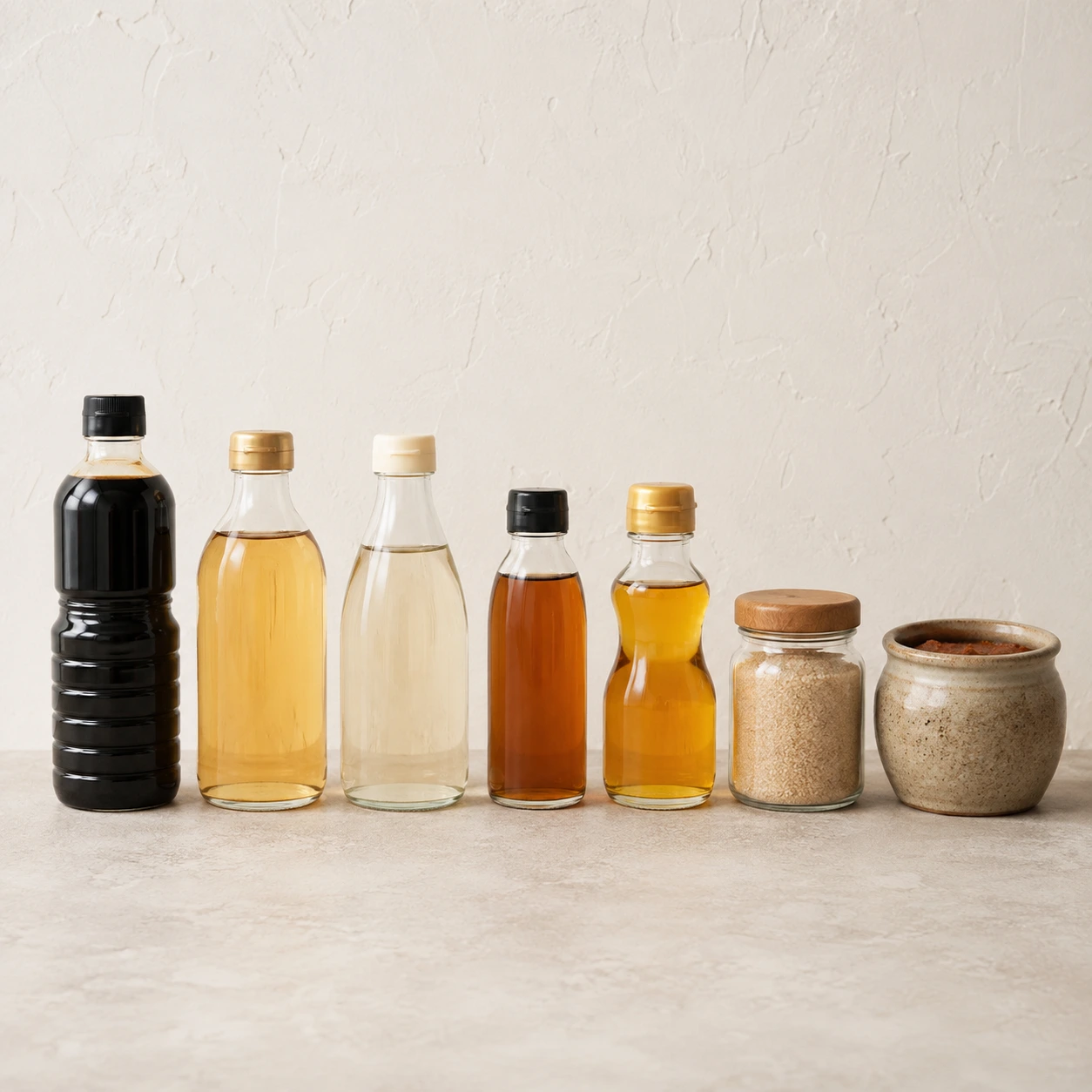
The Japanese Pantry Starter Kit: Seven Bottles That Cook Almost Everything
You do not need thirty Japanese ingredients. Seven bottles and jars cover the overwhelming majority of home recipes — here is what each one does and what to buy first.
Open a Japanese recipe and the ingredient list looks like a shopping trip. Soy sauce, mirin, sake, miso, dashi, rice vinegar, sesame oil — seven things you may not own, for one bowl of food. It reads as a barrier.
It is actually the opposite. Those same seven things reappear in nearly every recipe you will ever cook, in slightly different ratios. Japanese home cooking is unusually consolidated that way: unlike Italian or Indian cooking, where each dish pulls a different herb or spice off the rack, Japanese savoury cooking runs on a small, fixed set of fermented liquids. Buy them once and you have bought the cuisine.
Here they are in the order worth buying them, with what each actually does.
1. Soy sauce (shoyu)
The foundation. But not all soy sauce is the same, and the difference matters more than most people assume.
Koikuchi (濃口) is dark soy sauce — about 80% of Japanese production, brewed from equal parts soybean and wheat. This is the default, the one every recipe means when it just says "soy sauce."
Usukuchi (薄口) is lighter in colour but saltier, used in Kansai cooking when you want seasoning without darkening the dish.
Marudaizu (丸大豆) on a label means whole soybeans rather than defatted soy meal — a slower brew, rounder and less sharp. It is the mark of a better bottle.
Storage matters more than people think. Soy sauce oxidises. Once opened, refrigerate it and use it within a couple of months — the aroma flattens long before anything goes wrong with it.
2. Mirin
The most misunderstood bottle in the Japanese pantry, and the one most often bought wrong.
Real mirin — hon-mirin (本みりん) — is a sweet rice wine of around 14% alcohol, brewed from glutinous rice and koji. It does three things at once: adds a gentle, complex sweetness that sugar cannot replicate, supplies the glaze on teriyaki and grilled fish, and firms up proteins so simmered fish holds together.
What is usually sold outside Japan is mirin-fu chomiryo ("mirin-style seasoning"), which is under 1% alcohol, sweetened with corn syrup, and flatter in every direction. If you buy one thing from Japan rather than locally, make it the real bottle.
3. Miso
Fermented soybean paste, and the widest-ranging ingredient here. The two colours worth knowing:
- Shiro (white) miso — shorter fermentation, more rice koji, mild and sweet. Good in dressings, marinades, light soups.
- Aka (red) miso — longer fermentation, deeper, saltier, more assertive. Good in hearty soups and braises.
- Awase — the two blended. If you buy one tub, buy this. It is what most Japanese households actually use.
The rule: never boil miso. Dissolve it off the heat at the end of cooking. Boiling flattens the aroma and destroys the live cultures in unpasteurised paste.
4. Dashi
Technically a stock rather than a bottle, but it belongs on this list because so much else depends on it. Granulated instant dashi is what most Japanese households reach for on a weeknight, and it is a legitimate choice rather than a compromise.
The full explanation — kombu, katsuobushi, why you must not boil either — is in dashi explained. If you only ever use the granules, you will still cook well.
5. Rice vinegar
Milder and rounder than Western vinegars, at around 4–5% acidity against wine vinegar's 6–7%. That gentleness is why it can be used in quantity — sushi rice is roughly one part seasoned vinegar to ten parts rice, a ratio that would be brutal with anything sharper.
Watch the label: seasoned rice vinegar already contains sugar and salt (for sushi rice), while unseasoned is pure vinegar. Recipes almost always mean unseasoned unless they say otherwise.
Ponzu deserves its own mention here — rice vinegar and soy sauce with citrus, and one of the most useful bottles in any kitchen. It is a dipping sauce for hot pot, a dressing for cold tofu, and a finishing splash for grilled fish or steamed vegetables.
6. Toasted sesame oil
Not a cooking oil — a finishing oil. Japanese and Chinese toasted sesame oil is pressed from roasted seeds, and its aroma is destroyed by heat. Add it in the last few seconds, or off the heat entirely.
A little goes a very long way: half a teaspoon transforms a bowl of rice, a plate of blanched spinach, or a simple cucumber salad. First-press (一番搾り) on the label means the oil comes from the initial pressing only, which is more aromatic.
7. Sake (cooking)
The one people skip, and the one that quietly does the most invisible work. Sake removes fishy and gamey odours, tenderises proteins, and adds a background savouriness — and because the alcohol cooks off, it leaves depth without any boozy note.
If you cannot source it easily, dry sherry is the closest substitute. Avoid anything sold as "cooking sake" with added salt if you have a choice; it limits how much you can use.
Two ratios that unlock most recipes
With those seven items you can cook a startling proportion of the Japanese repertoire, because most recipes are the same handful of ratios:
Teriyaki / glazes — 1 : 1 : 1 : 1
Soy sauce, mirin, sake, sugar. Reduce until it coats a spoon.
Noodle broth and simmering liquid — 8 : 1 : 1
Dashi, soy sauce, mirin. Halve the dashi to 4:1:1 for a dipping sauce.
Once those two are in your head, teriyaki chicken, simmered daikon, oyakodon, udon broth and tempura sauce all stop being separate recipes and become variations on one idea.
What to buy first, on a budget
If you cannot buy all seven at once, this is the order that gives you the most cooking soonest:
- Soy sauce — nothing works without it.
- Mirin — the biggest quality gap between a Japanese bottle and a local substitute.
- Instant dashi — unlocks soup and every simmered dish.
- Miso — one tub of awase.
- Toasted sesame oil — the largest flavour change per yen spent.
- Rice vinegar or ponzu — start with ponzu; it is more immediately useful.
- Sake — genuinely helpful, easiest to defer.
Frequently asked questions
Does everything need refrigerating after opening? Soy sauce and miso, yes. Mirin, rice vinegar and sake are fine in a cool cupboard. Sesame oil keeps longer refrigerated but will cloud — harmless, and it clears at room temperature.
Can I substitute regular Chinese soy sauce? In a pinch. Chinese light soy is saltier and less sweet; Japanese shoyu contains wheat and is brewed differently, giving a rounder, slightly sweeter profile. The dish will work but will not taste quite right.
Is dark soy sauce the same as koikuchi? No — Chinese dark soy is thickened and often molasses-sweetened. Japanese koikuchi is thin and pourable. They are not interchangeable.
How long does an opened bottle really last? Soy sauce, 1–2 months for peak flavour (safe far longer). Mirin, roughly 3 months. Miso, up to a year refrigerated — it darkens with age but stays perfectly good.
Buy the seven, cook the two ratios, and the rest of the Japanese shelf becomes optional rather than intimidating.