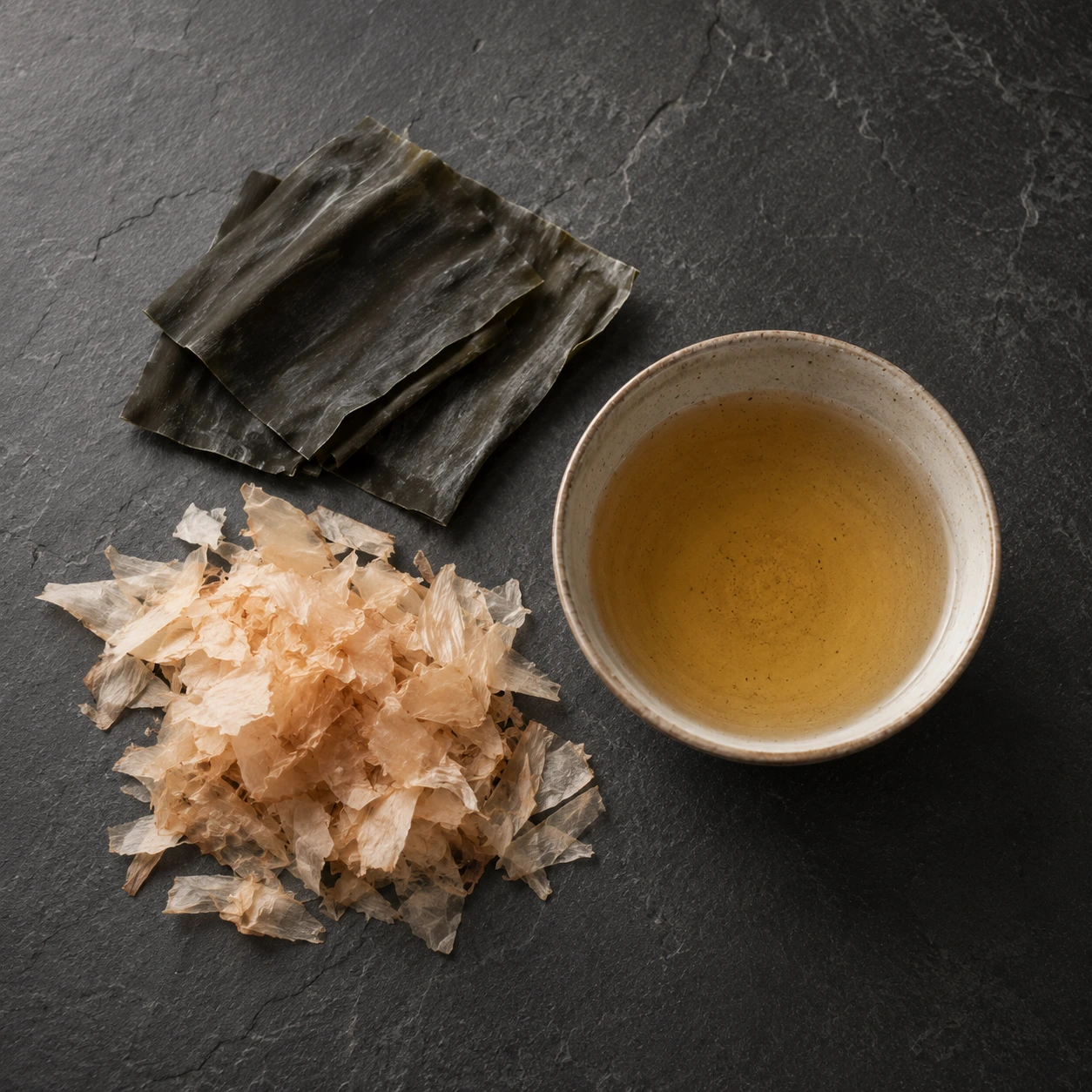
Dashi Explained: The Five-Minute Stock Behind Almost Every Japanese Dish
Miso soup, noodle broth, simmered vegetables and savoury egg all start from the same stock. Here is what katsuobushi and kombu actually do, and how to make dashi in five minutes or five seconds.
Western stock is an all-day project: bones, mirepoix, a slow reduction, skimming. Japanese dashi is the opposite discipline. It takes about five minutes, uses two ingredients, and is ruined by long cooking. If you boil it, you have made something worse.
That difference explains a lot about Japanese home cooking. When the foundational stock takes five minutes, a proper miso soup on a weeknight stops being ambitious and becomes routine. Almost everything savoury you associate with Japanese food — miso soup, udon and soba broth, simmered daikon, chawanmushi, the dipping sauce for tempura, oyakodon — is dashi plus two or three other things.
What dashi is made of
Kombu is dried kelp. It carries glutamate, the same amino acid that makes parmesan and tomatoes taste savoury. Kombu was, quite literally, where umami was discovered — Kikunae Ikeda isolated glutamate from kombu broth in 1908 and coined the word for what he was tasting.
Katsuobushi is skipjack tuna that has been simmered, smoked over weeks, inoculated with mould, sun-dried and aged into a block hard enough to be shaved with a plane. Those paper-thin shavings carry inosinate, a different savoury compound.
Here is why the pair matters: glutamate and inosinate are synergistic. Together they taste far more savoury than the sum of each alone — the multiplication is roughly eightfold. Two mild ingredients, five minutes, and a broth with more depth than most stocks get from a whole afternoon.
Ichiban dashi — the five-minute method
Ichiban dashi ("first dashi") is the clear, delicate version used where the stock is the star: clear soups, chawanmushi, the lightest simmered dishes.
- Put 10g of kombu in 1 litre of cold water. Soak 30 minutes if you have time, overnight in the fridge if you are organised. Do not wash off the white powder on the surface — that is mannitol, and it is flavour.
- Heat slowly. Pull the kombu out just before the water boils. Boiled kombu turns slimy and bitter, and this is the single most common mistake.
- Bring to a brief boil, kill the heat, and add 20g of katsuobushi.
- Let the flakes sink — about two minutes. Do not stir.
- Strain through a fine sieve. Do not squeeze the flakes. Squeezing pushes out bitterness and cloudiness.
A large bag of shavings is the economical way in if you cook Japanese food more than occasionally — 70g is a lot of dashi.
Niban dashi ("second dashi") is what you make from the used kombu and flakes: cover with water, simmer 10 minutes, strain. It is cloudier and stronger, and it is the correct stock for miso soup and braises where miso or soy will dominate anyway. Making it is not thrift theatre; it is how Japanese kitchens actually work.
Katsuobushi packets: the version most households use
Single-serve packets of katsuobushi are how a great deal of Japanese home cooking really begins. Drop one into hot water, wait two minutes, strain — one bowl of dashi, no scale, no leftover bag going stale.
They also do double duty as a topping. Katsuobushi scattered over okonomiyaki, hiyayakko (cold tofu), or a bowl of rice is not a garnish — the flakes visibly "dance" in the rising heat and season the dish as they go.
Instant dashi: the honest shortcut
Nearly every household in Japan keeps a jar of granulated dashi, and there is no purist point to be made about it. It is a five-second stock, and for a Tuesday-night miso soup the gap between it and hand-made dashi is much smaller than the internet suggests.
How to use it: roughly 1 teaspoon per 400ml of water. It is already salted, so cut back the soy sauce and salt in whatever recipe you are following. Instant dashi also contains added glutamate — that is the entire point of it, and it works.
Keep both. Granules on weeknights, real kombu-and-katsuobushi when the stock is the dish.
Miso soup: dashi plus one thing
Once you have dashi, miso soup is a two-minute job — and it contains the second big rule of Japanese cooking.
- Heat 400ml of dashi.
- Add your solids — cubed tofu, wakame, sliced spring onion, thin daikon — and cook until just tender.
- Take the pan off the heat. Dissolve about 2 tablespoons of miso in a ladleful of the hot dashi, then stir it back in.
- Do not let it boil again. Boiling miso destroys its aroma and kills the live cultures in unpasteurised paste.
Instant miso sachets follow the same logic — they contain dried dashi and paste together, so all you add is hot water. For anyone building the habit, they are a legitimate starting point.
The ratios worth memorising
Once dashi exists, most classic preparations are just proportions of dashi, soy sauce and mirin:
| Dish | Dashi : Soy : Mirin |
|---|---|
| Noodle dipping sauce (tsuyu) | 4 : 1 : 1 |
| Hot noodle broth (kake) | 8 : 1 : 1 |
| Simmered vegetables (nimono) | 8 : 1 : 1 |
| Tempura dipping sauce | 4 : 1 : 1 |
| Savoury egg custard (chawanmushi) | 3 parts dashi to 1 part beaten egg |
That table is most of Japanese home cooking. Learn dashi and you have unlocked all of it — the rest of the pantry is covered in our Japanese pantry starter kit.
Vegan and vegetarian dashi
Katsuobushi is fish, so standard dashi is not vegetarian. Two straightforward alternatives:
- Kombu dashi. Kombu alone, cold-steeped overnight. Clean, subtle, slightly sweet. The go-to in Buddhist temple cooking.
- Shiitake dashi. Dried shiitake soaked in cold water for several hours. Deep, almost meaty, and much stronger than kombu — use it as a component rather than the whole stock.
Combining the two gets you the glutamate-plus-nucleotide synergy again, this time from guanylate in the mushrooms. It is the plant-based version of the same trick.
Frequently asked questions
How long does homemade dashi keep? Three days refrigerated, three months frozen. Ice cube trays are the practical move — two cubes is a bowl of soup.
Why did my dashi turn out bitter or slimy? You boiled the kombu, or you squeezed the katsuobushi through the strainer. Both are recoverable habits.
Can I use fish stock or chicken stock instead? You can, but you will not be making Japanese food. Dashi is defined by its restraint — it is deliberately thin and clean so the other ingredients read clearly.
Does katsuobushi need refrigerating? Sealed, no. Once opened, keep it airtight and cool; the aroma is the first thing to fade. Single-serve packets sidestep the problem entirely.