Donabe: How to Season, Cook and Care for a Japanese Clay Pot
A donabe cooks rice and hotpot better than metal ever will — but only if you season it first and never heat it dry. The full method, including the rice.
A donabe is a lidded earthenware pot, and it does something metal pans cannot: it heats slowly, holds that heat for a very long time, and radiates it gently and evenly from every surface at once. Food cooked in one comes out softer and more evenly seasoned, and the pot stays hot enough at the table to keep cooking through an entire meal.
It is also the single most fragile item in a Japanese kitchen, and it has rules. Break them and it cracks — often on the first use.
What makes it work
The clay body is porous and thick. It takes several minutes to come up to temperature, which means no hot spots and no scorching, and it then behaves like a thermal battery — a donabe brought to the table stays at a simmer for twenty minutes with no heat under it.
Two regional traditions dominate. Iga ware (Mie prefecture) uses a highly porous ancient lakebed clay prized for heat retention. Banko ware (also Mie, around Yokkaichi) contains a high proportion of petalite, a lithium mineral that gives the pot exceptional resistance to thermal shock — which is why so much everyday donabe production comes from there.
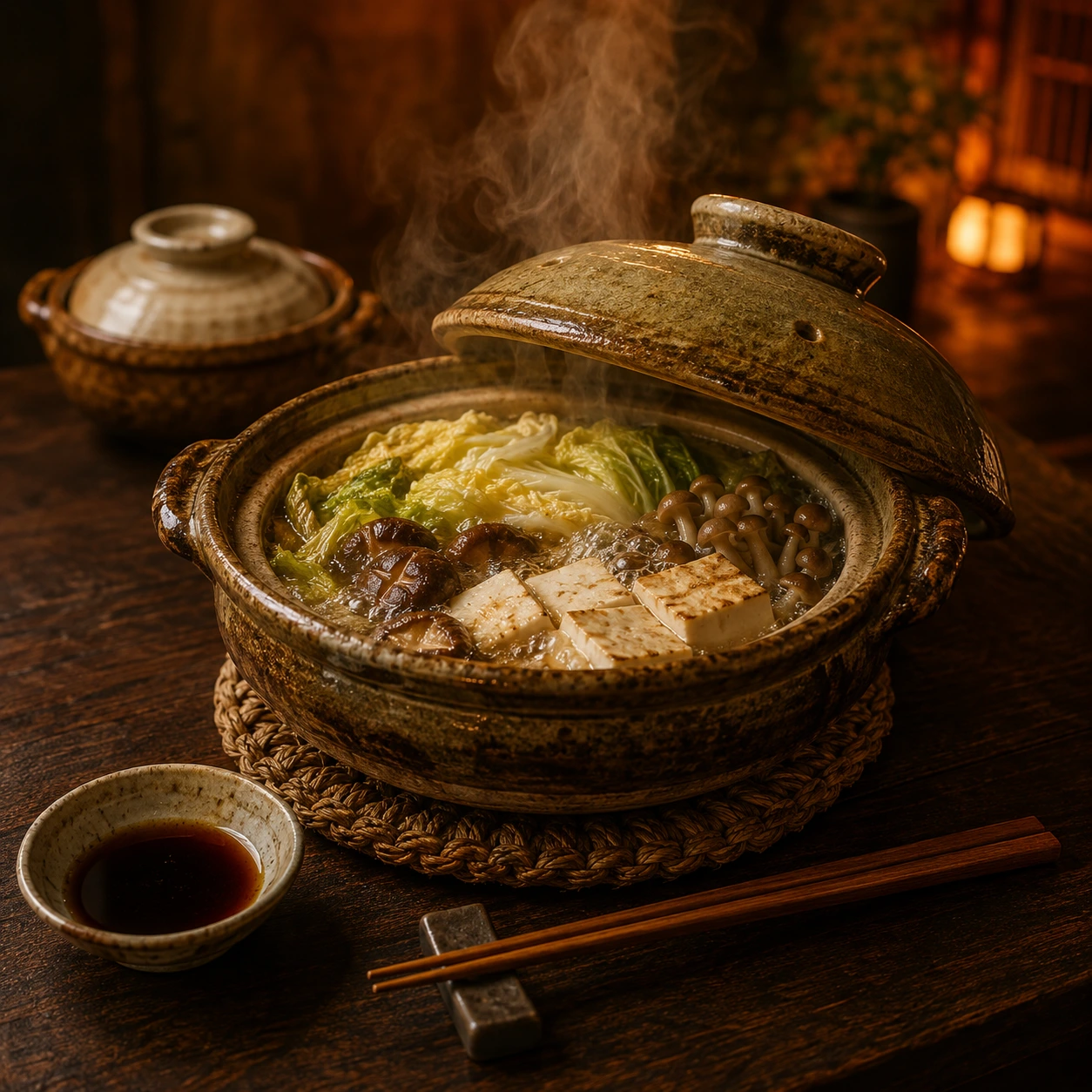
The deep-bodied chrysanthemum-patterned donabe is the classic household shape: enough depth for a full hotpot for three or four people, with the fluted rim that has become the visual shorthand for the whole category.
Season it before you cook in it — medome
A new donabe has microscopic pores and hairline channels through the clay. Medome — "closing the eyes" — fills them with starch so the pot doesn't seep, crack or absorb odours.
Fully glazed pots are more forgiving than unglazed ones, but the treatment costs an hour and extends the life of either. Do it before the first meal:
- Wash and dry the pot completely, inside and out. This can take several hours; the base must be bone dry.
- Fill it 80% with water and add a cup of cooked rice — or a few tablespoons of uncooked rice, or two of potato starch.
- Bring to a boil over low heat, then simmer for 30–60 minutes until you have a thin porridge.
- Turn off the heat and leave it to cool completely in the pot. Do not rush this; sudden cooling is as dangerous as sudden heating.
- Discard the porridge, rinse without detergent, and dry thoroughly for a day.
Repeat medome once or twice a year, or any time the pot has been scrubbed hard.
The rules that keep it alive
- Never heat it empty or nearly empty. The most common way donabe die.
- Dry the outside of the base before it goes on the flame. Water trapped on the base turns to steam inside the clay and cracks it.
- Start on low heat, raise gradually. No blasting from cold.
- Never put a hot pot on a cold, wet or metal surface. Use a wooden or woven trivet.
- Never pour cold water into a hot pot. Same failure mode in reverse.
- Check IH compatibility. Standard donabe do not work on induction hobs unless they have an embedded metal plate and say so explicitly. Gas and open flame are ideal.
- Wash with a soft sponge and minimal detergent — the porous clay absorbs it. Dry completely before storing, or it will grow mould.
- Store with the lid off or with paper between lid and rim, so trapped moisture can escape.
If a hairline crack appears, the rice-porridge medome treatment will often seal it. A crack you can see through means the pot is finished.
Cooking rice in a donabe
This is the use that converts people. Clay-pot rice has a distinct texture — each grain more separate, a faint sweetness, and if you get it right, a thin layer of golden scorched rice on the base (okoge) that is the best part of the pot.
A dedicated rice donabe is shaped for the job — the double lid traps a little pressure and stops the pot boiling over — and is sized in gō (about 180 ml of uncooked rice each). A 2-gō pot serves two to three people.
Double-lidded rice pots like this one are designed to be run without adjusting the flame at all: medium heat from start to finish, then rest. Follow the maker's timing if it comes with instructions. The staged method below is for an ordinary single-lid donabe.
The method, for 2 gō (360 ml uncooked rice):
- Rinse the rice until the water runs merely hazy, then soak 30 minutes and drain.
- Add rice and 400 ml water to the pot. Lid on.
- Medium heat until it boils — roughly 10 minutes. You will hear it and see steam at the lid vent.
- Reduce to low for 12 minutes. Do not lift the lid.
- Optional okoge: 20–30 seconds on high at the very end.
- Rest, off the heat and covered, for 10–15 minutes. This step is not optional — the grains finish absorbing from the inside during it.
- Fluff with a cutting motion.
The rice you start with matters as much as the pot; our rice guide covers the varieties.
Nabe: the meal the pot is named for
Nabe is winter food and a social format at once — the pot goes on a burner in the middle of the table, everyone cooks and eats from it directly, and rice or noodles go in at the end to finish the broth (shime).
A basic, excellent version:
- Broth: 1 litre water, a 10 cm piece of kombu soaked 30 minutes, then heated and removed before it boils. Add 2 tbsp soy sauce, 2 tbsp mirin, a splash of sake.
- In, in order of cooking time: napa cabbage stems, mushrooms, carrot, tofu, then leaves, then thin-sliced pork or fish at the table.
- Dip: ponzu with grated daikon, or sesame sauce.
- Shime: cooked rice with a beaten egg stirred through the remaining broth, or udon.
If you want depth without making stock, salted kombu strands dissolve straight into the broth and season it at the same time.
If clay's fragility puts you off, a cast-iron pot does much of the same work — slower to heat, similarly good at holding it, induction-compatible and effectively unbreakable. More on that in the Nambu ironware guide.
Frequently asked questions
Can I use a donabe on an induction hob? Only models with a built-in metal disc, and they will say so. A standard donabe will simply not heat.
Can it go in the oven? Most can, but check the maker's guidance — and never move it from oven heat onto a cold surface.
Why does my donabe smell? Porous clay absorbs odours, especially from detergent or from food left standing in it. Simmer water with a spoonful of tea leaves or rice to neutralise, and never store food in the pot.
Do I really need to do medome? Yes for unglazed or partially glazed pots. Fully glazed interiors are more forgiving, but the rice treatment does no harm and extends the pot's life either way.
Can I put it in the dishwasher? No. Detergent soaks into the clay and the thermal cycle risks cracking.
Is a donabe worth it if I only cook for one or two? A small 1–2 gō rice donabe is, easily. A large hotpot donabe only earns its shelf space if you eat communally.
Season it, keep the base dry, and never shock it with temperature. Do that and a clay pot outlives every non-stick pan you will ever buy — and makes better rice than the machine it replaces.