Nambu Tekki: Japanese Cast Iron, and Why It Cooks Differently
Iwate has been casting ironware for four centuries. What makes Nambu tekki pans and kettles different from Western cast iron, and how to keep one rust-free.
Cast iron is cast iron everywhere — but the Japanese tradition arrived at a different object from the American one, and the difference is worth understanding before you buy.
Nambu tekki is ironware from Iwate prefecture in northern Japan, produced continuously since the seventeenth century in Morioka and Oshu. It is thinner than a typical American skillet, often finely textured, and finished differently — and the result is a pan that heats more evenly, weighs less, and requires a slightly different care routine.
What sets it apart
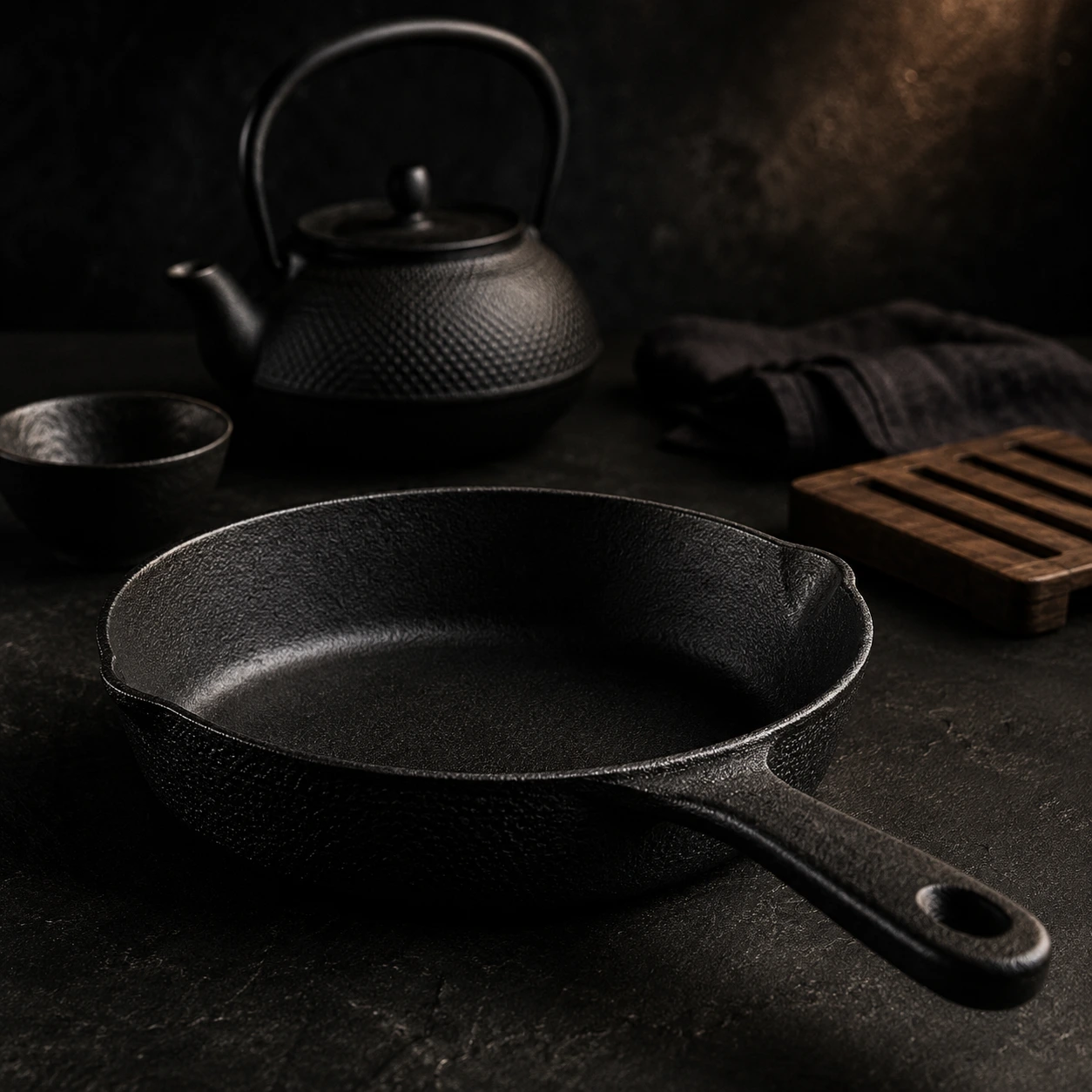
It is thinner. A Nambu pan is cast to a lighter section than the heavy Western skillet, and often to a shallower profile that makes stirring easy. It still stores a great deal of heat — that is what cast iron does — but you can lift it with one hand, which matters more in daily cooking than the last few degrees of thermal mass.
The surface is textured. The pebbled arare (hailstone) pattern on the outside of many pieces is traditional, and it increases surface area for more even heat transfer.
The finish is oxide, not seasoning. Many Nambu pieces are finished by baking at high temperature to form a hard iron-oxide layer, rather than relying entirely on a polymerised oil coating. They arrive more usable than a raw Western skillet, though they still build a seasoning layer with use.
It is cast by hand in sand moulds — one of the reasons prices sit above mass-produced cookware, and why individual pieces vary slightly.
The everyday frying pan is where most people start. It handles high-heat searing that non-stick cannot survive, goes from hob to oven to table, and improves with every use rather than degrading.
The small plate-shaped pans double as serving dishes — food goes to the table still sizzling and stays hot for the length of the meal. A detachable handle is what makes that work: it comes off for the oven, the toaster oven or the table, and clips back on to move the pan. This is a distinctly Japanese use of cast iron and a genuinely good one.
Ridged grill pans do the job a domestic kitchen usually cannot: high, dry, direct heat with proper contact marks, indoors, without a barbecue.
Iron serving bowls extend the same logic to the table — soup, stew or rice that stays hot from the first mouthful to the last.
Iron kettles: tetsubin and the important distinction
A tetsubin is a cast iron kettle for boiling water over heat. There is one distinction that catches buyers out constantly:
- A true tetsubin is bare iron inside. Water boiled in it picks up a trace of iron and, according to long tradition, tastes softer and rounder. It must be dried thoroughly after every use or it will rust.
- An enamel-lined iron kettle (often sold as a "teapot") has a glass lining and is designed for steeping tea, not for direct heat. It will not season, will not add iron, and putting it on a flame can crack the enamel.
Check which you are buying. Both are legitimate; they are not interchangeable.
The trace iron point is real but modest — cast iron cookware does contribute a small amount of dietary iron, particularly with acidic foods. Treat it as a pleasant side effect, not a supplement.
Seasoning and the first use
Most Nambu pans arrive pre-treated and need very little:
- Rinse and dry with heat — put the empty pan on a low flame for a minute or two until every trace of moisture is gone.
- Wipe a thin film of neutral oil over the cooking surface while it is warm. Thin. A thick coat goes sticky.
- Cook something fatty first — bacon, or vegetables in a generous amount of oil. This is the fastest way to build the initial layer.
Non-stick performance develops over weeks. It never becomes PTFE-slick, and an egg will stick until the pan has some history. Preheat properly and use enough fat and the problem mostly disappears.
Care: three rules
1. Dry it with heat, every single time. Wash, then return the pan to a low flame until it is bone dry and just too hot to touch. Air-drying is not enough — this is the rule that prevents 90% of rust.
2. Minimal detergent, no soaking, no dishwasher. Hot water and a stiff brush handles almost everything. Stuck food comes off with water simmered in the pan for a minute, not with a scouring pad.
3. Do not store food in it. Acidic and salty food left in cast iron strips seasoning and can pit the surface.
If it rusts — and it will, eventually, if you forget once — the pan is not ruined. Scrub the rust off with steel wool or a rust eraser, wash, dry over heat, oil, and cook something fatty in it. Cast iron is one of the few kitchen items that is genuinely repairable.
A tetsubin gets the same treatment with one addition: after emptying, put it back on residual heat for thirty seconds so the interior steam-dries, and never scrub the inside — the mineral scale that builds up over time is protective and desirable.
Nambu tekki vs Western cast iron
| Nambu tekki | Western skillet | |
|---|---|---|
| Weight | Lighter, thinner section | Heavier, thicker |
| Finish | Baked oxide layer, often textured | Raw or factory pre-seasoned |
| Heat retention | Good | Higher |
| Even heating | Excellent | Good, slower to equalise |
| Table use | Designed for it | Rarely |
| Price | Higher — hand-cast | Lower — mass produced |
Neither is superior in general. If you sear thick steaks and want maximum stored heat, a heavy Western skillet wins. If you want a pan you will actually lift and use daily, and take to the table, Nambu wins.
Frequently asked questions
Does it work on induction? Yes — cast iron is ideal for induction. Clay donabe are the ones that usually don't.
Can I use metal utensils? Yes. Cast iron is not a coating you can scratch off with a spatula.
Is it safe if there is rust? Small surface rust is not dangerous; scrub, dry and re-oil. Deep pitting means the piece has been badly neglected.
Is it heavy? Lighter than the equivalent Western skillet, but still iron. A 24 cm pan is a real weight — consider size honestly if wrist strain is a factor.
Does cooking in iron really add iron to food? In small amounts, yes, more so with acidic and moist foods. It is a minor contribution, not a treatment.
How long does it last? Generations. Nambu pieces are routinely inherited, and there is a repair and re-coating trade for antiques.
Buy one pan, dry it over heat every time, and it will still be in the kitchen in fifty years. That is a very different proposition from replacing a non-stick pan every two.