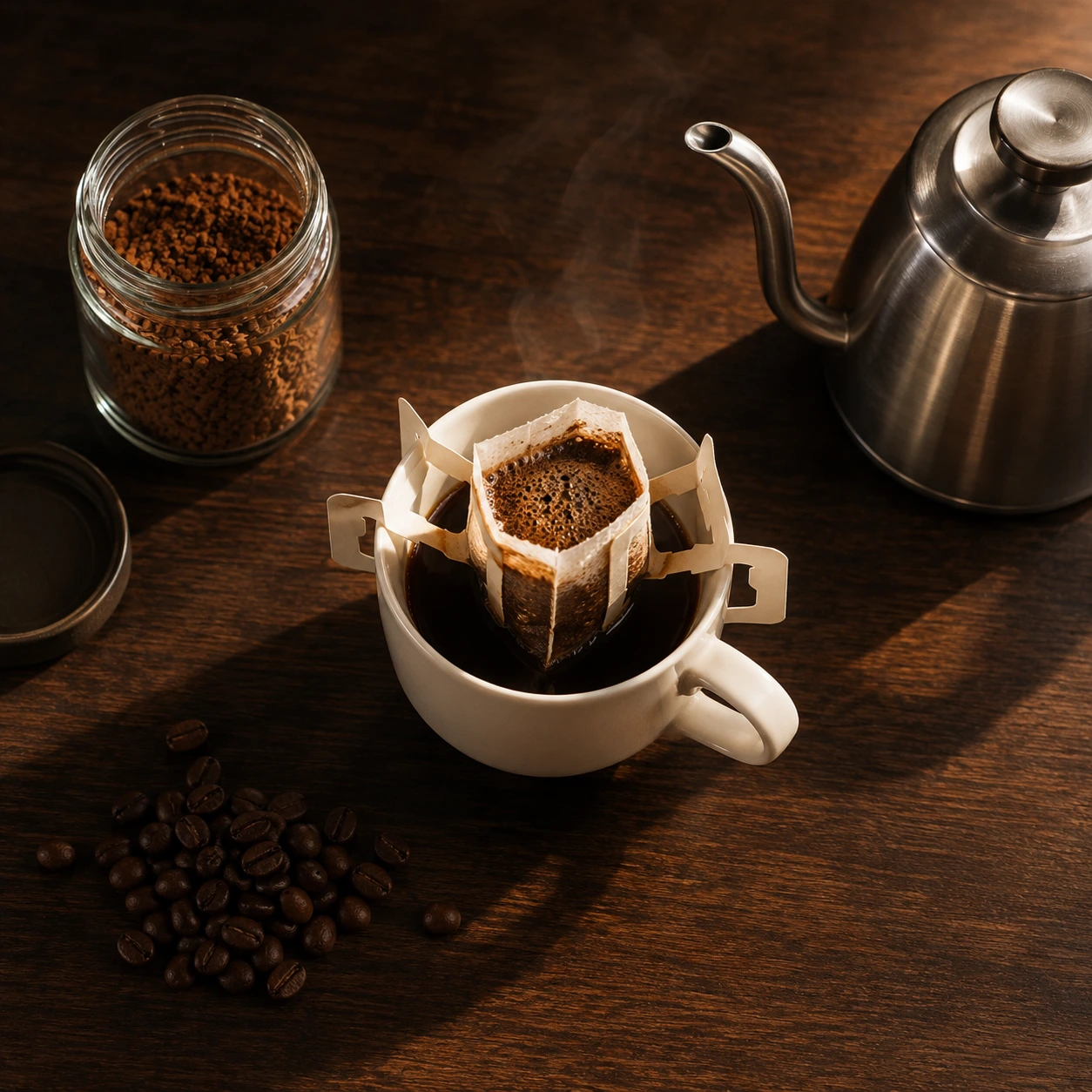
Japanese Coffee at Home: Drip Bags, Instant and the Kissaten Style
Japan quietly built one of the world's best coffee cultures around a dark, clean, hand-poured cup. Here's what to buy and how the drip bag format works.
Japan drinks a great deal of coffee, and it drinks it in a way that has almost nothing to do with espresso. The national reference cup is a dark-roasted, hand-poured filter coffee — clean, low in acidity, faintly bitter, served black in a small cup and often accompanied by nothing at all.
That preference produced two things worth importing: the kissaten brewing tradition, and the single-serve drip bag, which is the most convenient good coffee ever devised.
What "Japanese roast" actually means
Two conventions separate a Japanese cup from a third-wave Western one.
Roast level. The domestic default sits considerably darker than the light, fruit-forward roasts that dominate specialty coffee elsewhere. A Japanese "medium" is often what a Nordic roaster would call dark. The intent is a rounded, chocolate-and-caramel cup with the acidity deliberately suppressed.
Extraction style. The kissaten method uses a fine-to-medium grind, a slow pour from a thin-spouted kettle, and a long, gentle contact time. Some old-school shops pour at temperatures closer to 85 °C and take three or four minutes over a single cup. The result is denser and sweeter than a fast pour, with the sharp edges filed off.
Neither is objectively better than the specialty approach. They are aimed at a different cup.
Drip bags: the format Japan got right
A drip bag is a sealed sachet of ground coffee with two cardboard wings. You tear the top, hook the wings over the rim of a mug, and pour hot water through it in two or three stages. Ninety seconds later you have real filter coffee, brewed on the cup, with no equipment and one item to bin.
It is not instant coffee. It is a disposable single-serve pour-over, and the gap in quality between it and instant is enormous.
The large box of standard-blend drip bags is the workhorse format — this is what sits in Japanese office kitchens and hotel rooms, and it is dramatically better than the instant sachets that occupy the same role elsewhere.
At the premium tier, drip bags built on top export-grade beans are worth the difference: the format's limit is the coffee inside it, not the method.
Decaffeinated drip bags are one of Japan's underrated categories — the domestic market takes decaf seriously enough that the roast quality doesn't collapse the way it often does abroad.
How to brew one properly, because the instructions on the box are terse:
- Tear along the top, unfold both wings, hook them over the cup.
- Pour just enough water to wet all the grounds — about 20 ml — and wait 30 seconds. This is the bloom, and it matters more here than in any other method.
- Pour the rest in two or three slow additions, keeping the water level below the top of the bag.
- Remove the bag as soon as it stops dripping. Squeezing it or leaving it in extracts the bitter tail.
Total water: roughly 140–160 ml per bag.
Ground coffee and the kissaten method
If you want the full experience, the equipment is minimal and lasts decades.
A long-running classic ground blend is the correct starting point. This one is roasted bean by bean before blending — a common Japanese approach that keeps each origin's character intact instead of averaging everything into one roast curve.
A richer, fuller-bodied blend suits milk better if you drink café au lait rather than black.
The brewing gear itself is a small subject of its own — flat-bottom versus cone drippers, the three-hole Kalita design, and the reason a thin-spouted kettle changes the cup. We cover it in the Japanese pour-over guide.
A workable starting recipe: 20 g of coffee, 300 g of water at about 90 °C, poured in four stages over three minutes, medium grind.
Instant, and where it is genuinely fine
Japanese instant coffee is better than most, and there is no snobbery about it domestically — it appears in offices, konbini and homes without apology.
The everyday jar is aimed at a clean, unremarkable, entirely drinkable cup — the standard against which supermarket instant elsewhere generally loses.
The deeper-roast version is the one to use for iced coffee and for cooking — instant dissolves into batters, tiramisu and coffee jelly in a way ground coffee cannot.
And café au lait sticks — coffee, milk powder and sugar in one sachet — are a genuine Japanese habit rather than a compromise. One stick, hot water, done.
Canned coffee deserves a mention even though it rarely travels: Japan's vending machines have sold hot and cold canned coffee since the late 1960s, and it remains a category with more variety than most countries' entire coffee aisles.
Storing coffee so it stays worth drinking
- Oxygen and heat are the enemies, not time as such. Keep beans and grounds in an airtight container away from the stove.
- Do not refrigerate an opened bag. Condensation each time you open it does more damage than the cold prevents.
- Ground coffee stales noticeably within two weeks of opening. Drip bags are individually sealed and therefore hold far longer, which is part of their appeal.
- Whole beans keep aroma several times longer than pre-ground, if you have a grinder.
Frequently asked questions
Is a drip bag as good as a proper pour-over? Close. You lose control over grind and ratio, and the paper filter is small — but a fresh drip bag beats a carelessly made V60. It comfortably beats instant.
Why does Japanese coffee taste less acidic? Darker roasting plus lower brew temperatures and slower extraction. The bright fruit acidity that specialty roasters chase is deliberately suppressed.
Can I use a drip bag twice? No. The grounds are fully extracted after one pass; a second pour gives you brown, bitter water.
Is Japanese coffee grown in Japan? Almost none of it — apart from tiny volumes in Okinawa and Ogasawara. Japan's contribution is roasting, blending and brewing, not agriculture.
What is a kissaten? A traditional Japanese coffee house, typically decades old, dark-wooded, serving hand-poured coffee in china cups. They predate the café-chain era and are a distinct institution.
If you buy one thing, make it a box of drip bags — it is the format that best explains why a country with no coffee farms takes coffee this seriously. If you want to go further, the dripper guide is the next step.