Wave or 101? Japanese Pour-Over Coffee Drippers, Explained
Flat-bottom or cone, three holes or one, ceramic or copper — what each Japanese dripper design actually does to the cup, and a recipe that works.
Pour-over coffee looks like a single method and is actually several. The dripper you choose determines how water moves through the coffee bed — and that governs extraction, body and how much your technique matters.
Japan is where most of this hardware comes from. The two design philosophies you will meet are the cone and the flat bottom, and choosing between them is the only real decision in the category.
Cone versus flat bottom
Cone drippers (the V60 being the famous example) funnel water toward a single large hole. The coffee bed is deep in the middle and shallow at the edges, water accelerates as it converges, and flow is largely controlled by how you pour. That makes them expressive: a skilled pour produces a bright, clean, high-clarity cup, and a careless one produces something sour or bitter.
Flat-bottom drippers hold the coffee in an even layer and drain through three small holes. Water contacts the whole bed at the same depth, and the small holes restrict flow so the dripper — not your pouring hand — sets the pace. The result is more even extraction, more body, and dramatically more consistency between cups.
If you want a forgiving daily brewer, buy flat-bottom. If you enjoy the ritual and want to chase clarity in a single-origin, buy a cone.
The wave design is the best-known flat-bottom system: the fluted paper filter stands on its own and touches the dripper wall only at the ridges, so hot air escapes and the coffee bed sits in a stable, insulated layer. It is the most consistent pour-over method available to a beginner, and the reason it appears in so many competition setups is precisely that it is hard to get wrong. Wave drippers are sized to their filter — 155 for one to two cups, 185 for two to four — and the two are not interchangeable.
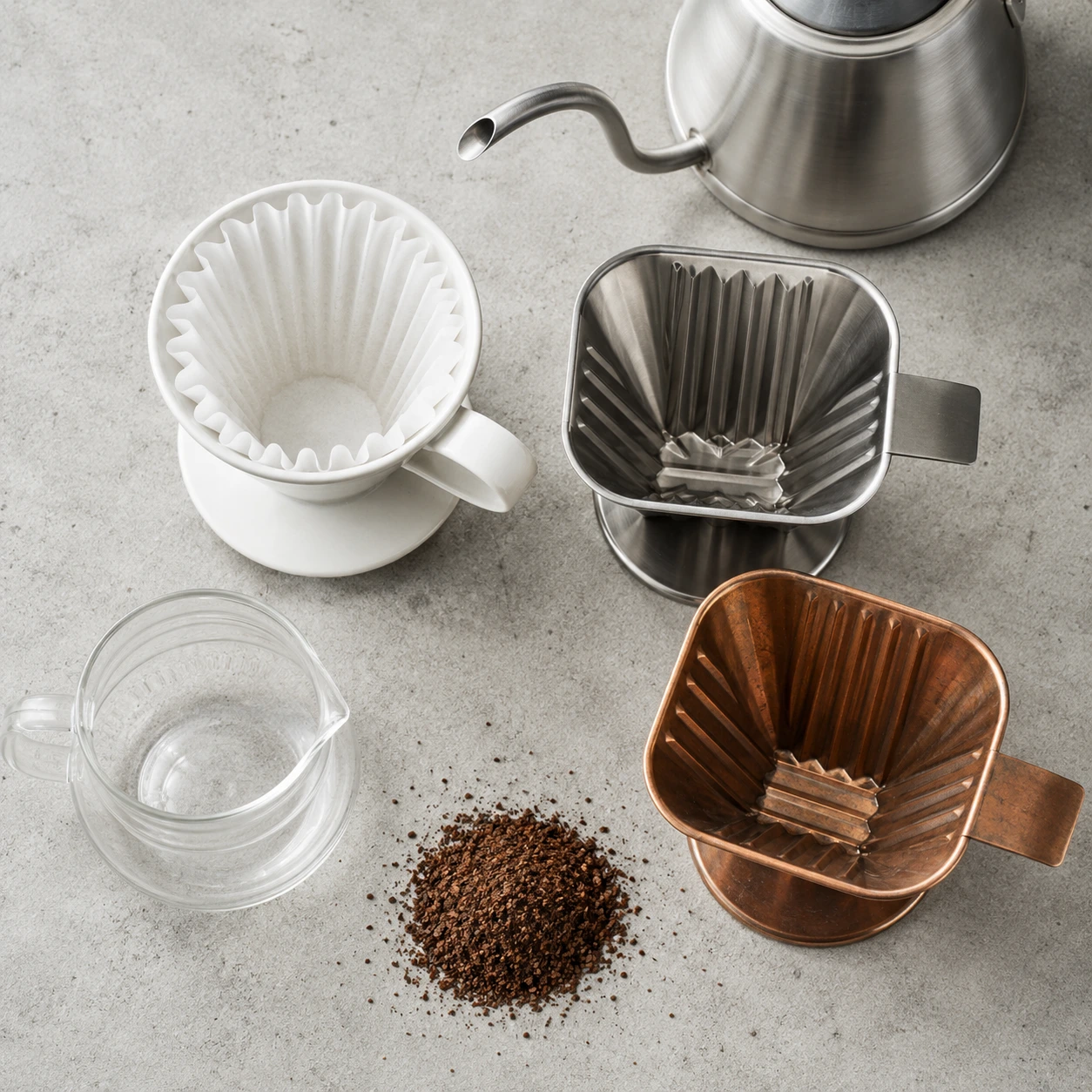
The same system in porcelain. Ceramic is slower to warm than steel and then extremely stable once hot, and it is the most pleasant version to use at a table — this one is made as a collaboration with a Nagasaki porcelain kiln, which is why it looks like tableware rather than equipment. Preheat any ceramic dripper with hot water before brewing, or a cold body will pull several degrees out of your first pour.
The trapezoid classic
Before the wave came the trapezoid — three holes in a sloped, wedge-shaped body. It is the design that defined Japanese home coffee for decades, and it is still in daily use across the country.
Stainless steel is the practical version: unbreakable, quick to warm, and the one to take travelling.
Copper is the enthusiast's choice, for a real reason rather than an aesthetic one — copper's thermal conductivity is far higher than ceramic's, so the dripper reaches brewing temperature almost instantly and holds it steadily through the pour. Temperature stability is one of the quiet variables in pour-over, and copper handles it best. It develops a patina, which most owners consider the point.
Trapezoid sizing follows its own numbers: 101 is one to two cups, 102 is two to four. Buy the size you drink, because a dripper run under capacity extracts unevenly.
The kettle is not optional
The narrow gooseneck spout is the piece of equipment that changes results most, and it is the one people skip. A normal kettle dumps water in a wide, fast stream that gouges channels through the coffee bed — water then races down those channels and under-extracts everything else.
A gooseneck gives you a thin, slow, steerable stream that can be laid down in controlled circles. A slim body also makes it easier to hold at a low, stable angle, and a copper one — this is a Tsubame-made pot, from the Niigata metalworking town that supplies much of Japan's kitchen hardware — holds pouring temperature better than steel while it drains. If you are choosing between a fancier dripper and a proper kettle, buy the kettle.
A recipe that works
For a flat-bottom dripper, 2 cups:
| Variable | Value |
|---|---|
| Coffee | 20 g |
| Water | 300 g |
| Ratio | 1:15 |
| Grind | Medium — table salt, not sand |
| Water temperature | 90–93 °C |
| Total time | 2:45 – 3:15 |
- Rinse the paper filter with hot water and discard the rinse. This removes paper taste and preheats the dripper and server.
- Add the grounds, level the bed, and make a small dip in the centre.
- Bloom: pour 50 g of water in a slow spiral, just wetting everything. Wait 40 seconds. It should visibly swell and release gas — if it doesn't, the coffee is stale.
- Pour to 150 g in slow concentric circles, avoiding the very edge.
- Wait for the level to drop, then pour to 300 g in the same way.
- Remove the dripper as soon as it stops dripping freely; the last drops are bitter.
If it tastes sour and thin, grind finer or brew hotter. If it tastes bitter and heavy, grind coarser or pour faster. Change one variable at a time.
For cone drippers, use the same ratio with a slightly finer grind and a more continuous pour.
Which coffee to put in it
Japanese roasting sits darker than the specialty norm, and the classic kissaten cup — dense, clean, low-acid — is built for exactly this equipment. Our Japanese coffee guide covers the roasts, drip bags and instant tiers, and why a dark roast likes a slightly lower brew temperature than the 93 °C above.
Filters, and why they matter here
Wave filters and trapezoid filters are not interchangeable, and neither works properly in the wrong dripper. Buy filters that match the system and the size number.
Japanese paper filters are typically oxygen-bleached rather than chlorine-bleached, and denser than most supermarket alternatives — which is part of why the cup comes out cleaner. Unbleached filters need a more thorough rinse or they contribute a papery note.
Frequently asked questions
Which dripper is best for a beginner? Flat-bottom wave. It removes the two variables — pour rate and bed geometry — that beginners struggle with.
Do I need a scale? More than you need a nice dripper. Coffee-to-water ratio is the largest single factor in how the cup tastes, and eyeballing it does not work.
Can I use a normal kettle? You can, and you will get channelling and inconsistency. Pour slowly through a spoon held above the bed as a temporary workaround.
What grind size? Medium, roughly table salt. Too fine and the bed clogs and over-extracts; too coarse and water rushes through.
Metal or paper filter? Paper gives a cleaner cup by trapping oils and fines. Metal gives more body and sediment. Japanese pour-over tradition is firmly paper.
Why rinse the filter? It removes papery flavour and preheats the equipment. Skipping it is the most common reason a first cup tastes flat.
Buy a gooseneck kettle, a flat-bottom dripper and a scale, in that order of importance. The coffee inside is the last variable — and the drip bag guide covers where to find it.