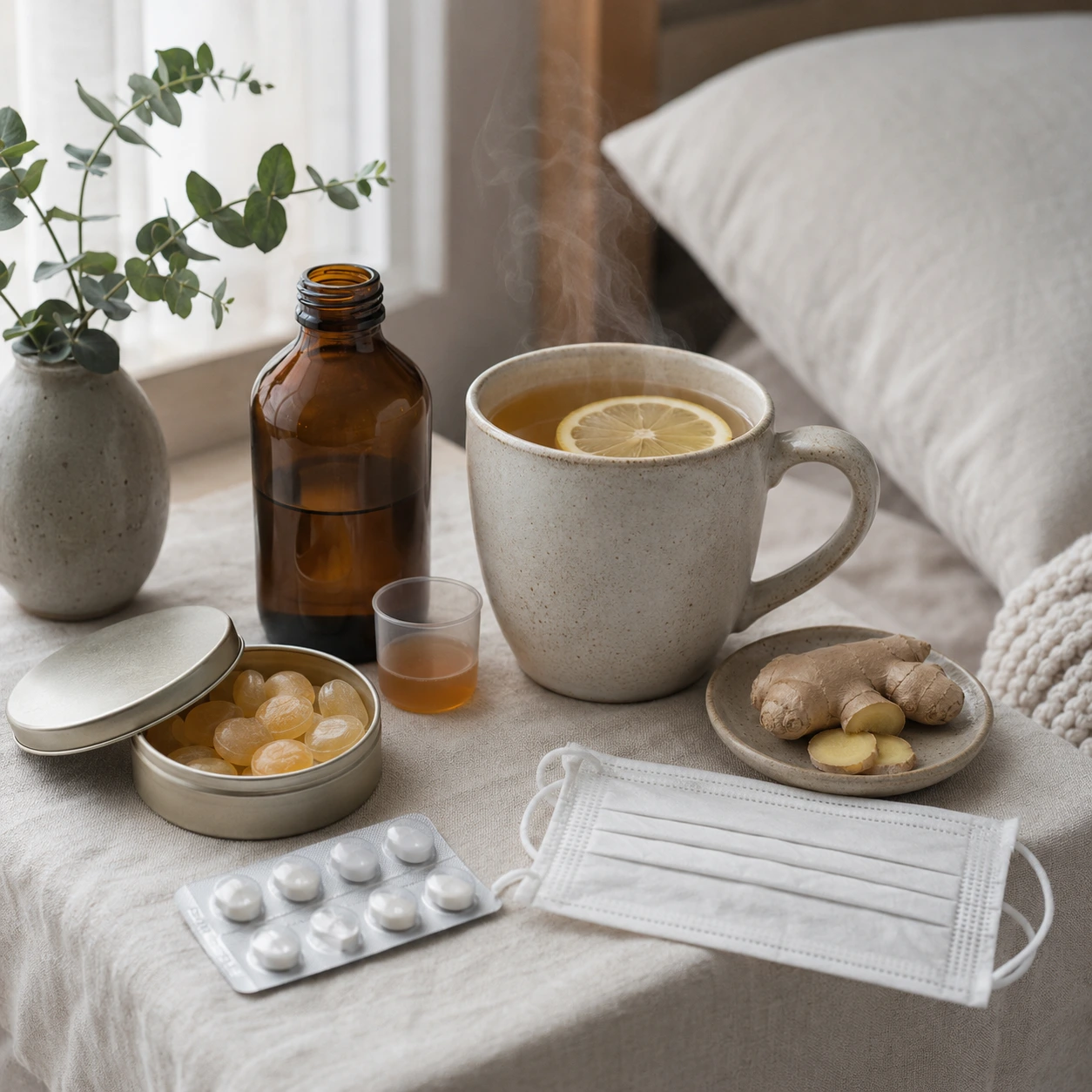
Japanese Cold and Throat Remedies: Lozenges, Gargles, Combination Medicines and What the Label Classes Mean
What Japan reaches for at the first sign of a cold, from Ryukakusan lozenges and iodine gargles to Pabron and Colgen Kowa, with a plain explanation of food, quasi-drug and OTC medicine labels, the ingredients inside, and when to stop self-treating.
The first sign of a cold in Japan sets off a well-rehearsed routine. A mask goes on, the gargle bottle comes out of the bathroom cabinet, a tin of herbal lozenges appears on the desk, and someone finds the box of 総合感冒薬 (sōgō kanbōyaku, combination cold medicine) kept in the kitchen drawer. Very little of it is exotic, but the range and the labelling can be confusing from abroad.
This guide explains what Japanese people actually use, and how to read the three legal classes printed on every box: food, quasi-drug and over-the-counter medicine. That distinction decides what you can import, how it should be taken, and which products contain ingredients restricted outside Japan.
The first-day routine
- Gargling. うがい (ugai) is taught in primary school and practised for life: plain water after coming home, an antiseptic gargle when the throat is sore.
- A mask. For courtesy, humid airways, and to stop a cough spreading.
- Warm fluids. Honey and grated ginger in hot water, 柚子茶 (yuzu-cha, yuzu marmalade tea), or 甘酒 (amazake, sweet rice drink).
- Lozenges on the desk all day.
- Early rest.
The habit that does most of the work is the boring one: warm fluids, humidity and an early night. Everything else supports it.
Ryukakusan's loquat leaf candy is the everyday desk sweet of the cold season, built around the company's own herb powder, and it sits legally in the food category.
Three labels that change everything
| Japanese | Reading | Class | What it means |
|---|---|---|---|
| 食品 | shokuhin | Food | Candies and drinks. No dose, no claims, no import limits |
| 医薬部外品 | iyakubugaihin | Quasi-drug | Mild registered actives: medicated lozenges, some gargles. Usually importable |
| 第3類医薬品 | dai-san-rui iyakuhin | OTC class 3 | Lowest risk: iodine gargles, herbal throat powders |
| 第2類医薬品 | dai-ni-rui iyakuhin | OTC class 2 | Most combination cold medicines and nasal sprays |
| 指定第2類 | shitei dai-ni-rui | Designated class 2 | Extra caution, often codeine, ephedrine or NSAIDs |
The same brand can span three classes. Ryukakusan's silver tin of herbal powder is a class 3 medicine, its medicated lozenges are quasi-drugs, and the candy above is food. Read the small box on the packaging before assuming a product is the one you meant.
Gargles and sprays for the throat and nose
The classic Japanese gargle is brown povidone-iodine diluted in a measuring cup, used two or three times a day for a sore throat. It stains and tastes of iodine, which is why clear iodine-free versions exist.
The Colgen Kowa one-push bottle is the standard format: a single press measures a dose into the cup, with the cooling finish most Japanese adults associate with a sore-throat morning.
The mild version is colourless, herbal-scented and less irritating, the better choice for children old enough to gargle.
Most Japanese OTC nasal sprays combine a decongestant such as naphazoline with an antihistamine, and the rule for that class applies: no more than a few days of continuous use, or the congestion rebounds.
Pabron's metered spray has a fine mist and a backflow-prevention nozzle, and covers both the cold and the hay-fever case.
Combination cold medicines and what is inside them
A Japanese 総合感冒薬 treats every symptom at once. A typical pack contains an antipyretic-analgesic (acetaminophen, ibuprofen or loxoprofen), an antihistamine for the runny nose, a cough suppressant (dextromethorphan or dihydrocodeine), an expectorant, and often caffeine to counter the drowsiness the antihistamine causes.
Two ingredients explain why some products are restricted abroad. Dihydrocodeine is a weak opioid, prescription-only in many countries. dl-Methylephedrine is a bronchodilator related to ephedrine, and ephedrine-type compounds are controlled in several jurisdictions. Pabron Gold A is a long-established example that contains both, alongside acetaminophen, an expectorant and caffeine.
The fine-granule sachets dissolve on the tongue, which is why it is the version people keep for travel.
The Colgen Kowa family takes the same approach in several formats.
One tablet per dose in a blister strip is the simplest possible regimen and the easiest to carry in a wallet.
Whatever the format, check the active-ingredient list, take it with food, and never combine two combination medicines.
Kampo at the first chill
葛根湯 (kakkontō) is the traditional answer to the very first shiver: a kampo formula taken before the sweating stage, when the neck and shoulders are stiff. It contains 麻黄 (maō, ephedra), so it is unsuitable for heart disease or high blood pressure and not for long use. 麦門冬湯 (bakumondōtō) is the formula for the dry, tickly cough that lingers after a cold. The kampo guide covers how these formulas are chosen.
The caffeine-free evening teas article lists the warm drinks that will not keep you awake.
When to see a doctor, and cautions for children and pregnancy
Self-treatment is for an ordinary cold. See a doctor for a fever above 38.5 °C lasting more than three days, difficulty breathing, chest pain, a sore throat with white patches, ear pain, or any cold that is not clearly improving after ten days.
Japanese adult cold medicines are labelled for age 15 and over unless the box says 小児用 (shōniyō, for children). Products containing dihydrocodeine are not for under-12s. Aspirin-containing products are not for children at all.
In pregnancy and while breastfeeding, ask a doctor before any combination medicine or kampo formula; ephedra formulas and third-trimester NSAIDs are avoided, and heavy iodine gargling is discouraged. A water gargle, honey drinks and food-class lozenges are the safe defaults.
Importing and dosing
Most countries allow a personal supply of OTC medicine of around two months' worth. Products with dihydrocodeine or ephedrine-type ingredients may be stopped or need a declaration; check your national rules before ordering and keep the original box. The customs duty guide covers thresholds by country.
Japanese OTC doses are often lower than Western equivalents, with acetaminophen at 300 mg per dose typical; follow the Japanese instructions rather than doubling up.
Frequently asked questions
Can I take a Japanese cold medicine with paracetamol? Almost certainly not, because the combination product already contains acetaminophen. Check the box.
Why do so many contain caffeine? To offset the drowsiness from the antihistamine. Take the last dose well before bed.
Is the Ryukakusan candy the same as the powder in the tin? No. The tin is a class 3 medicine with a dosing schedule; the candy is a sweet with herb extracts.
How long can I use a nasal spray? A few days at a time, a week at most. Longer use causes rebound congestion.
A gargle, a tin of lozenges, warm fluids and an early night handle most colds. For the rest, the kampo guide is the natural next read.