Kampo Explained: Japanese Herbal Medicine, the Formulas People Buy, and the Cautions
How kampo differs from Chinese medicine, what the drugstore class marks mean, which formulas Japanese households actually keep, and why licorice and ephedra deserve respect.
Kampo, 漢方 (kanpō), is the Japanese branch of East Asian herbal medicine, and it occupies a position no other traditional system does: prescribed by ordinary hospital doctors, covered by national health insurance, and sold in every drugstore as standardised granule sachets made by pharmaceutical companies.
That makes it easier to buy than Chinese medicine and harder to buy well. The formulas are real drugs with real actives, chosen by a person's constitution rather than a symptom list. This guide covers the system, the formulas people buy, how to take them, and where the risks are. It is not medical advice.
How kampo differs from Chinese medicine
Kampo arrived from China in the sixth century and diverged in the Edo period, when Japanese physicians stripped it back to the classical formulas of the Han dynasty texts, hence the name, "Han method".
| Feature | Kampo | Chinese TCM |
|---|---|---|
| Formulas | Fixed; 148 approved for insurance prescription | Individually composed and adjusted |
| Form | Standardised extract granules from licensed makers | Raw herbs decocted at home, or patent pills |
| Who prescribes | Any licensed doctor; most Japanese physicians use some | TCM practitioners with separate training |
| Diagnosis | 証 (shō): constitution, plus abdominal palpation | Pattern differentiation, pulse and tongue |
A kampo formula is the same wherever you buy it, and the skill lies entirely in matching it to the person. Shō is assessed on whether someone is 実 (jitsu, robust) or 虚 (kyo, depleted), hot or cold, and where the imbalance sits; the same cold in a robust person and a frail one gets a different formula.
The drugstore class marks
Over-the-counter medicines in Japan carry a risk class on the box.
| Mark | Reading | Meaning |
|---|---|---|
| 第1類医薬品 | dai-ichi-rui | Pharmacist must explain in person |
| 第2類医薬品 | dai-ni-rui | Pharmacist or registered seller; most kampo sits here |
| 第3類医薬品 | dai-san-rui | Lowest risk; some tonics and vitamins |
Almost all kampo granules are 第2類, which tells you two things: they are medicines, not supplements, and they can interact with other drugs.
The formulas people actually keep
| Japanese | Reading | Traditional use |
|---|---|---|
| 葛根湯 | kakkonto | Very first hours of a cold, stiff neck and shoulders |
| 小青竜湯 | shoseiryuto | Watery runny nose, hay fever, thin nasal discharge |
| 防風通聖散 | bofutsushosan | Abdominal fat and constipation in robust people |
| 葛根湯加川芎辛夷 | kakkonto-ka-senkyu-shin'i | Blocked nose and sinus congestion |
Kakkonto is the one nearly every household keeps. It is meant for the first day of a cold in someone who feels chilled, has no sweat and a tight neck, and is generally agreed to be pointless once the cold is established; our cold and throat remedies guide covers what comes after.
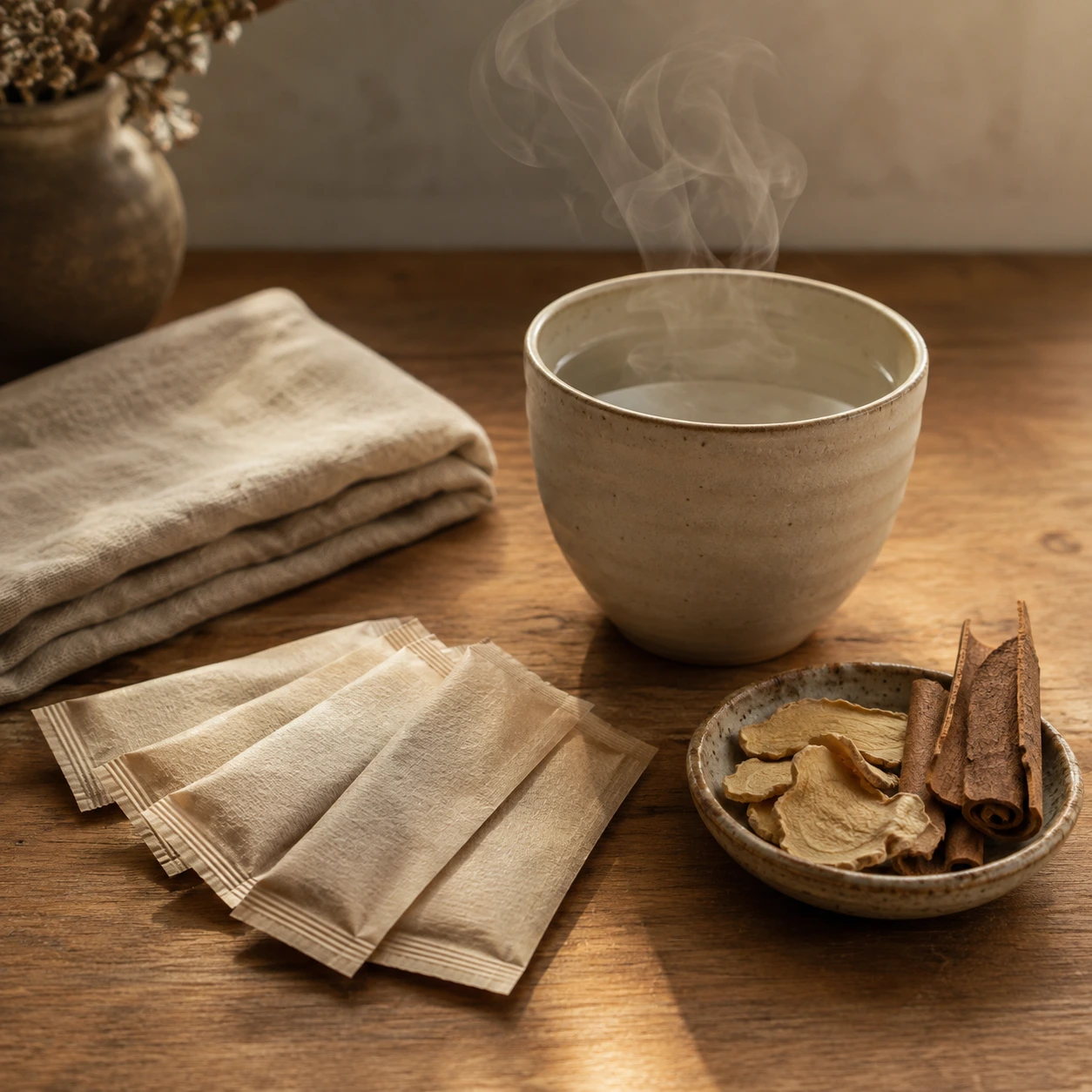
Kracie's 45-sachet kakkonto is the household-staple format: individual granule packets that keep for years in a drawer.
Gingyosan is the mirror image, for colds that start hot and sore-throated rather than chilled and stiff, and the nine-packet box is the travel size.
How to take granules
- Standard adult dosing is one sachet three times a day; child doses are given by age on the box.
- Take them 食前 (shokuzen, before meals) or 食間 (shokkan, between meals, about two hours after eating); several actives absorb better on an empty stomach.
- Dissolve in about 100 ml of warm water and drink it warm. This matters for warming formulas like kakkonto; swallowing the granules with cold water is acceptable if the taste defeats you.
- An acute formula should answer within two or three doses; if a cold formula has done nothing in a day, stop. A constitutional formula such as bofutsushosan gets a month, and longer use belongs under a doctor.
Tonics and single herbs
Alongside the formulas, drugstores sell herbal tonics that sit between kampo and supplement; the class mark says which.
Yomeishu is a 14% alcohol liqueur infused with 14 herbal ingredients, licensed as a medicine for chilliness, poor appetite and fatigue, and taken as a 20 ml measure before meals rather than as a drink.
Inochi no Haha A is a century-old 13-herb women's formula in the kamishoyosan family, plus vitamins and calcium, sold for menopausal symptoms; the White version reworks it for younger women.
Red ginseng, 紅参 (kōjin), is steamed, dried Panax ginseng root and the classic East Asian tonic for fatigue; this Maruman shot pairs it with maca in Japan's single-bottle energy-tonic format.
Realistic expectations
Kampo has more clinical research than most traditional systems and less than its reputation suggests. Shakuyakukanzoto has decent evidence for cramps and daikenchuto is used routinely after Japanese bowel surgery. Kakkonto's evidence for shortening colds is weak. Bofutsushosan produces small, real weight loss in trials, mostly through its laxative and ephedra content, not a mechanism to rely on.
The formulas suit the vague, functional complaints that Western medicine handles poorly: feeling cold, tired, bloated or out of sorts. They are a poor tool for anything with a clear diagnosis.
Cautions
- Licorice, 甘草 (kanzō). In around 70% of formulas. Its glycyrrhizin can raise blood pressure, lower potassium and cause swelling, especially over weeks or alongside diuretics. Never stack two formulas that both contain it.
- Ephedra, 麻黄 (maō). In kakkonto, shoseiryuto and bofutsushosan. A stimulant that raises heart rate and blood pressure; avoid it with heart disease, hypertension, thyroid disease, prostate enlargement, and alongside decongestants.
- Interactions. Shosaikoto with interferon caused fatal lung inflammation and is contraindicated; several formulas affect blood thinners. Tell a pharmacist everything else you take.
- Pregnancy and children. Ephedra and several purgative herbs are unsuitable in pregnancy; child doses exist, but the formulas were designed for adults.
- Import limits. Most countries cap personal imports of medicines at a month or two of supply; see our customs guide.
Check with a doctor if you have a chronic condition, take regular medication, are pregnant or breastfeeding, or intend to take a formula for more than a month.
Frequently asked questions
Is kampo the same as Chinese herbal medicine? Same roots, different practice: fixed formulas at fixed doses, made by pharmaceutical companies and prescribed by regular doctors.
Can I take kakkonto with paracetamol? Generally yes, but not with other decongestants or stimulants, because of the ephedra.
Do the granules taste bad? Bitter and earthy. Warm water makes them tolerable.
Can I take two formulas at once? Not without a pharmacist checking for overlapping licorice and ephedra. Combinations are common in clinics, rare on the shelf.
Keep a box of kakkonto for the first shiver, respect the class mark, and leave constitutional formulas to a doctor who can read your shō. For the rest of a cold, our cold and throat remedies guide takes over, and an evening caffeine-free tea is the gentler ritual.