Japanese Foam Cleansers Explained: Dense Lather, Amino Acids, Oils and Balms
Why Japanese face wash is built to foam like whipped cream, the difference between amino-acid and soap-based formulas, how to use a foaming net, and what 薬用 on the tube actually means.
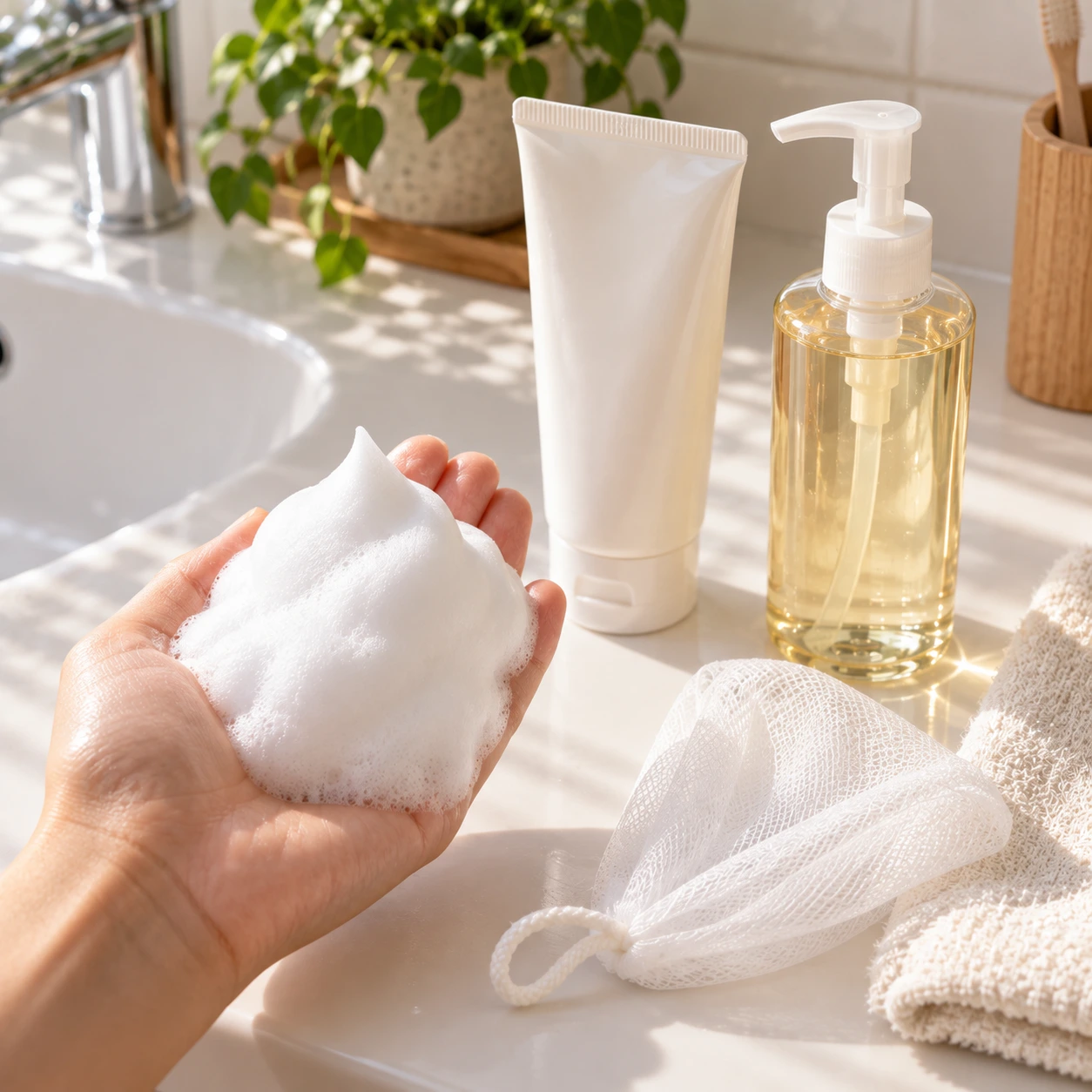
Pick up a tube of Japanese face wash and the first thing on the front is usually a photograph of foam — a dense white peak that looks like meringue. That is not decoration. It is the product's main selling point, and it says a great deal about how Japan thinks cleansing should work.
The logic runs like this: skin is damaged by rubbing, so the cleanser should do the work and the hands should barely touch the face. A thick cushion of foam is the mechanism. Everything else follows from it.
The formats, and what each one removes
| Japanese | Reading | Format | Removes |
|---|---|---|---|
| 洗顔フォーム | sengan fōmu | Cream in a tube, lathered by hand | Sweat, sebum, light sunscreen |
| 泡洗顔 | awa sengan | Pump that dispenses ready foam | Same, with no lathering effort |
| 酵素洗顔 | kōso sengan | Enzyme powder, mixed with water | Dead skin, blackheads, dullness |
| クレンジングオイル | kurenjingu oiru | Liquid oil, emulsifies with water | Makeup, waterproof sunscreen |
| クレンジングバーム | kurenjingu bāmu | Solid balm that melts on skin | Makeup, with a richer finish |
| クレンジングジェル | kurenjingu jeru | Water- or oil-based gel | Light makeup, sensitive skin |
The important split is between the first three and the rest. Foam, pump foam and powder are face wash (洗顔, sengan): water-based, designed to remove what water and mild surfactant can lift. Oil, balm and gel are cleansing (クレンジング, kurenjingu): designed to dissolve what water cannot, meaning makeup and long-wear sunscreen. The two are used in sequence in the evening, and the double cleansing method has its own guide.
Senka's Perfect Whip is the reference tube: inexpensive, ubiquitous, and the standard by which every other foam's density is judged.
DHC's olive-oil cleanser is the equivalent reference on the oil side: the first step of the evening for anyone wearing sunscreen or makeup.
Dense foam, no friction
The Japanese phrase is 摩擦レス (masatsu-resu, friction-free). The foam, not the fingers, should contact the skin. A thin lather forces you to rub; a thick, elastic foam lets you roll it across the face with almost no pressure.
The test is simple: turn your foam-covered hand upside down. If the foam stays put, it is dense enough. Makers call it 弾力泡 (danryoku awa, elastic foam).
Bioré's Marshmallow Whip is the pump version of the idea: the foam arrives ready and bouncy, and the formula is buffered to stay near skin's natural mild acidity while it works.
Curél's pump foam is the choice when the barrier is already compromised: it washes without pulling ceramides out of the stratum corneum, which is the specific damage harsher cleansers do to dry skin.
Amino acid versus soap: the surfactant that matters
Japanese labels make the surfactant type unusually easy to read.
| Label cue | Reading | Chemistry | pH | Feel |
|---|---|---|---|---|
| アミノ酸系 | aminosan-kei | Amino-acid surfactants (cocoyl glutamate, cocoyl glycinate) | 5–6.5 | Soft, low-stripping, rinses cleanly |
| 石けん系 / カリ石ケン素地 | sekken-kei / kari sekken soji | Potassium soap of fatty acids (myristate, palmitate, laurate) | 9–10 | Squeaky, very clean, can feel tight |
| 弱酸性 | jakusansei | "Mildly acidic" — a formulation claim, usually amino-acid based | 5–6 | Gentle |
Skin sits at roughly pH 4.5–5.5. A soap-based foam pushes it alkaline after washing; healthy skin recovers within an hour, dry or reactive skin takes longer and feels it. That is the argument for amino-acid formulas; the counter-argument is that soap-based foams lather densest and suit oily skin very well.
BULK HOMME's face wash is a soap-based formula done properly: real soap base, a foam dense enough to hold its shape, and a finish that does not feel tight. Sold as a men's product, it is simply a well-made cleanser.
How to lather properly
The foaming net (泡立てネット, awadate netto) costs almost nothing and is the difference between the foam on the packaging and the foam most people actually make.
- Wet the net and squeeze out excess water.
- Squeeze 1–2 cm of cleanser onto the net.
- Add a few drops of water and rub the net between the palms for 20–30 seconds. The foam should double, then thicken.
- Squeeze the foam off the net into one hand.
- Apply to the T-zone first, then the cheeks, rolling the foam rather than rubbing.6. Rinse with lukewarm water, around 32–34°C, paying attention to the hairline and jaw.
- Pat dry. Never rub with the towel.
Rinse the net after use and hang it to dry, or it will grow mould.
Morning and evening are different jobs
In the morning there is only overnight sebum and last night's cream to remove. One wash with foam is enough; for dry skin, water alone is the Japanese default.
In the evening, sunscreen and makeup need an oil or balm first; foam cannot dissolve them and rubbing harder does not help.
A balm like DUO's is the oil step for people who find liquid oil messy: solid in the jar, it melts on contact and emulsifies with water the same way.
For waterproof mascara, a dual-phase eye remover on a cotton pad, held on the closed eye for ten seconds and drawn down without pressure, spares the lashes and stops mascara migrating across the face.
What 薬用 means on the tube
薬用 (yakuyō, medicated) marks a product registered as a 医薬部外品 (iyakubugaihin, quasi-drug). It means the formula contains an active ingredient approved for a specific, modest claim — preventing acne, preventing rough skin — at a set concentration. It does not mean the cleanser is stronger.
The common cleanser actives are dipotassium glycyrrhizate (an anti-inflammatory from liquorice root) and isopropyl methylphenol (an antibacterial). Our guide to reading Japanese cosmetics labels covers the wider system.
Senka's quasi-drug version of Perfect Whip is a good illustration: the same foam, with dipotassium glycyrrhizate added and a regulated claim to prevent recurring breakouts rather than to cure them.
Frequently asked questions
Is a pump foam weaker than a tube foam? No. They are diluted to dispense as foam and dosed accordingly; two pumps is usual.
Can I use a foam cleanser to remove sunscreen? Light, non-waterproof daily sunscreens usually wash off with foam. Anything labelled ウォータープルーフ (waterproof) or designed for sport needs an oil or balm first.
Is soap-based always bad? Not at all. Oily, resilient skin often prefers it. The problem is soap-based foam on dry or barrier-damaged skin twice a day.
Lather it properly, keep the hands off the face and let the oil do the evening's heavy lifting. The routine order guide shows where cleansing sits relative to lotion and cream, and the men's grooming guide has the shortest possible version.