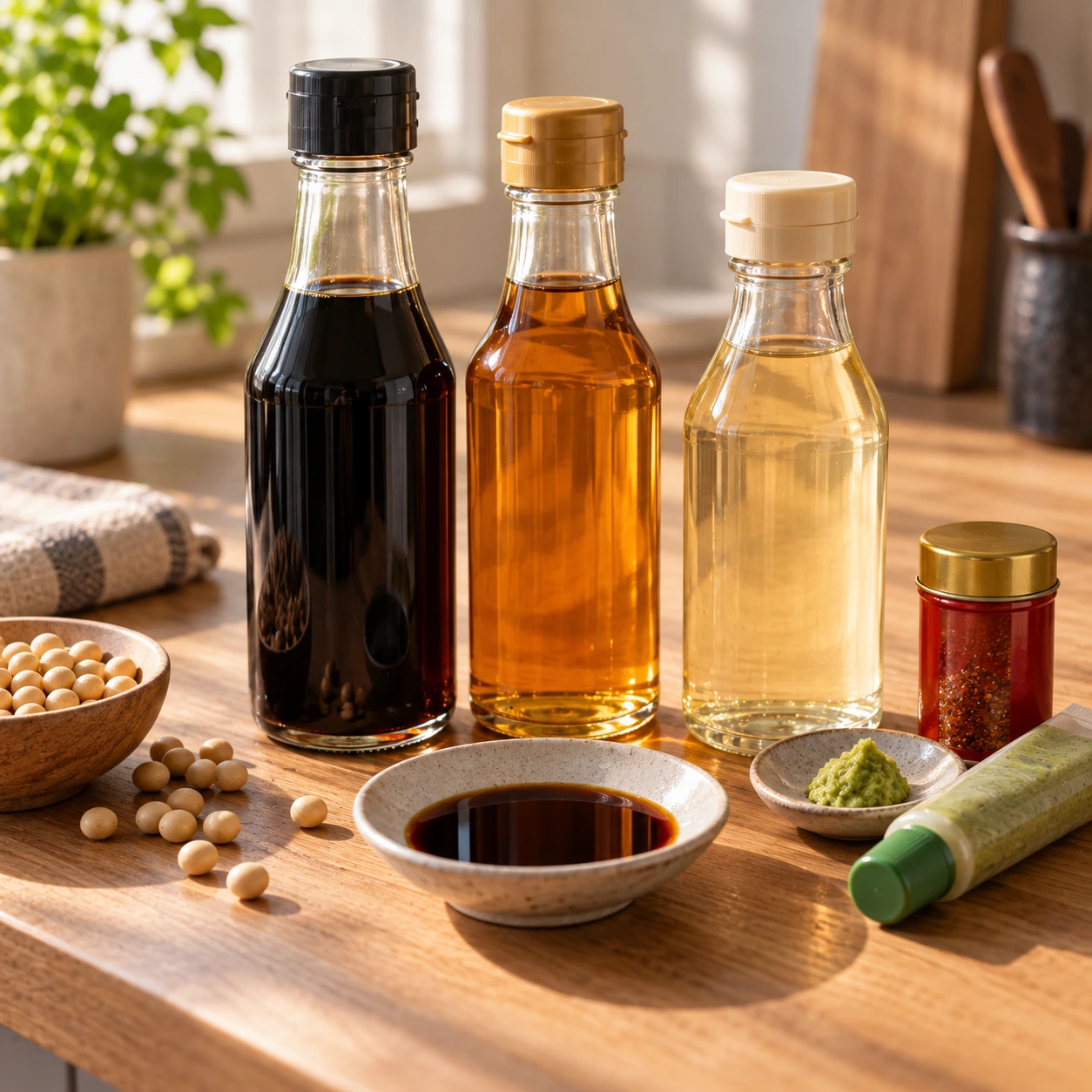
Soy Sauce, Mirin and Rice Vinegar: The Three Bottles Behind Japanese Cooking
The five soy sauce types, what honjozo and marudaizu mean on a label, real mirin versus the imitation, which vinegar to buy, and the sa-shi-su-se-so order that Japanese cooks season in.
Most of the savoury depth in Japanese food comes from three bottles: soy sauce, mirin and rice vinegar. Add dashi and you can make the majority of home dishes with nothing else.
The bottles are cheap and look interchangeable, which is why so many kitchens end up with the wrong one. A mirin-style seasoning is not mirin, and a sushi vinegar poured into a stir-fry will make it sweet.
This guide sorts the shelf, then explains the order Japanese cooks add these things in, which matters more than most recipes admit.
The five soy sauces
Japanese law recognises five types of 醤油 (shōyu). They differ in the wheat-to-soybean ratio, the brewing time and, in two cases, a second fermentation.
| Japanese | Reading | Character | Use |
|---|---|---|---|
| 濃口 | koikuchi | Standard dark soy; about half wheat, half soybean; roughly 16% salt | Everything; over 80% of Japanese production |
| 淡口 | usukuchi | Pale colour, saltier at 18–19%, lighter aroma | Kansai-style simmered dishes and clear soups where colour matters |
| 溜まり | tamari | Almost all soybean, thick, deep, little wheat | Sashimi, glazes, teriyaki gloss; the usual gluten-free choice |
| 再仕込み | saishikomi | Brewed twice, using soy sauce instead of brine | Sashimi and sushi; too rich for cooking |
| 白 | shiro | Mostly wheat, amber-pale, sweet | Chawanmushi, pickles, dishes that must stay pale |
Usukuchi is lighter in colour, not in salt. The extra salt stops the fermentation early, which keeps the colour pale; use about a fifth less than a recipe written for koikuchi.
Reading the label
Two words on the front tell you most of what you need.
本醸造 (honjōzō) means the sauce was made by full fermentation of soybeans and wheat with koji mould and brine, usually over six months to a year. The alternative, 混合 (kongō, blended), cuts brewed sauce with hydrolysed protein and tastes flat by comparison.
丸大豆 (marudaizu) means whole soybeans rather than the defatted soybean meal most industrial soy sauce is brewed from. The oil left in whole beans gives a rounder, softer sauce with a gentler aroma.
The reference whole-soybean koikuchi: mild and rounded, with the soft mouthfeel that marudaizu brewing produces, and the one to buy if you are replacing a generic bottle.
Organic whole soybeans and sun-dried salt, brewed slowly: a table bottle for using raw, on tofu or sashimi, where the aroma is the point.
Also useful: 減塩 (gen'en, reduced salt) cuts the salt to around 8–9%; 生 (nama) means unpasteurised, and needs refrigerating from the start.
Mirin, and the two things sold next to it
Real mirin, 本みりん (hon-mirin), is a sweet rice wine: glutinous rice and rice koji fermented in shōchū, then aged. It is around 14% alcohol and 40–50% sugar, and it does three things in a pan: sweetens without cloying, gives simmered food a gloss, and tightens the surface of fish and meat so they hold their shape.
A hon-mirin with a lineage back to 1766, made from glutinous rice, rice and rice koji only: the standard for teriyaki, nimono and anything that should shine.
みりん風調味料 (mirin-fū chōmiryō, mirin-style seasoning) is glucose syrup, flavourings and under 1% alcohol. It sweetens but does none of the rest. 料理酒 (ryōrishu, cooking sake) is sake with salt added so it can be sold without a liquor licence; it adds umami and cuts fishy smells. Use dry drinking sake instead if you have it.
Vinegar: rice, grain, sushi-su, black
- 米酢 (komezu, rice vinegar) is brewed from rice and is soft, around 4.5% acidity, with a faint sweetness. The default for dressings and pickles.
- 穀物酢 (kokumotsu-su, grain vinegar) is brewed from a blend of grains, sharper and cleaner, and the everyday bottle in most Japanese kitchens.
- すし酢 (sushi-su) is rice vinegar already mixed with sugar and salt. Convenient for sushi rice; keep it away from anything else.
- 黒酢 (kurozu, black vinegar) is aged brown-rice vinegar, mellow and malty, drunk diluted as a health tonic and used in Chinese-style dishes.
A textbook grain vinegar, blended from wheat, sake lees, rice and corn: the all-purpose acid for sunomono, pickling liquid and cutting the richness of fried food.
Sa-shi-su-se-so: the order matters
Japanese cooks season simmered dishes in a fixed sequence, remembered by the first syllables:
- さ (sa) sugar, 砂糖 (satō), and by extension mirin and sake. Large molecules penetrate slowly, so they go in first.
- し (shi) salt, 塩 (shio). Salt tightens the surface of ingredients; added before sugar it blocks sweetness getting in.
- す (su) vinegar. Its acidity mellows with heat, so it goes in after the structure is set.
- せ (se) soy sauce, from the old spelling せうゆ. Its aroma is volatile; add it late so it survives.
- そ (so) miso. Most fragile of all; last, and never boiled.
Sugar first, soy sauce late. Get that right and a nimono tastes like a Japanese one rather than a sweet stew.
The spice cabinet
Japanese cooking uses few spices, but two sit on every table.
Wasabi in a tube is mostly horseradish; this one is over half 本わさび (hon-wasabi, true Japanese wasabi), which gives it the colour and grassy aroma of the fresh rhizome rather than pure heat.
七味唐辛子 (shichimi tōgarashi, seven-flavour chilli) blends chilli with sansho, sesame, nori, hemp seed, ginger and yuzu peel; Yawataya Isogoro of Nagano has made it since 1736, and the tin is the one to keep by the noodle bowl.
Storage
- Soy sauce oxidises. From the moment the bottle is opened it darkens, loses aroma and picks up a flat, sherry-like note. Refrigerate after opening and finish within a month or two.
- Squeeze bottles with a one-way valve stop air reaching the sauce and keep it fresh at room temperature for months.
The "freshness bottle" format: whole-soybean koikuchi in a double-walled pouch bottle that holds the sauce fresh for 120 days after opening without refrigeration.
- Hon-mirin keeps at room temperature; refrigerating crystallises the sugar. Mirin-style seasoning needs the fridge.
- Vinegar is stable at room temperature almost indefinitely. Cloudiness is harmless.
- Wasabi paste loses its heat fast once opened; keep it cold and use within a few weeks.
Frequently asked questions
Is Japanese soy sauce gluten-free? No; koikuchi is roughly half wheat. Tamari is the near-exception, but check the label, as some tamari contains a little wheat.
Can I use Chinese soy sauce instead? It is saltier and less aromatic. It works in a marinade; it will not taste Japanese in a broth.
Why does my teriyaki not shine? No real mirin. The sugar and alcohol in hon-mirin reduce to a glaze that mirin-style seasoning cannot match.
Do I need both rice and grain vinegar? No. Rice vinegar is the gentler choice for dressings; grain vinegar does everything else. Pick one.
With these three bottles settled, the table sauces in the sauces guide make more sense, since almost all of them are soy sauce, mirin and vinegar in different proportions, and dashi is the liquid they go into.