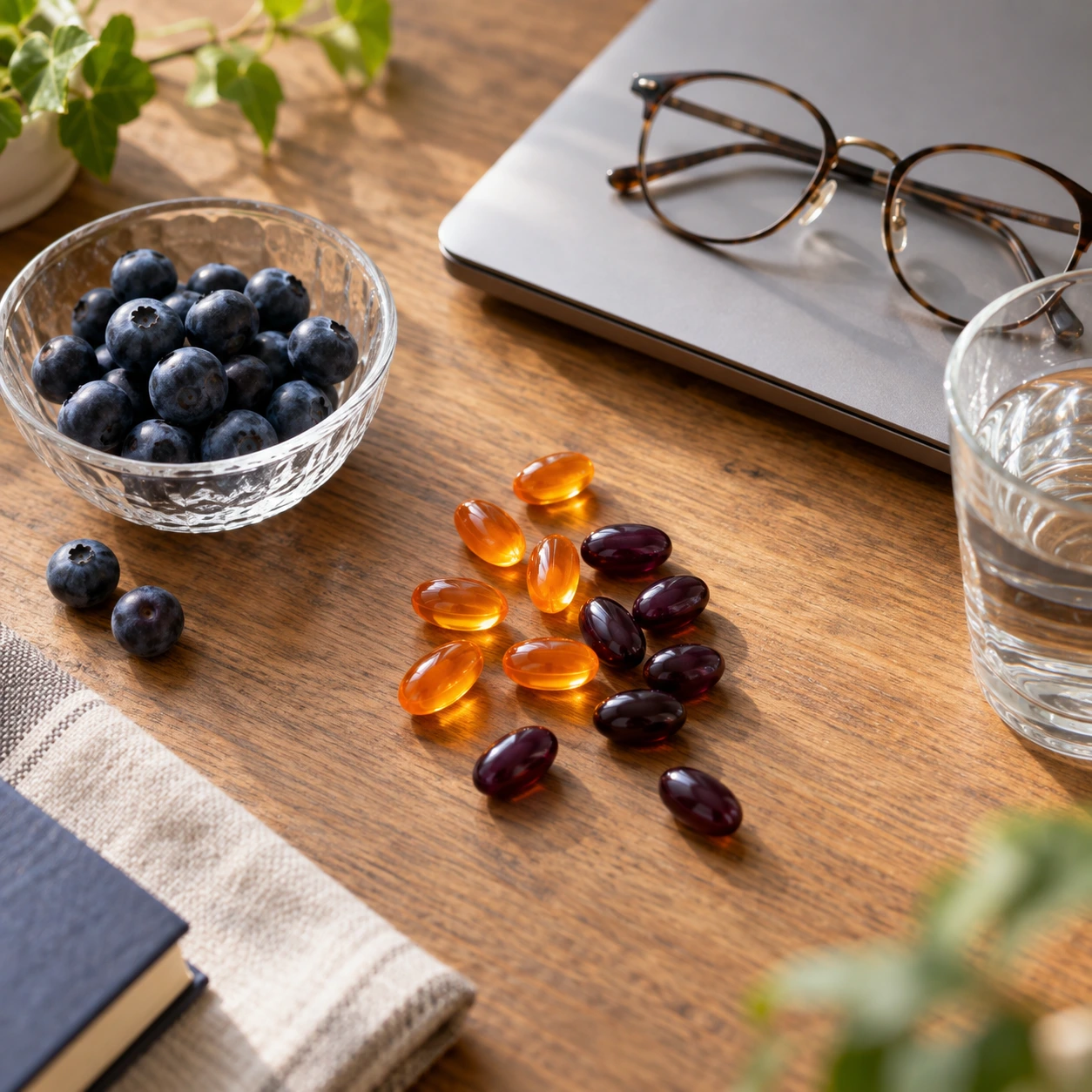
Lutein, Bilberry and Astaxanthin: A Guide to Japanese Eye Supplements
What AREDS2 actually showed for lutein and zeaxanthin, why Japan loves bilberry despite thin evidence, and how to tell screen strain from a macular problem.
Japan has one of the largest eye-supplement markets anywhere, and the shelf splits neatly into two traditions. The older one is bilberry, ブルーベリー (burūberī), which has been marketed for tired eyes since the 1990s. The newer one is lutein, which arrived with a genuine clinical trial behind it and has taken over the top of the category.
They address different problems, and buying the wrong one is the commonest mistake. Here is what the evidence supports, what the Japanese claims actually say, and how to take these ingredients so they absorb.
The ingredients
| Japanese | Reading | Ingredient | Source |
|---|---|---|---|
| ルテイン | rutein | Lutein | Marigold petals |
| ゼアキサンチン | zeakisanchin | Zeaxanthin | Marigold petals |
| アントシアニン | antoshianin | Anthocyanins | Nordic wild bilberry |
| アスタキサンチン | asutakisanchin | Astaxanthin | Haematococcus algae |
| DHA | dī-eichi-ē | Docosahexaenoic acid | Fish oil |
Lutein and zeaxanthin are carotenoids that concentrate in the macula, the central patch of the retina, forming a yellow pigment that filters blue light. The others are antioxidants with more indirect stories.
What AREDS2 found for lutein
The evidence for lutein comes largely from AREDS2, a large American trial that gave 10 mg of lutein and 2 mg of zeaxanthin daily to people who already had intermediate age-related macular degeneration. Over five years the combination reduced progression to advanced disease by roughly a quarter, and it safely replaced the beta-carotene that had been linked to lung cancer in smokers.
What AREDS2 did not show is that lutein prevents macular degeneration in healthy eyes, or does anything for cataract. For everyone without a diagnosis, the more modest, better-supported effect is that daily lutein raises macular pigment density over three to six months, which improved glare recovery and contrast sensitivity in small trials.
Dear-Natura Gold pairs lutein with zeaxanthin in the AREDS2 pattern, and its notified claim is written around macular pigment and colour contrast, the closest Japanese equivalent to the trial formula.
DHC's version gives 16 mg of marigold lutein in a single soft capsule, one a day, which is the simplest way to reach a trial-level dose without a multi-tablet routine.
What the Japanese claims say
Most lutein products carry the 機能性表示食品 (kinōsei hyōji shokuhin, foods with function claims) mark, explained in our joint supplements guide. The wording is near-identical across brands because it comes from the same papers: lutein "increases macular pigment density", "protects the eyes from light stimulation such as blue light" and "supports contrast sensitivity". Nothing on any box claims to prevent or treat disease; if a reseller listing says otherwise, that is the reseller talking.
Menotakara is a plain 20 mg lutein capsule with no other actives, useful if you already take a multivitamin and only want to add the carotenoid.
Bilberry: tradition ahead of evidence
Bilberry supplements are a Japanese institution, sold on the story of wartime pilots eating jam to see at night. The story is unverified and the science that followed is thin: a systematic review found no convincing effect on night vision, and the Japanese trials on eye fatigue are small and short. Bilberry is harmless at supplement doses, but treat it as a traditional ingredient rather than a proven one.
Morinaga's blend is the sensible compromise: Nordic bilberry for tradition, marigold lutein for the evidence, and vitamin A, which genuinely is needed for night vision.
DHC's fast-dissolving bilberry adds lutein and crocetin, a saffron-derived carotenoid with a few small Japanese trials on focusing fatigue, and is the version heavy screen users tend to buy.
Astaxanthin and DHA
Astaxanthin is the red pigment in salmon and krill, produced commercially from algae. Japanese trials at 6 mg a day reported less eye fatigue and better accommodation, the eye's ability to shift focus, but they are small and mostly maker-funded.
DHA makes up a large share of the retina's fatty acids, which is why it appears in eye products. AREDS2 also tested omega-3 and found it added nothing for macular degeneration, so buy fish oil for its other reasons, covered in our fish oil guide, rather than for the eyes.
Fancl's Enkin combines astaxanthin with lutein and zeaxanthin and is notified for focusing ability and eye fatigue, aimed at the over-forties who find small print drifting away.
Screen strain is not a macular problem
Two different complaints send people to this shelf, and they need different answers.
- Screen strain is tired, dry, gritty eyes after hours of close work, a problem of focusing muscles and reduced blinking, not of the retina. The fixes are looking 6 m away for 20 seconds every 20 minutes, a larger font, and lubricating drops. Supplements play a minor role at best.
- Macular concern is about age, family history and smoking. Distortion of straight lines or a grey patch in central vision needs an ophthalmologist, not a capsule.
For the first problem, Lion's Smile 40 EX drops are the drugstore standard, cooling and preservative-free, and they do more for a long day at a screen than any supplement.
How to take them
- Take carotenoids with a meal that contains fat. Lutein, zeaxanthin and astaxanthin are fat-soluble and absorb poorly on an empty stomach or with a black coffee.
- Take them daily at the same meal. Macular pigment builds slowly; expect three months before any measurable change.
- Do not stack products. Two lutein supplements plus a multivitamin can push you past 40 mg a day, which is safe but pointless.
Check with a doctor if
- You have been diagnosed with macular degeneration. The AREDS2 formula is a specific regimen; your ophthalmologist should choose it.
- You smoke. Lutein is fine, but avoid any product with beta-carotene.
- You are pregnant or breastfeeding, or buying for a child. Vitamin A content in bilberry blends adds up.
- Vision has changed suddenly, or you see flashes, floaters or a curtain. That is urgent and nothing here applies.
None of this is medical advice.
Frequently asked questions
Lutein or bilberry for computer work? Lutein, if either. It has the better evidence for contrast and glare, and screen fatigue responds more to habits and drops than to any supplement.
How much lutein is enough? 10 mg a day matches the trial. Japanese products run 10–20 mg; more has not been shown to help.
Is astaxanthin worth adding? Only if eye fatigue is the complaint; its trials are small and short. Lutein remains the priority.
Can I get this from food? Yes. A daily portion of cooked spinach or kale supplies around 10 mg of lutein, which is why the supplement matters most for people who do not eat greens.
Take a 10–20 mg lutein capsule with breakfast, fix the screen habits, and give it a season. If you are building a wider daily regime, our supplement routine guide covers how to fit it in.