Aojiru Explained: Barley Grass, Kale and Ashitaba, and How to Actually Drink It
What Japanese green juice is, how the three base greens taste, powder versus frozen, how to mix it so it is pleasant, and what it does and does not replace.
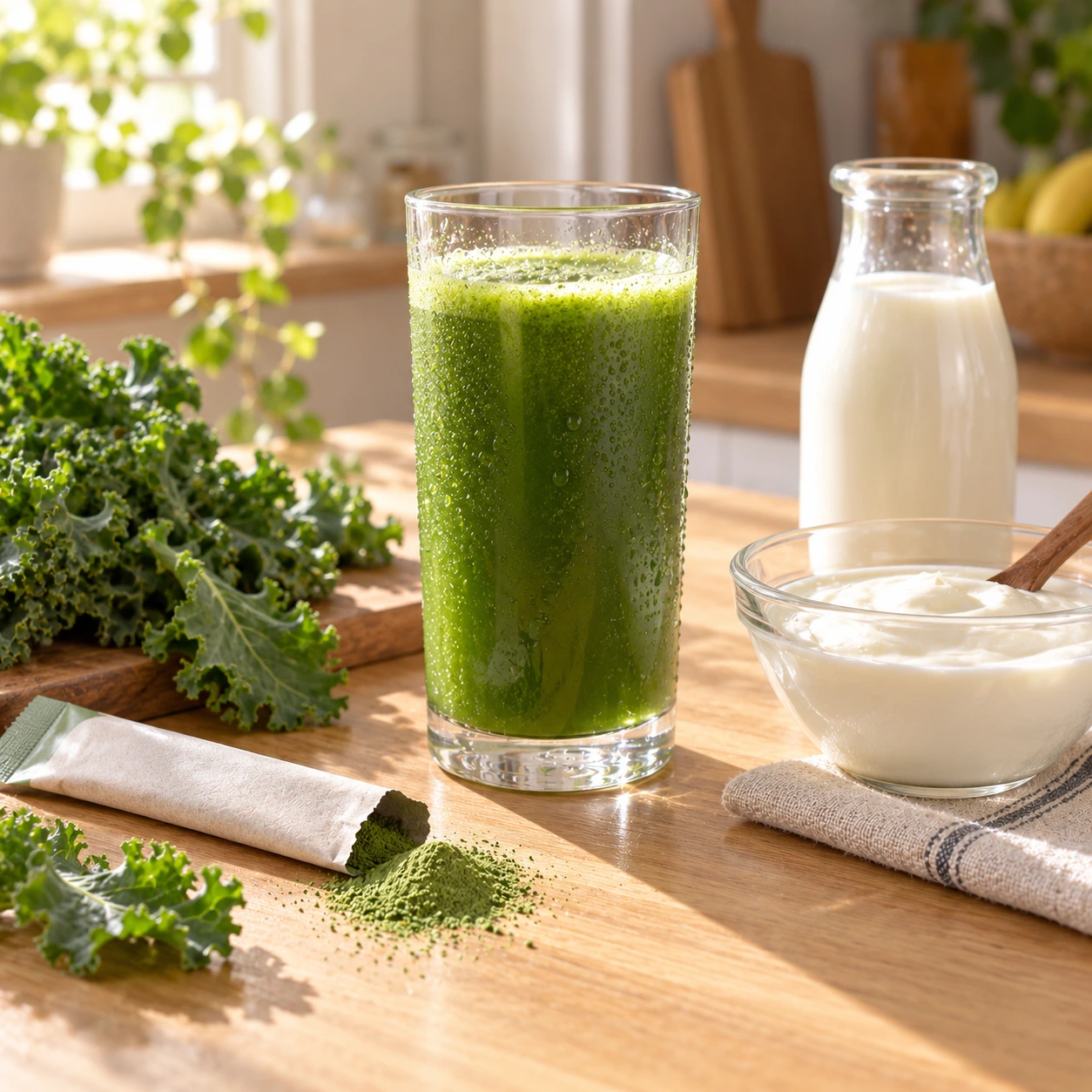
Aojiru, 青汁 (literally "green juice"), is the drink most Japanese households keep in the cupboard and rarely admit to enjoying. It is dried, powdered green leaf, usually barley grass, kale or ashitaba, sold in single-serve sticks that dissolve in water. One stick, one glass, once a day.
It is not a smoothie, not a detox, and not a replacement for vegetables. What it is, done well, is a cheap, shelf-stable way to add a serving of dark leafy greens to a diet that lacks them, and the modern products taste far better than the reputation suggests.
The three greens
Almost every aojiru is built on one of three leaves, and the leaf decides the taste.
| Japanese | Reading | Plant | Taste |
|---|---|---|---|
| 大麦若葉 | ōmugi wakaba | Young barley grass | Mild, faintly sweet, like weak green tea |
| ケール | kēru | Kale | Grassy, bitter, the original harsh aojiru |
| 明日葉 | ashitaba | Angelica keiskei | Herbal, slightly celery-like, a little bitter |
If you have never drunk aojiru, start with barley grass. It is the gentlest and it is what most Japanese products now use as the base. Kale is the traditional choice and the most nutrient-dense per gram, but it is the one that earned the drink its bad name. Ashitaba, "tomorrow's leaf", is a coastal herb from the Izu islands and Kagoshima named for how fast it regrows, and its yellow stem-sap polyphenols, chalcones, are why it appears in supplements as well as juice.
Yakult's barley grass aojiru is grown without pesticides on the Kunisaki peninsula in Oita and squeezed from fresh leaf rather than milled from dried, which gives it the clean, tea-like taste that converts sceptics.
Shionogi's granules are 100% Kagoshima ashitaba and the reference point for the herbal, chalcone-forward style.
The "mazui, mou ippai" moment
In 1990 the kale-juice maker Q'SAI ran a television advert in which the actor Yana Nobuo drank a glass, grimaced, and said まずい、もう一杯 (mazui, mō ippai): "disgusting, another glass". It became one of the most famous lines in Japanese advertising and fixed aojiru in the public mind as medicine you endure. The industry has spent thirty years making the drink pleasant to escape it.
Q'SAI's own modern kale stick shows how far that has gone: domestic kale softened with matcha, plus collagen and hyaluronic acid for the beauty-supplement market.
Powder, frozen or jelly
- Powder sticks are the default: 3–5 g of dried leaf per sachet, stable for a year or more, no fridge. Look for 粉末 (funmatsu, powder) or 顆粒 (karyū, granules).
- Frozen packs are fresh-squeezed juice flash-frozen in 90 ml pouches. Better flavour and no processing beyond pressing, but they need freezer space and thaw in a glass of water for 10 minutes.
- Jelly sticks are aojiru set with agar for people who dislike drinking it. Sweeter, and usually the most sugar of the three.
Shionogi's frozen ashitaba straight pack is the purist's version, pressed leaf and nothing else, and the one to try to learn what the plant actually tastes like.
How to mix it
- Put the powder in the glass first, then add 100–150 ml of cold liquid. Powder on top of water clumps.
- Stir hard for ten seconds, or shake in a bottle. Barley grass dissolves cleanly; kale leaves a little sediment, which is normal.
- Drink within a few minutes. The colour dulls and the taste turns grassy as it sits.
Water is the standard. Milk or soy milk rounds off bitterness and is how most Japanese children get it. A stick stirred into 100 g of plain yoghurt makes a green breakfast, in a banana smoothie the powder disappears entirely, and a stick in hot, not boiling, water is a passable winter green tea.
Yakult's citrus version with Sicilian lemon and kabosu is built for water and supplies a day's iron and folic acid per cup, the kind of specific claim worth checking against the label.
The strawberry children's version adds calcium, vitamin C and iron and is designed to be mixed with milk, which tells you that the base flavour has been reduced to almost nothing.
What it does and does not replace
A stick of aojiru is roughly one small serving of cooked greens by weight of leaf: a useful contribution of vitamin K, folate, beta-carotene and a couple of grams of fibre. It does not replace the volume, water, or variety of eating vegetables, and Japan's health ministry target of 350 g of vegetables a day is not met by three sticks. Think of it as insurance for the days you eat badly, not as the plan.
The "enzyme" and "lactic acid bacteria" claims on some boxes are thinly supported; the greens are the point.
Suntory's blend of barley grass and ashitaba with Uji matcha and sencha is the version that tastes most like a good Japanese green tea, and its quercetin glycoside is a notified functional ingredient rather than a flavour.
Reading the label
- 砂糖不使用 (satō fushiyō) means no added sugar. Fruit-flavoured and children's versions often contain 1–3 g per stick; check the 炭水化物 (carbohydrate) line.
- 香料 (kōryō) is flavouring, 甘味料 (kanmiryō) sweetener. Plain barley grass sticks need neither.
- 国産 (kokusan) is domestic leaf; many name the prefecture.
- A short ingredient list is the whole test. The best products list one or two plants and nothing else.
Ito En's sugar-free stick lists seven Japanese plant ingredients with no flavourings, preservatives or colours, and is what a clean label looks like.
Vitamin K and who should check with a doctor
Dark greens are rich in vitamin K, and aojiru concentrates it. One stick can supply well over the daily requirement. That is fine for most people, but vitamin K directly counteracts warfarin, and starting or stopping a daily green juice can move an INR reading. If you take warfarin, talk to your doctor before starting and then keep the dose constant rather than skipping days. Kale-based products are also high in potassium, which matters for people with kidney disease. Pregnant women and children can drink standard aojiru, but skip the versions with added herbs or functional ingredients unless a doctor has looked at them. None of this is medical advice.
Frequently asked questions
Does it taste as bad as the advert? Modern barley grass sticks taste like mild green tea. Kale still tastes like kale.
Is it the same as wheatgrass? Close. Barley grass is the young leaf of the barley plant, wheatgrass of wheat. Aojiru is dried and powdered rather than juiced fresh, which makes it far easier to keep.
When should I drink it? Any time; with breakfast is easiest to keep up. Avoid taking it alongside iron tablets, as the fibre and polyphenols can blunt absorption.
Is it gluten-free? Barley grass is harvested before the grain forms and is generally free of gluten, but coeliacs should look for products tested and labelled as such.
Buy a box of plain barley grass sticks, mix one into milk or yoghurt at breakfast, and see whether it becomes a habit. If it does, our supplement routine guide covers what else is worth adding to a morning.