DHC Supplements: The Complete Beginner's Guide to Japan's Favorite Vitamin Brand (2026)
Why every Japanese convenience store carries those little foil pouches — and how to build a sensible daily stack from DHC's enormous lineup without guessing.
Walk into any convenience store, drugstore, or supermarket in Japan and you will find the same rack: rows of slim foil pouches, each labeled with a number of days, hanging in tidy columns. That rack is DHC — and those pouches are how an enormous share of Japan does its daily vitamins.
For overseas shoppers, DHC is a strange discovery. The brand is everywhere in Japan, the pouches cost less than a coffee shop visit, and the lineup runs past a hundred products with names like "Heme Iron 30 Days" and "Sustained-Release Vitamin B Mix." Which raises the obvious questions: what actually is DHC, why does Japan trust it so completely, and where should a first-timer start? This guide answers all three, using the products we ship directly from Tokyo.
From translation office to vitamin empire
DHC's origin story is delightfully unglamorous: the initials stand for Daigaku Honyaku Center — "University Translation Center" — the company's first business in 1972. The pivot into cosmetics and then supplements came later, but the translation-office DNA stuck: DHC built its reputation on making things clear, cheap, and consistent rather than exotic.
Today the supplement line is a Japanese default brand the way Kleenex is a default tissue. Three habits explain why:
- Day-count packaging. Nearly every product comes as a "20日分" or "30日分" pouch — 20 or 30 days' worth. No giant tubs, no mental math, no commitment beyond a month.
- Single-purpose products. One pouch, one job. Vitamin C is vitamin C; heme iron is heme iron. You assemble your own stack instead of buying a kitchen-sink formula.
- Everyday pricing. Most pouches cost about as much as a lunch set. Trying something for a month is a trivial decision, which is exactly how supplement habits actually form.
How to read a DHC pouch
Three things on the label matter, and none require Japanese:
- The day count — 「30日分」 means 30 days' supply at the recommended daily amount.
- The daily amount — 「1日2粒目安」 means "2 tablets per day as a guide." Take them with water, ideally with a meal, at whatever time you'll actually remember.
- The format — hard capsules, soft gel capsules (ソフトカプセル), or small tablets. DHC pills run famously small by Western standards; that's deliberate.
One cultural note worth importing along with the pouch: Japanese supplement culture treats these as food — a quiet daily habit supporting an ordinary diet — not as medicine or miracle. That mindset is half of why the habit sticks.
The starter shelf: daily foundations
If you're new to the brand, start where Japan starts — the unglamorous basics.
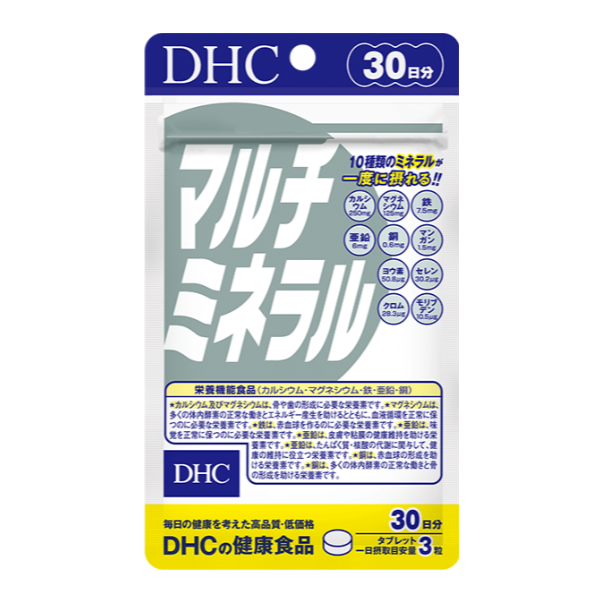
DHC Multi Mineral — ten minerals including iron, zinc, and magnesium in one small daily dose. The single most sensible first pouch.
DHC Vitamin C Hard Capsules, 30 Days — the brand's eternal bestseller. Plain, potent, absurdly economical.
DHC Vitamin D, 30 Days — one tiny tablet a day; a staple for office workers and anyone short on sunshine.
DHC Sustained-Release Vitamin B Mix — the B-complex in a slow-release tablet, a formulation touch that shows the brand's engineering side.
Any two of these make a rational starting stack for under the price of a movie ticket.
Beauty from within: the second shelf
Japan pioneered the idea of the "beauty supplement," and DHC's versions are the accessible entry point. Pair this section with our inner-beauty supplements guide for the full picture.
DHC Collagen, 30 Days — fish-derived collagen peptides in tablet form, the category classic.
DHC Hyaluronic Acid, 30 Days — the moisture molecule taken as a daily capsule; the inner-care sibling of the lotions in our hyaluronic acid guide.
Ceramide Moisture, 30 Days — ceramides, the skin's own barrier lipids, in a small daily dose.
DHC Coenzyme Q10 Inclusion Complex, 30 Days — CoQ10 processed into a cyclodextrin "inclusion complex," DHC's signature take on the classic beauty-support ingredient. The related PQQ + Q10 pouch combines it with PQQ for variety.
Elsys White 240EX — the L-cysteine and vitamin C combination that Japanese shoppers know well.
The lifestyle shelf: iron, oils, and the famous ones
DHC Heme Iron, 30 Days — iron in its heme form with folic acid and B12; a small capsule and one of the brand's most reordered products.
EPA Premium, 30 Days — the fish-oil pouch, soft capsules of omega-3 EPA.
GABA, 30 Days — the amino acid Japan famously puts in everything from chocolate to sparkling water, in a simple daily format.
DHC Maca, 30 Days — concentrated maca extract with cordyceps, guarana, zinc, and selenium.
Fermented Black Sesamin+, 30 Days — fermented black sesame extract with fourteen supporting botanicals; a very Japanese formula you will not find on Western shelves.
Liver Extract + Ornithine — the classic companion for social seasons, pairing liver extract with the amino acid ornithine.
Three sensible starter stacks
The Basics Stack — Multi Mineral + Vitamin C + Vitamin D. The boring, correct answer; about a minute of effort per day.
The Beauty Stack — Collagen + Hyaluronic Acid + CoQ10. The classic Japanese inner-care trio; give it a full pouch cycle before judging.
The Busy-Life Stack — Heme Iron + Sustained-Release B Mix + EPA. Built around long days, commutes, and convenience-store lunches.
Start with one stack, not three. The 30-day pouch format exists precisely so you can audition a routine for a month and adjust — our daily supplement routine guide shows how to make it stick.
Sensible-use notes (read this part)
Japanese supplement culture is conservative by design, and it's worth adopting that too. These are foods, not medicines: they support a normal diet rather than replace it, and they don't treat conditions. Check labels so you don't double up on the same nutrient across pouches; if you are pregnant, nursing, taking medication, or managing a health condition, run your stack past a doctor or pharmacist first. And the day-count on the pouch is a guide, not a challenge — more is not better.
Frequently asked questions
Are DHC supplements safe to buy from overseas? We ship the identical pouches sold in Japanese stores, direct from Tokyo — same lots, same labels, no gray-market repackaging.
Why are the pills so small? Japanese consumers strongly prefer small, easy tablets, and manufacturers oblige. Most DHC daily doses are one to four small pills.
Tablets or the same ingredient as a drink? Japan sells both; tablets win on cost and shelf life, drinks on ritual. Start with pouches.
How long until I notice anything? Think in pouch cycles — one to three months of consistent use — and judge by how your overall routine feels, not by day three.
Which single pouch should I buy to try the brand? Vitamin C or Multi Mineral. Cheap, useful, and representative of everything DHC does well.
The verdict
DHC turned supplements into what they always should have been: a small, cheap, unglamorous daily habit. The pouches are easy to understand, easy to carry, and easy to quit or continue — which is why Japan never quit. Pick one stack from this guide, commit to a 30-day cycle, and you'll know exactly why that rack sits next to every Japanese cash register. The full DHC range in our catalog ships direct from Tokyo, day-count pouches and all.