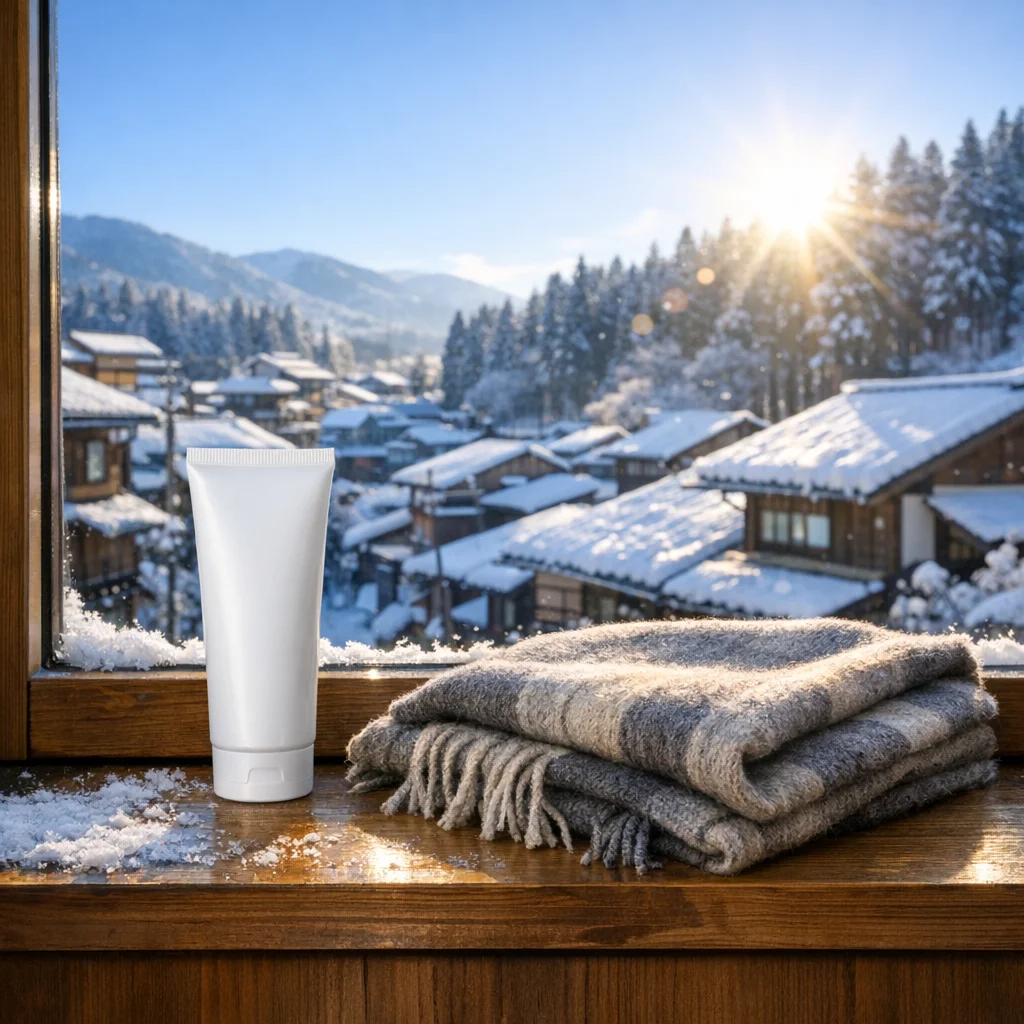
Do You Need Sunscreen in Winter? What Japanese Skincare Says
Do you need sunscreen in winter? Yes: UVA stays steady all year and snow reflects UV back up. How Japan handles winter sun, which formats suit, and reapplying.
Yes, you do need sunscreen in winter. UVA, the longer-wave ultraviolet light that makes up most of the UV reaching the ground, stays at much steadier levels through the year than the burning UVB of summer, passes through cloud and window glass, and is reflected back up by snow. That is why Japanese skincare treats sunscreen as a year-round daily step rather than a summer product.
This guide explains what changes about the sun in winter and what does not, how Japanese sunscreen labels help you choose, which lighter or more moisturising formats suit cold weather, and how to reapply when you are wrapped up or out on the slopes.
Why do you need sunscreen in winter?
Sunlight carries two kinds of ultraviolet that matter for skin:
- UVB is the shorter wavelength that causes sunburn. It is strongest around midday in summer and drops sharply in winter, especially at higher latitudes.
- UVA is the longer wavelength. It makes up around 95% of the UV that reaches the Earth's surface, reaches deeper into the skin, and varies far less between seasons.
The winter sun feels weak because UVB, and the warmth that comes with a high summer sun, falls away. UVA does not fall nearly as much. You are unlikely to burn on a grey January commute, but your skin is still receiving UV.
UVA also passes through window glass, which blocks most UVB. Long hours by a sunny window, or driving, add up.
What about cloudy days?
Clouds reduce UV, but less than most people assume. Thin or broken cloud lets a large share through, and on some days scattering around the edges of clouds can even raise UV levels briefly. Heavy, dark cloud blocks more. In practice, a cloudy winter day is not a reason to skip sunscreen, only a reason to choose a lighter, more comfortable one.
Snow, altitude and the ski trip
Snow changes everything. According to the World Health Organization, fresh snow can reflect up to 80% of UV radiation, which means UV reaches your face from below as well as above. UV levels also rise as you climb, so a sunny day on a mountain brings much more exposure than the same day in a city.
That combination is why skiers and snowboarders burn on cold, bright days. For a day on the snow:
- Use a high-protection, water-resistant sunscreen. SPF50+ and PA++++ are the top ratings on a Japanese label.
- Cover the places reflection reaches. Under the chin, the nostrils, the ears and the underside of the jaw catch light bouncing off snow.
- Reapply every couple of hours, and again after wiping your face, sweating heavily or falling.
- Protect your lips with an SPF lip balm, and your eyes with goggles or sunglasses.
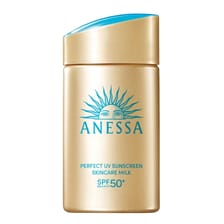
ANESSA
Anessa Perfect UV Skincare Milk NA 60mL
The ultimate UV milk with SPF50+ PA++++ that flawlessly protects against UV rays. Formulated with skincare ingredients, it moisturizes while protecting the skin from UV rays. With a sweat- and water-resistant waterproof formula, it can also be used as a makeup primer for the face and body.
From 35 USD
How does Japanese skincare handle winter sun?
In Japan, 日焼け止め (hiyakedome), sunscreen, is part of the morning routine all year. Drugstore shelves shrink a little in winter, but they never disappear. The habit is built into products too: many Japanese day creams, milks and makeup bases carry an SPF and PA rating, so the last morning skincare step is often also the sun protection.
Our guide to why Japanese sunscreen is different covers the textures and the culture in detail. For winter, two parts of the label are worth understanding:
| Label | What it measures | Range |
|---|---|---|
| SPF | Protection against UVB, the burning rays | Up to SPF50+ |
| PA | Protection against UVA, using the Japanese grading system | PA+ to PA++++ |
Because UVA is the year-round concern, the PA rating matters more in winter than many people realise. A sunscreen with a high SPF but a low PA protects you well from summer burn but less from steady winter UVA.
Which sunscreen formats suit winter?
Winter skin is usually drier, and the gel-water formulas that feel perfect in August can feel tight in January. Japanese ranges offer plenty of alternatives. Our comparison of Japanese sunscreen formats goes through them all; the winter-friendly ones are:
- Moisturising essences. Creamier than watery gels, but still light. Skin Aqua Super Moisture UV Essence is a common winter switch.
- Milks. Fluid emulsions that spread easily and feel comfortable on dry skin.
- Sensitive-skin UV lotions. Fragrance-free, alcohol-free formulas from ranges such as Curél suit skin that gets irritated by cold wind and central heating.
- Day milks with SPF. One step that moisturises and protects, useful on short winter days.
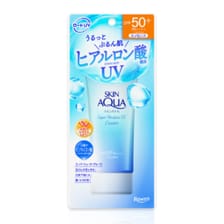
Skin Aqua
Skin Aqua Super Moisture UV Essence 80g
Skin Aqua sunscreen essence for face and body. Formulated with 3 types of hyaluronic acid (moisturizing ingredients), it protects the skin from dryness and retains moisture. Easily removed with soap, it is recommended for daily UV protection and as a makeup base.
From 16 USD
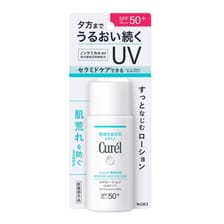
Curél
Curel Intensive Moisture Care UV Lotion 60ml
A UV lotion with SPF50+ PA+++ that protects the skin from UV rays and dryness. Formulated with moisturizing ingredients such as ceramide functioning ingredient, eucalyptus extract, and asunaro extract, it keeps the skin hydrated until evening. It blends smoothly without feeling heavy and can also be used as a makeup base.
From 25 USD
If your skin is very dry, apply moisturiser first, give it a minute or two to settle, then apply sunscreen as the final step. Our Japanese winter skincare routine explains the full layering.
What SPF do you need in winter?
It depends on what your day involves:
| Winter day | Sensible choice |
|---|---|
| Mostly indoors, near windows | A daily SPF30 or higher with a good PA rating |
| Short commute, grey sky | A daily SPF30–50 milk, essence or day cream |
| Long walk on a bright day | SPF50+ PA++++, reapplied |
| Skiing, snowboarding, mountains | SPF50+ PA++++, water-resistant, reapplied often |
Whatever the number, apply enough. SPF is tested at 2 milligrams per square centimetre of skin, and a common guide for the face and neck is two finger-lengths of product. Most people use far less.
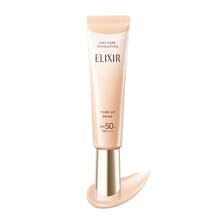
A day milk is the easiest way to make that amount feel comfortable in winter. Shiseido's Elixir Day Care Revolution, for example, is a morning milk that moisturises, adds a soft tone-up tint and carries an SPF50+ PA++++ rating, so it replaces two steps.
Elixir
ELIXIR Day Care Revolution Tone Up Pure Beige 35g
A daytime emulsion that serves as an emulsion, makeup base, and UV protector, simply applied at the end of your morning skincare routine. The Pure Beige color naturally enhances skin tone, providing moisture and a radiant finish. Protects the skin from UV rays with SPF50+ PA++++.
From 46 USD
How do you reapply sunscreen in winter?
Reapplying is awkward under a hat and scarf, and impossible to remember in the dark by 5 pm. A few habits help:
- Reapply when you go out, not on a fixed schedule, if you spend most of the day indoors.
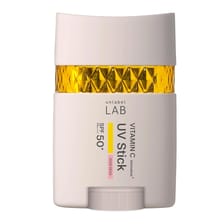
- Use a stick or a cushion for top-ups over makeup. Our guide on how to reapply sunscreen over makeup has the techniques.
- Reapply after scarves and masks. Wool and face masks rub sunscreen off the chin and cheeks.
- Keep one in your coat pocket. Small tubes and sticks travel well.
unlabel lab
unlabel LAB V Smooth UV Stick R 20g
A direct-application UV stick formulated with a Vitamin C derivative. Featuring SPF50+ PA++++, it provides a rose-beige tint that naturally evens out the skin tone. Its curved shape allows for quick, mess-free application, while sebum-absorbing ingredients maintain a smooth, non-sticky feel.
From 21 USD
Don't forget your hands and lips
Winter routines tend to stop at the jawline, but two areas get steady exposure all season:
- The backs of your hands. They are uncovered on the steering wheel, on a phone and on every walk without gloves. A sunscreen or an SPF hand cream after your morning routine covers them.
- Your lips. Cold wind and low humidity dry them out, and on bright days, especially on snow, they catch reflected light from below. An SPF lip balm handles both at once.
The neck and ears are also easy to miss when you are pulling on a scarf, so take the last of the sunscreen on your fingers down to them.
Frequently asked questions
Do you really need sunscreen in winter? Yes. UVA levels stay much steadier through the year than UVB, and UVA passes through cloud and window glass. A light daily sunscreen is enough for most winter days.
Do you need sunscreen on a cloudy day? Yes. Clouds reduce UV, but thin or broken cloud lets much of it through.
Do you need sunscreen indoors? If you sit near a window for long periods, it is worth wearing some, because UVA passes through ordinary glass.
What sunscreen should I use for skiing? A high-protection, water-resistant formula rated SPF50+ and PA++++, reapplied every couple of hours. Snow reflects UV back onto the face.
Is a moisturiser with SPF enough in winter? On a short, mostly indoor day, a moisturiser or day milk with a good SPF and PA rating is a reasonable choice, as long as you apply a generous amount.
Can dry or sensitive skin wear sunscreen every day in winter? Usually, yes, with a moisturising or sensitive-skin formula. If your skin reacts, try a different format and patch test first; for persistent skin problems, check with a doctor or pharmacist.
Find winter-friendly milks, essences and sticks on our sunscreen and UV care shelf.