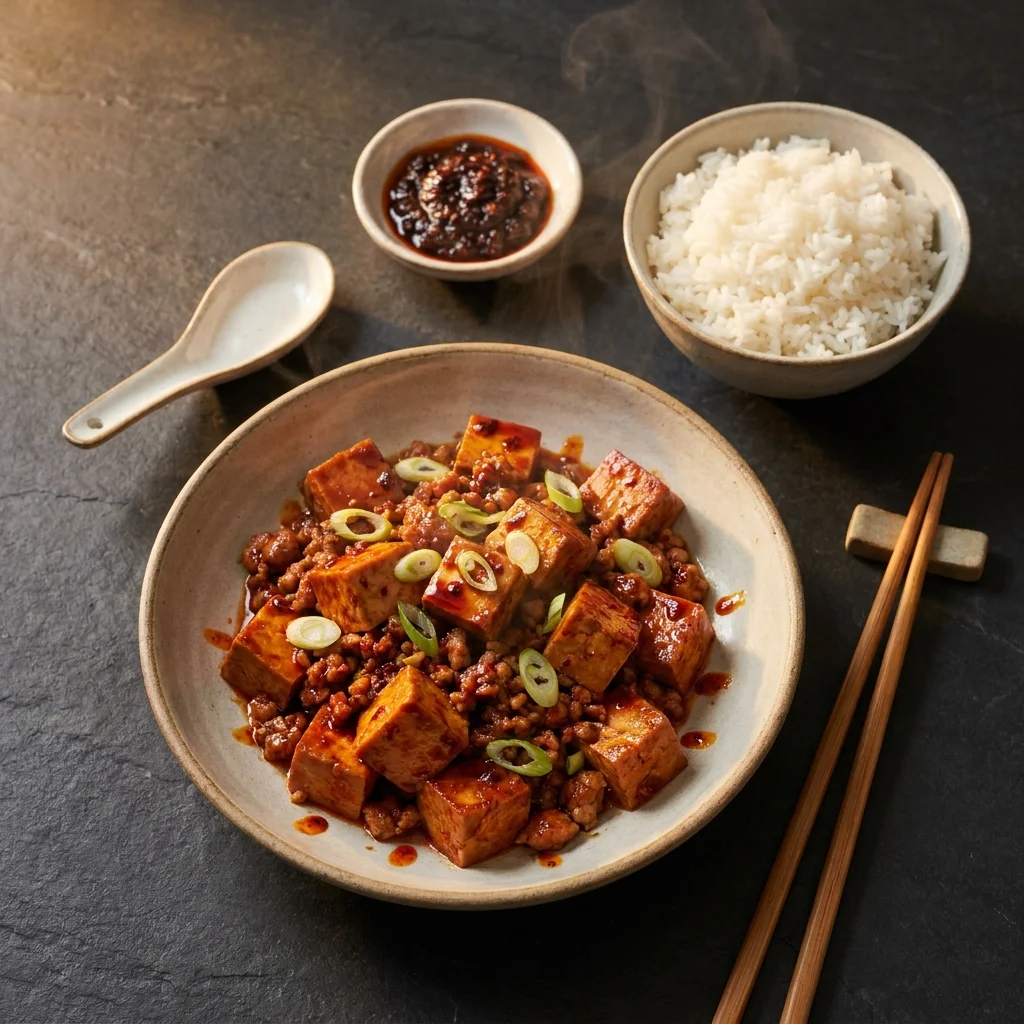
Japanese Mapo Tofu and the Chūka Classics to Cook Tonight
Japanese mapo tofu is milder, glossier and faster than the Sichuan original. A guide to chūka cooking at home: the pantry, the dishes and a 15-minute recipe.
Some of Japan's most-cooked weeknight dinners did not start in Japan. Gyōza, fried rice and mapo tofu all came from China, changed on arrival, and settled into Japanese home cooking as a category of their own: chūka.
Japanese mapo tofu is the best example. It is milder, glossier and quicker than the numbing Sichuan original, and it is on the table in a great many Japanese households every week. This guide covers what chūka is, the short pantry list that makes it work, a 15-minute mapo tofu, and four more dishes worth cooking.
What is chūka cooking?
Chūka ryōri (中華料理) means Chinese cuisine, but in practice it describes Chinese food as cooked and eaten in Japan. It is its own tradition, sweeter and milder than most regional Chinese cooking, fond of eggs and thick glossy sauces, and served with plain rice.
Ramen came into Japan by the same route; for decades it was sold as chūka soba. Today chūka sits alongside Japanese and Western cooking as one of the three styles that most Japanese home cooks move between without thinking.
How mapo tofu came to Japan
Mapo tofu is a Sichuan dish of tofu and minced meat in a fiery, numbing sauce. Its Japanese version owes a great deal to Chen Kenmin, a Sichuan-born chef who popularised Sichuan cooking in Japan from the 1950s and 1960s. He adjusted the heat and numbing spice for Japanese palates, and his restaurants and teaching made dishes like mapo tofu and ebi chili (prawns in chilli sauce) household names.
Boxed sauce kits did the rest. Once mapo tofu could be made with a sachet, a block of tofu and some mince, it became an everyday dinner.
The chūka pantry
You need fewer bottles than you might think.
| Ingredient | Japanese name | What it does |
|---|---|---|
| Chilli bean paste | Tōbanjan (豆板醤) | Heat and fermented depth; the base of mapo tofu |
| Sweet bean sauce | Tenmenjan (甜麺醤) | Rounds the heat with sweetness and colour |
| Concentrated chūka seasoning | Chūka dashi | Instant savoury stock for soups, stir-fries, fried rice |
| Toasted sesame oil | Goma abura (ごま油) | Finishing aroma |
| Chilli oil | Rāyu (ラー油) | Heat at the table, essential for gyōza |
| Potato starch | Katakuriko (片栗粉) | Gives sauces their glossy, clinging texture |
Doubanjiang is the one that matters most. It is fermented broad bean and chilli paste, salty and deep, and its flavour develops in hot oil rather than water.
The concentrated seasoning paste is the shortcut behind good fried rice and quick soups: a teaspoon dissolved in hot water gives a convincing stock.
More bottles and how they compare are in our Japanese pantry starter kit.
A 15-minute Japanese mapo tofu (serves 2–3)
Ingredients
- 1 block tofu, 300–400 g (firm for beginners, silken for a softer result)
- 150 g minced pork
- 1 tbsp neutral oil
- 1 tsp each grated garlic and ginger
- 1–2 tsp doubanjiang, to taste
- 1 tbsp tenmenjan (or 2 tsp miso with 1 tsp sugar)
- 1 tbsp soy sauce
- 200 ml water with ½ tsp chūka seasoning paste
- 1 tbsp potato starch mixed with 2 tbsp water
- 2 spring onions, sliced; sesame oil to finish
Method
- Cut the tofu into 2 cm cubes and simmer gently in salted water for 2 minutes. This firms it up so it holds together. Drain.
- Heat the oil in a frying pan and fry the mince until browned and crumbly.
- Add the garlic, ginger and doubanjiang, and fry for 30 seconds until the oil turns red and fragrant.
- Stir in the tenmenjan, soy sauce and stock. Bring to a simmer.
- Slide in the tofu and simmer for 3 minutes, moving the pan rather than stirring so the cubes stay whole.
- Take the pan off the heat, stir the starch mixture and pour it in. Return to the heat and bubble for 30 seconds until glossy.
- Finish with spring onions, a few drops of sesame oil, and chilli oil if you want more heat. Serve with rice.
The boxed shortcut: Cook Do and mapo tofu kits
Japanese supermarkets have a whole shelf of chūka sauce kits, and there is no shame in using them; most Japanese households do. Ajinomoto's Cook Do range covers the restaurant classics, with a sauce pouch that turns mince, tofu or vegetables into a finished dish in minutes.
Marumiya's mapo tofu base is the gentle family version, sold in mild, medium and hot strengths and usually with a separate thickening sachet.
Some sauce kits contain meat extracts, which can matter for import rules in certain countries. Check the label and our delivery information before ordering.
Four more chūka dishes to cook at home
Gyōza. Pan-fried dumplings filled with pork, cabbage and garlic chives, crisp on the bottom and steamed on top. They became a national favourite after the war, and cities such as Utsunomiya and Hamamatsu still compete over which eats the most. Dip in soy, vinegar and rāyu.
Chāhan. Japanese fried rice: day-old rice, egg, spring onion and something savoury, seasoned with soy and chūka paste and tossed over high heat.
Tenshinhan. A fluffy crab omelette set on a bowl of rice and covered with a glossy sweet-and-sour or soy-based sauce. It is a Japanese invention, which is why you will not find it in China.
Hiyashi chūka. Cold ramen noodles topped with strips of egg, ham and cucumber, dressed with a sweet vinegar sauce or a rich sesame dressing. It is the classic summer lunch.
If noodles are your entry point, our Japanese instant noodles guide covers the ramen side.
Frequently asked questions
Is Japanese mapo tofu spicy? It is milder than Sichuan mapo tofu and usually less numbing. You control the heat with the amount of doubanjiang, and boxed kits come in mild, medium and hot.
Is mapo tofu Japanese or Chinese? Chinese in origin, from Sichuan. The version cooked in Japanese homes has been adapted to local tastes and is considered part of chūka cooking.
What can I use instead of tenmenjan? Miso with a little sugar is the standard home substitute. Hoisin sauce also works in a pinch.
What is the difference between doubanjiang and gochujang? Doubanjiang is a salty fermented broad bean and chilli paste. Gochujang is a Korean paste made with glutinous rice and chilli, sweeter and thicker. They are not interchangeable one for one.
What is tenshinhan? A crab omelette over rice with a thick, glossy sauce. It is a Japanese chūka dish with no direct equivalent in China.
Start with a jar of doubanjiang and the 15-minute recipe above. For the sauces that sit next to it on the shelf, see Japan's table sauces explained or browse seasonings and sauces.