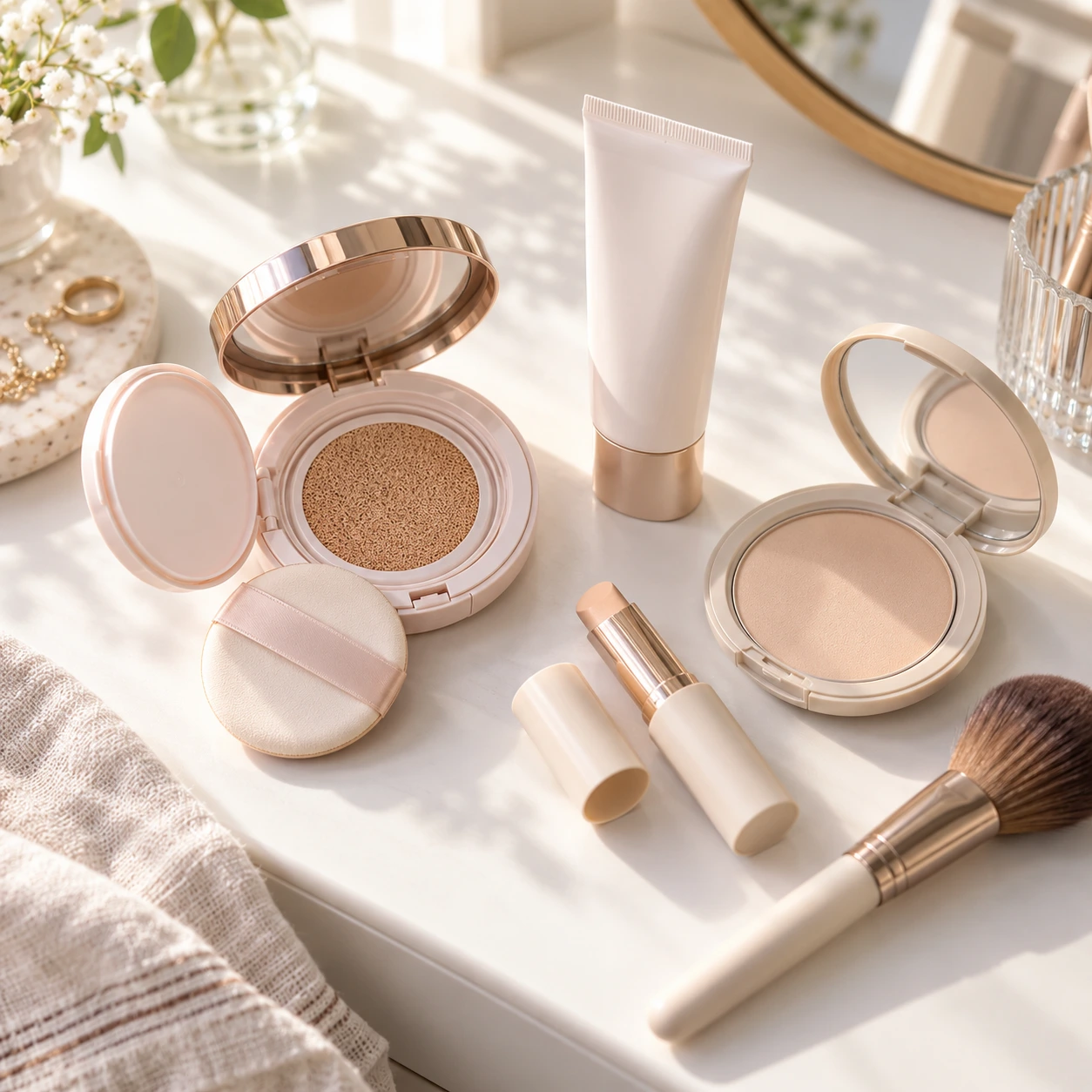
Japanese Base Makeup Explained: Cushion, Liquid, Powder and the Order They Go On
Japanese base makeup is built in thin layers that each do one job. How the routine is ordered, what the ochre shade numbers mean, and which format survives a humid summer.
Japanese base makeup is not one product. It is a short stack of thin layers, each doing a single job, and the finished face is meant to look like skin that happens to be very even rather than skin with something on it.
Coverage is light to medium by default, textures are built for heat and humidity, and almost every layer carries its own UV rating. Once you know the order, choosing between a cushion, a liquid and a powder becomes a question of skin type and season.
The order: base, foundation, powder
| Japanese | Reading | Step | Job |
|---|---|---|---|
| 化粧下地 | keshō shitaji | Base or primer | Grips foundation, corrects tone, carries UV |
| ファンデーション | fandēshon | Foundation | Evens colour and texture |
| コンシーラー | konshīrā | Concealer | Spot coverage after foundation |
| フェイスパウダー | feisu paudā | Face powder | Sets, mattifies, adds UV |
- Finish skincare and let the last layer absorb for two or three minutes; foundation over wet lotion pills.
- Apply a pea-sized amount of base from the centre of the face outward.
- Apply foundation thinly with a sponge or fingers.
- Concealer only where the foundation has not covered.
- Press, do not sweep, a light veil of powder over the T-zone.
The base is the step most people outside Japan skip, and it is the one that makes everything else last. A foundation on bare skin has nothing to hold on to; over a base it sits evenly and resists sebum for hours longer.
A UV base at SPF50+ PA++++ with a non-chemical filter is the modern default first layer: it covers pores lightly, tones up the complexion and does the sunscreen job at once, which is why many Japanese routines stop here on a bare-face day.
Cushion, liquid or powder
Cushion is liquid foundation soaked into a sponge inside a compact. Press the puff into the sponge, pat onto the face. The finish is dewy, the coverage light and buildable, and it suits dry or normal skin best. Wash the puff weekly and swap the refill every six to twelve months.
A moisture-led cushion shows what the format does well: a thin, luminous layer that reads as skin rather than makeup.
Liquid gives the most control over coverage. Japanese liquids lean satin rather than matte, and the best are formulated against sebum oxidation, the greying that happens when foundation mixes with skin oil across a day.
This long-wear fluid is the reference for that approach: fine red pigments counter the dullness sebum causes, so the shade you applied at eight is still the shade at six.
Powder foundation is the Japanese workhorse. Pressed pigment applied with a sponge, it takes seconds, reapplies over itself through the day, and its oil-absorbing finish is why it dominates in summer and among oily skin types.
A gloss-film powder shows how far the category has moved: it blurs pores and adds a polished sheen rather than flattening the skin, so it works on drier complexions too.
Reading the shade numbers
Japanese foundations combine an undertone family with a depth number.
| Code | Japanese | Undertone |
|---|---|---|
| OC | オークル (ōkuru) | Ochre, the neutral to slightly yellow standard |
| PO | ピンクオークル (pinku ōkuru) | Ochre with a pink lean |
| BO | ベージュオークル (bēju ōkuru) | Ochre with a warmer beige lean |
| P | ピンク (pinku) | Pink, cooler |
The number runs from about 10 (lightest) through 20 (medium) to 30 or 40 (deepest). OC-20, or the shade marked 標準色 (hyōjunshoku, standard colour), is where most people should start.
Ochre is the neutral default because most Japanese skin has a yellow-olive undertone; the pink family exists for people who look sallow in it. Neutral or warm in Western lines means ochre; cool-toned means pink ochre first.
BB cream and concealer
A Japanese BB cream is base and foundation in one, usually with SPF, for days when the full routine is not worth the effort; a CC cream is the colour-correcting cousin, tinted against redness or sallowness rather than for cover.
A drugstore BB at SPF35 PA++ is the quick-day option: base, colour and daily UV in one tube, with a moisturising finish for normal to dry skin.
Concealer comes after foundation in the Japanese order, not before, and goes on in small amounts only where foundation has not done the job: a spot tool for shadows and marks, not a second layer.
Tone-up and colour-correcting bases
Japanese base makeup has a whole category of tinted primers that correct skin colour before foundation. The tint disappears under foundation but changes how the face reads: lavender lifts dullness on yellow-leaning skin, green softens redness, pink warms a tired complexion. A tone-up base is the related idea, a lightly pigmented cream that brightens the skin a half-step and is worn alone under powder in summer.
A green-tinted base at SPF19 PA++ is the classic redness corrector: a thin layer on the cheeks and nose sides only, then foundation over the whole face as usual.
SPF in makeup versus sunscreen
A UV base at SPF50 is enough for a short commute; a day outdoors still needs sunscreen underneath. A foundation's rating is measured at 2 mg per square centimetre, about a quarter teaspoon for the face, and nobody applies foundation that thickly; a UV base is applied generously and is designed to be the protection layer. For a beach or a hike, apply sunscreen first, let it set, then build makeup over it; the sunscreen formats comparison covers which texture to use.
Sweeping an SPF powder over makeup at lunchtime tops up protection without disturbing what is underneath.
A finishing powder at SPF50 PA+++ that removes with an ordinary face wash when worn alone is the standard reapplication tool, and it doubles as the setting step.
Humidity and removal
Japan's summer is hot and wet, and the industry is built around 崩れ (kuzure), the breakdown of makeup by sebum and sweat. Look for 皮脂崩れ防止 (hishi kuzure bōshi, sebum-breakdown prevention) on primers and powders, and in July switch from cushion to powder.
A BB cream or a base marked 石鹸で落ちる (sekken de ochiru, removes with soap) comes off with foam alone; long-wear liquids and high-SPF bases need an oil cleanser first, then foam, as in the double cleansing method.
Frequently asked questions
Can I wear a cushion without a base? You can, but it will not last as long and will look patchier over pores by mid-afternoon.
Are Japanese shade ranges deep enough for darker skin? Most drugstore lines stop around OC-30, a medium tan. Department-store lines go further, but check the range before ordering.
Is powder foundation bad for dry skin? Older formulas were; current gloss-finish powders over a moisturising base are fine for all but very dry skin.
Do I need to set a cushion with powder? Only on the T-zone if you are oily or the day is humid; setting the whole face removes the dewy finish.
Build the layers in order, start from the standard ochre shade, and treat the base as the sun-protection step. For what goes on before any of it, the skincare order guide covers the layers underneath.