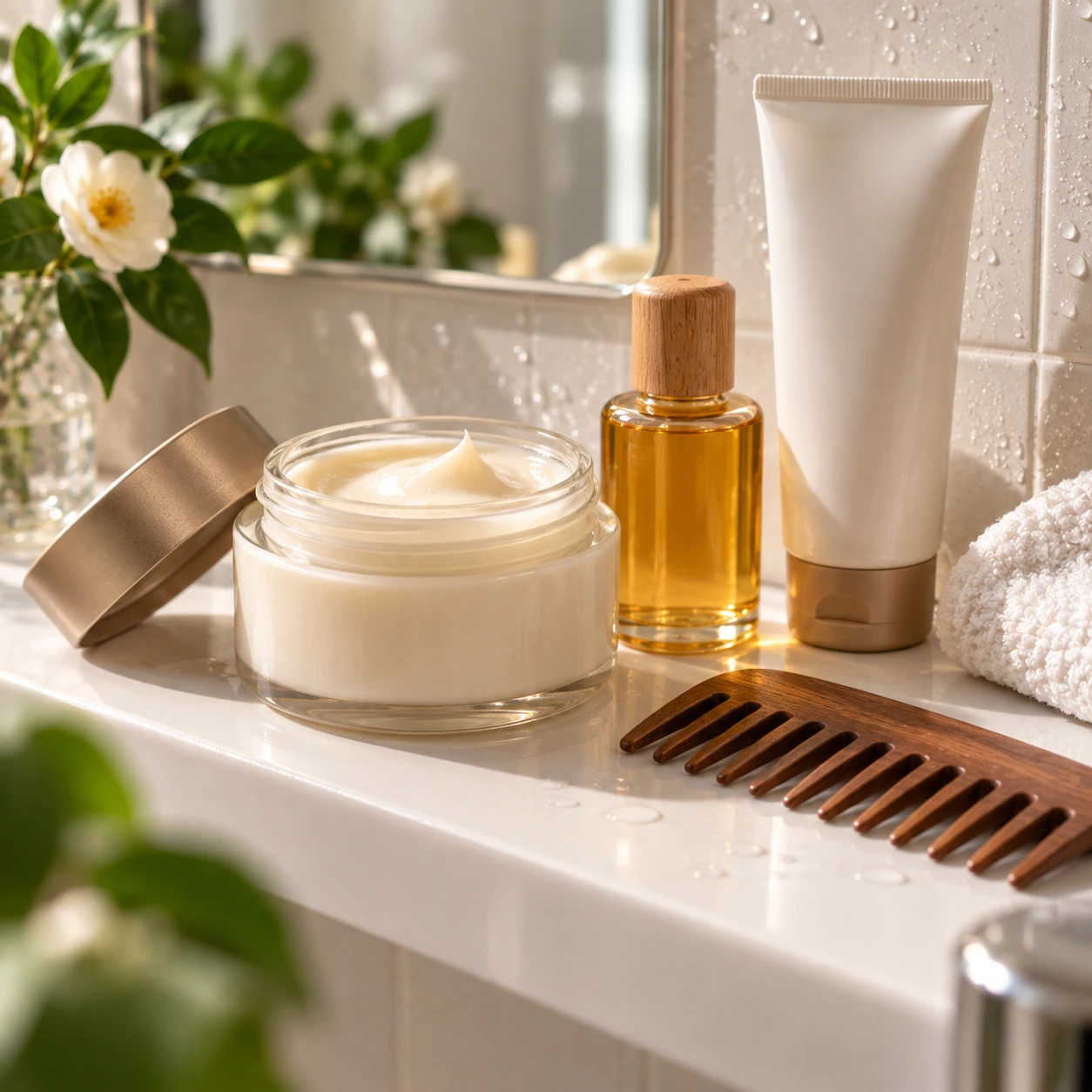
Japanese Hair Treatments and Masks: Rinse-Off, Leave-In and the Damage Care Chemistry
Treatment, mask, oil or milk? What each Japanese hair care format does, what keratin, ceramide and camellia actually repair, and how to apply them so the ends stop snapping.
Japanese hair care is organised around one phrase: ダメージケア (damēji kea, damage care). Shampoo cleans, but everything after it exists to put back what heat, bleach, sun and friction have taken out of the hair shaft, and the products come in a strict sequence of rinse-off and leave-in steps.
The confusing part is the naming. A トリートメント (torītomento, treatment) is not a ヘアマスク (hea masuku, hair mask), and neither is the オイル (oiru, oil) or ミルク (miruku, milk) that goes on after the towel.
Shampoo rankings and the best-known brand lines are in the best Japanese hair care roundup; this article covers the steps after the shampoo.
Treatment, mask and pack
A treatment is the everyday rinse-off conditioner that follows every shampoo. A mask or pack is a denser version used once or twice a week; the line between the two names is mostly marketing.
| Japanese | Reading | Frequency | Job |
|---|---|---|---|
| トリートメント | torītomento | Every wash | Daily smoothing and light repair |
| ヘアマスク / ヘアパック | hea masuku / hea pakku | 1–2 times a week | Concentrated repair |
| 洗い流さないトリートメント | arainagasanai torītomento | After every wash | Leave-in oil, milk or cream |
A rinse-off treatment is not optional in the Japanese routine; it is the conditioner, and skipping it leaves the cuticle open.
The weekly pack tier is where concentration goes up. This one works even when rinsed immediately, which suits a routine where the treatment is applied in the shower rather than left on in the bath.
A keratin-and-argan mask from a straightening series is the texture-specific kind Japan does well: it weighs wavy, unruly hair into a smoother line, and the 300 g tub is the economical size at twice a week.
What the repair ingredients do
- Keratin (ケラチン, kerachin). Hair is keratin, so hydrolysed keratin is the direct patch: protein fragments that fill gaps in the cuticle and cortex. Best for bleached or heat-damaged hair; too much on healthy hair makes it stiff.
- Ceramide (セラミド, seramido). The lipid that glues cuticle scales together. Restores the barrier and stops the hair drinking water in humid weather.
- Hydrolysed silk (加水分解シルク, kasuibunkai shiruku). A lighter, film-forming protein for slip and shine without weight.
- Camellia oil (椿油, tsubaki abura). The traditional Japanese hair oil, high in oleic acid, which penetrates rather than coats. It is the reference point for every modern hair oil.
- Argan, apricot and yuzu seed oils. Lighter modern alternatives with a less greasy finish.
How to apply a rinse-off treatment
- Shampoo, then squeeze water out of the hair until it no longer drips. Treatment on sopping hair is diluted before it touches anything.
- Take an amount the size of a large cherry for shoulder-length hair; double it for long hair.
- Apply from the mid-lengths to the ends. Keep it off the scalp and the first few centimetres of root, which are new hair and do not need it.
- Comb through with a wide-tooth comb so every strand is coated. This is the step people skip and the one that prevents uneven results.
- Leave 3 to 5 minutes for a treatment, 5 to 10 for a mask; a warm towel helps a mask penetrate.
- Rinse until the hair feels smooth rather than slippery.
For bleached or heavily coloured hair, use a keratin-led mask twice a week for the first month after the chemical service, then drop to once and alternate with a ceramide or oil-led one. Bleached hair takes protein readily and loses it quickly, so consistency matters more than concentration.
Leave-in: oil, milk or cream
The 洗い流さないトリートメント (arainagasanai torītomento, leave-in treatment) goes on towel-dried hair before the dryer.
- Oil. Gloss, frizz control and heat protection; best on medium to thick hair. Two or three drops for short hair, five or six for long, warmed between the palms and applied to the ends first.
- Milk. A light emulsion for fine hair that oil would flatten.
- Cream. The heaviest option, for coarse or very damaged hair; also the best heat protector.
- Mist. Almost weightless, for detangling or resetting bed hair.
A salon leave-in in the oil-emulsion style is the everyday choice for medium hair that needs to be manageable rather than shiny.
Pure camellia oil is the original leave-in and still the best value in the category: it works on hair, scalp and skin, a single drop is enough for the ends, and it has no scent to compete with anything else.
Acid-heat care, 酸熱トリートメント (sannetsu torītomento), is the salon technique of using an acid plus the heat of a straightener to bond repair ingredients into the hair, and this leave-in is the home version. Apply, then dry and iron as normal; the heat is part of the method.
Scalp care is a separate step
Japanese hair care treats the scalp as skin, with its own step after the treatment is rinsed, on the reasoning that hair quality is set at the follicle.
- Scalp lotion or serum. Applied to a towel-dried scalp with a nozzle and massaged in; the scalp equivalent of a face lotion.
- Carbonated shampoo (炭酸シャンプー, tansan shanpū). A foaming aerosol in which dissolved carbon dioxide lifts sebum and residue. Once a week in place of ordinary shampoo.
- Scaling cleanser. A pre-shampoo oil or gel that dissolves hardened sebum around the follicle. Also weekly.
A fragrance-free ceramide scalp lotion with a direct-touch nozzle is the gentle end of the range, for dry or itchy scalps that react to scented products.
Humid weather and frizz
Frizz is hair absorbing water from the air through a damaged cuticle. Japanese summers are the stress test, and the approach is layered: a ceramide treatment seals the scales in the shower, a leave-in oil or cream slows water exchange, and the hair is dried fully with a dryer rather than left to set in whatever shape the humidity gives it. Look for 湿気ブロック (shikke burokku, humidity block) on the label.
A plant-based yuzu oil formulated specifically to block humidity on wavy, hard-to-manage hair is the seasonal pick: light enough for daily summer use, with a citrus scent instead of the usual floral.
Frequently asked questions
Can I use a mask every day? Not usefully. Protein and lipids build up and daily masking leaves hair limp. Twice a week for damaged hair, once for healthy hair.
Oil on wet or dry hair? Both, for different jobs. On towel-dried hair before the dryer it protects and shapes; on dry hair a single drop tames flyaways. Never on dripping hair.
Should I use a treatment if my hair is not damaged? Yes, a light one after every wash; skip the weekly mask until the hair has been coloured or heat-styled.
How long before I see a difference? A good mask changes how hair feels on the first use. Fewer split ends and less breakage in bleached hair takes four to six weeks of consistent use.
Treatment every wash, a mask at the weekend, a few drops of oil before the dryer, and the scalp looked after as skin. The traditional ingredients behind it, camellia oil above all, are covered in the traditional ingredients guide.