Hyaluronic Acid the Japanese Way: Layering Lotions for Deep Hydration
Japan doesn't slather hyaluronic acid — it layers it. The technique, the products, and why three thin coats beat one thick one.
Hyaluronic acid is everywhere in skincare, but Japan uses it differently. Where a Western routine reaches for one concentrated serum, the Japanese approach spreads the molecule across multiple watery layers — each thin, each pressed in by hand, each building on the last. The result is hydration with depth rather than a slick surface film.
The difference shows up in the products themselves. Japanese hyaluronic lotions are engineered watery on purpose — thin enough to apply three times without a trace of tack, cheap enough that three applications don't feel extravagant. The formula assumes the technique; the technique justifies the formula. Understand the pairing and a plain-looking bottle of lotion becomes a system.
This is the technique guide. For the supplement side of the story, see our hyaluronic acid inner-care guide; for the general theory of layering, the hydration layering guide goes deeper.
Why layers beat one thick coat
Hyaluronic acid is a humectant — it holds water, but only the water it can reach. One heavy application sits mostly on the surface, holding surface moisture and evaporating ambition. Several thin applications behave differently: each coat gets thirty seconds to settle and bind, and the next coat lands on skin that's already damp — which is exactly the condition humectants love. Successive layers bind moisture at slightly different depths of the skin surface instead of pooling on top.
There's also a molecular-weight story. Good Japanese formulas stack multiple weights of hyaluronic acid: larger molecules film and protect at the surface, smaller ones settle into the upper layers. Layering multiplies the effect of that stack — you're not applying more product so much as giving the stack more chances to distribute.
And then there's the hand-press — te-de-press in Japanese beauty vocabulary — which matters as much as the count. Warm the lotion between palms, press it into the face, and hold for a breath on each zone: cheeks, forehead, chin, then the edges. Pressure improves contact and absorption; rubbing just relocates product and adds friction. Watch any Japanese skincare routine video and you'll see it: palms, not fingertips; pressing, not swiping.
The layering stack, product by product
Layer 1 — the everyday base. The classic Hada Labo Gokujun: multiple weights of hyaluronic acid in a watery, fragrance-free liquid built for exactly this technique. This is the bottle the whole method was popularized on.
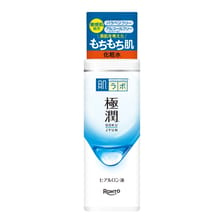
Hada Labo
Hada Labo Gokujyun Hyaluronic Acid Lotion
A lotion from the "Gokujyun" series that pursues the moisture your skin truly needs. Formulated with 4 types of hyaluronic acid, its gentle, thick texture provides deep hydration, leading to soft, bouncy skin. Weakly acidic, fragrance-free, colorant-free, oil-free, alcohol-free, and paraben-free, making it suitable for sensitive skin.
From 144,000 UZS
Layer 2 — the syrupy upgrade. On dry days or dry skin, follow with the Premium version — a thicker, deeper hyaluronic stack that rides on top of the first coat without pilling. The two-bottle combination is the classic winter configuration in Japan.
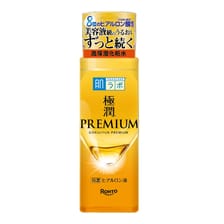
Hada Labo
Hada Labo Gokujyun Premium Hyaluronic Acid Lotion
A highly moisturizing lotion that pursues serum-level hydration and provides long-lasting moisture. It contains a generous amount of 8 types of hyaluronic acid, just like a serum. Despite its rich, thick texture, it blends smoothly into the skin, leading to healthy, moisture-filled bare skin with every use.
From 203,000 UZS
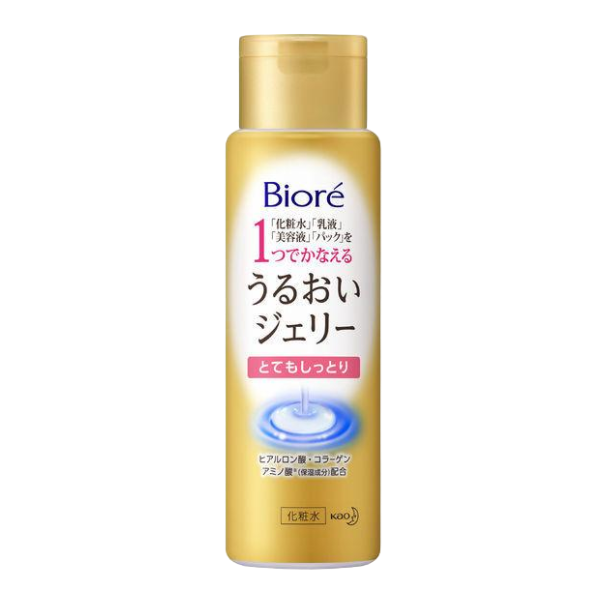
The seal — jelly or cream. Humectants need a lid; without one, they're holding water at the surface where dry air can take it back. Biore's Uruoi Jelly is the lazy-genius option: a bouncy moisture jelly that locks the layers in, absorbs fast, and doubles as a five-second full routine on exhausted nights.
Bioré
Biore Moisture Jelly Very Moist (Main Bottle)
An all-in-one jelly that completes lotion, emulsion, serum, and pack in one step. With its unique "Moisture Penetration & Pack Formula," it delivers moisture deep into the stratum corneum, leaving skin plump and soft. Contains hyaluronic acid, collagen, and amino acids. Fragrance-free and colorant-free.
From 187,000 UZS
The sensitive-skin variant. Reactive skin runs the same play with Curel's ceramide lotion — the same watery, layerable texture with dermatology-counter gentleness and barrier-supporting ceramide care in place of fragrance and frills.
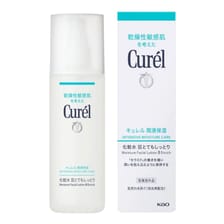
Curél
Curel Intensive Moisture Care Lotion
Curel Intensive Moisture Care Lotion (Very Moist) is designed for dry, sensitive skin. Moisturizing ingredients (eucalyptus extract) penetrate deeply into the stratum corneum, keeping your skin smooth and resistant to external irritation. Contains anti-inflammatory agents to prevent skin roughness.
From 283,000 UZS
The morning shortcut. When three layers aren't happening before work, Hada Labo's UV White Gel compresses lotion, moisturizer, and daily UV protection into one pump — the layering philosophy, folded into a single step for the days that need it.
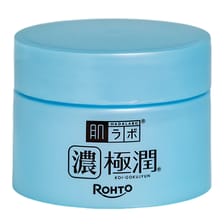
Hada Labo
Hada Labo Gokujun UV White Gel
A dense hyaluronic gel packed with moisture. This high-performance all-in-one product provides both skincare and UV protection. It firmly blocks UV rays with SPF50+ and PA++++.
From 270,000 UZS
The routine, timed
- After cleansing (0:00): first coat, pressed in with palms. Skin should feel damp, not wet — if it's dripping, you used double what the technique needs.
- (0:30): second coat, half the amount. Focus on cheeks and anywhere that feels tight. You'll notice the second coat absorbs faster — that's the primed-surface effect working.
- (1:00): optional third coat for winter, air-conditioned offices, or long-haul flights.
- (1:30): seal with jelly or cream. Done — under two minutes, and most of that is waiting.
Morning version: two coats, then sunscreen as the seal (the sunscreen formats guide pairs naturally). Evening version: the full stack, sealed with cream.
Common mistakes
- Rubbing instead of pressing — friction, waste, and none of the depth. Palms flat, press and hold.
- Skipping the seal — in dry air, unsealed humectants can pull moisture the wrong way. The lid isn't optional; it's half the system.
- Too much per layer — if it drips or feels slimy, halve the amount. Layers should vanish in thirty seconds.
- Applying to bone-dry skin — the first coat works best within a minute of cleansing, while skin is still damp. Water attracts water.
- Judging by day three — like everything in the Japanese routine, the payoff compounds over weeks. Give it a month before you vote.
Frequently asked questions
How many layers is optimal? Two is the everyday answer; three for dry conditions; five is a famous Japanese dry-day ritual but firmly in enthusiast territory. More than that is hobby, not skincare — which is also fine.
Can I layer a Western hyaluronic serum the same way? Usually not — most are too viscous and pill by the second coat. The watery Japanese lotion texture is what makes multi-layering practical. Use the serum as a single mid-routine step instead.
Does the technique work for oily skin? Yes — often better than heavy creams do. Watery layers hydrate without occlusion; seal with the jelly rather than a rich cream and skip nothing.
Lotion, essence, toner — what's the difference? In Japanese routine language, "lotion" is the watery hydrating step (what the West calls a hydrating toner). Essences are treatment concentrates. The bottles above are all lotions in the Japanese sense.
Layering is the cheapest upgrade in skincare: same products, better order, real difference. The bottles above ship direct from Tokyo, and the technique costs nothing at all.