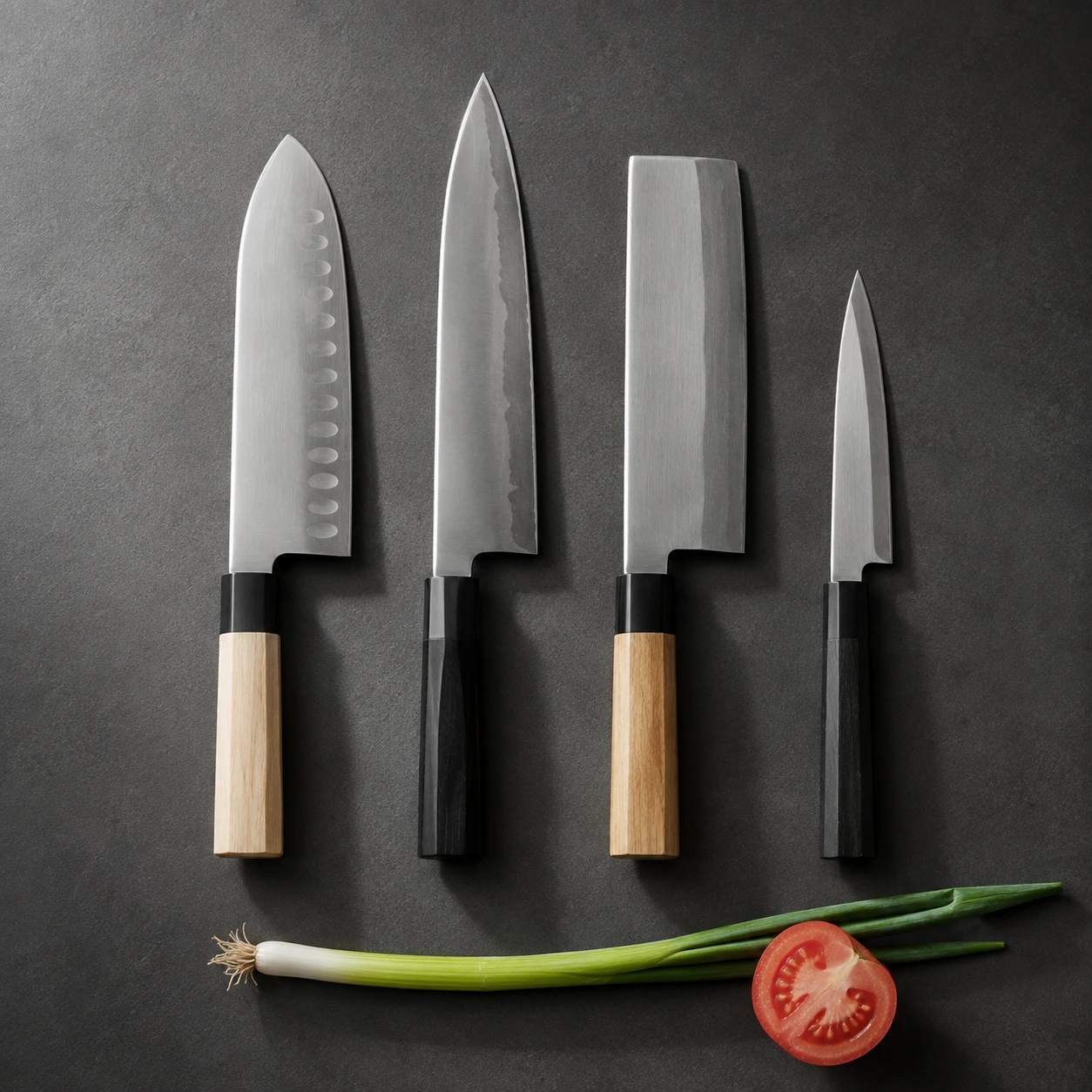
Santoku, Gyuto, Nakiri, Petty: Which Japanese Kitchen Knife to Buy (2026)
Six blade shapes cover almost everything a Japanese kitchen does. Which one to buy first, what size to get, and why two knives beat a block of eight.
A Japanese knife is thinner, harder and lighter than a European one, and it is sharpened to a narrower angle. That combination is why it cuts so cleanly — and why buying one requires slightly more thought than picking whichever block is on offer.
The good news: the shapes are not arbitrary. Each one solves a specific problem, the names describe the job, and two knives genuinely do cover a household kitchen.
The six shapes that matter
| Japanese | Reading | Length | What it is for |
|---|---|---|---|
| 三徳 | santoku | 165–180 mm | "Three virtues" — meat, fish, vegetables. The household default |
| 牛刀 | gyuto | 180–240 mm | The Japanese chef's knife. Longer, pointed, better for large work |
| 菜切 | nakiri | 165–180 mm | Straight rectangular blade for vegetables only |
| ペティ | petty | 120–150 mm | Small work — peeling, trimming, garlic, fruit |
| 出刃 | deba | 150–180 mm | Thick, heavy, single-bevel. Breaking down whole fish |
| 柳刃 | yanagiba | 210–270 mm | Long, thin, single-bevel. Slicing sashimi in one stroke |
The first four are double-bevel — sharpened on both sides, usable by anyone. The last two are single-bevel, ground flat on one face, and made in right- and left-handed versions. Buying a single-bevel knife for general cooking is a common and expensive mistake.
Start with a santoku
If you are buying one knife, it should be a santoku at 165–170 mm. It is short enough to control on a small board, tall enough to keep knuckles clear, and the rounded tip makes it forgiving.
This is the professional-tier workhorse: hard, thin, no decoration, priced for people who use knives all day. If you want the best cutting performance per unit of money in this article, it is here.
The one-piece steel design is the other well-known approach — blade and hollow handle formed as a single body, so there is no seam to trap food, and the balance sits noticeably further forward. People tend to have immediate opinions about the metal handle; try to hold one before deciding.
The Damascus-clad tier adds a layered outer steel over a hard core. The pattern is largely cosmetic, but the softer cladding does protect the brittle core, and the 175 mm length suits larger hands.
At the entry level, a Seki-made stainless santoku costs a fraction of the above and still outperforms most Western supermarket knives. This is the correct first Japanese knife for someone who is not sure yet — and unusually for this category, the softer stainless used in lines like this one is rated dishwasher-safe. The harder, thinner blades above are not.
Then add a gyuto or a petty
The second knife depends on what your first one struggles with.
If you cook large — roasts, whole cabbages, big batches — add a gyuto.
A 210 mm gyuto is the standard professional length: enough blade to slice through a cabbage in one pass, with a proper tip for detail work the santoku cannot do.
A 200 mm version in the one-piece format is lighter than most European chef's knives of the same length, which changes how long you can work before your wrist notices.
If you cook small — one or two people, lots of prep, fruit and garlic — add a petty.
A 130 mm petty is a paring knife with real reach. It handles everything a santoku is too big for and is the second-most-used knife in most Japanese home kitchens.
If you cook mostly vegetables, consider a nakiri instead.
The straight edge contacts the board along its full length, which means no rocking and no "last uncut thread" at the end of a stroke. For shredding cabbage or slicing daikon it is faster than a santoku and does nothing else well.
Size, and the mistake people make
Buy the length you can control on the board you own. A 240 mm gyuto on a 30 cm board is unusable, and a knife that is unusable stays in the drawer.
Rough guide by board:
- Board under 30 cm → santoku 165 mm, petty 130 mm
- Board 30–40 cm → santoku 175 mm or gyuto 210 mm
- Board over 40 cm → gyuto 210–240 mm
Weight matters as much as length. Japanese knives are meant to be pushed and pulled, not rocked with force — the edge does the work. If a knife feels like it needs pressure, it is dull, not underpowered.
Handles: wa vs yo
Wa-handles are the traditional Japanese form — light, usually octagonal or D-shaped wood, friction-fitted to the tang. They shift the balance towards the blade and feel nimble.
Yo-handles are Western-style, riveted, heavier, and more familiar to most buyers.
Neither is better. Wa-handles are lighter and easier to replace; yo-handles are more robust to dishwashing abuse — which you should not be doing anyway. See our knife care guide for the rest.
Before you order: check your country's rules
This matters more with knives than with anything else in the catalogue.
- Many countries impose an age check on knife imports, and some require the recipient to confirm receipt in person.
- A few restrict blade length or specific shapes by post.
- Customs clearance for knives is occasionally slower than for other goods.
None of this is exotic or a reason to avoid ordering — but check your destination's rules before you buy a 240 mm gyuto, not after.
Frequently asked questions
Is a santoku better than a chef's knife? Different, not better. It is shorter, flatter, thinner and lighter, which suits push-cutting and small boards. A gyuto is the Japanese chef's knife if you want the Western shape in Japanese steel.
Can I put a Japanese knife in the dishwasher? Assume no. Heat, detergent and impacts damage both edge and handle, and hard thin steel chips against other cutlery. A few entry-level stainless lines are explicitly rated for it; nothing clad, hammered, carbon or wa-handled is. Hand wash and dry immediately either way.
Do I need a deba or yanagiba? Only if you break down whole fish or cut sashimi. They are specialist single-bevel tools and are frustrating for general prep.
How often do these need sharpening? With home use, a proper whetstone session every few months, plus regular light maintenance. Japanese steel holds an edge longer than European steel but is harder to bring back once truly dull.
Are Japanese knives too hard/brittle for everyday use? They chip if you hit bone, frozen food, or a ceramic board. On a wooden board with normal ingredients they are perfectly durable.
What about left-handed cooks? Double-bevel knives (santoku, gyuto, nakiri, petty) work for either hand. Single-bevel knives must be bought in a left-handed version.
One santoku and one petty covers 95% of a home kitchen. If you want to understand what you are paying for when the price triples, read the knife steel guide next.