VG-10, Molybdenum Vanadium, White Steel: Japanese Knife Steel Explained
Stainless or carbon? What HRC actually means, why Damascus patterns are mostly cosmetic, and how to tell which steel is worth paying for.
Knife listings are full of alloy names — VG-10, AUS-8, SG2, Shirogami, molybdenum vanadium — and they are presented as though the buyer already knows what they mean. Most people don't, so they either pay for a name or ignore the field entirely.
The underlying trade-off is simple, and once you understand it every listing becomes readable. Steel is a compromise between hardness, toughness and corrosion resistance, and you cannot maximise all three. Every Japanese knife is a position taken on that triangle.
The three properties, and what you give up
Hardness determines how fine an edge the steel can take and how long it holds it. Measured on the Rockwell C scale (HRC). Higher = sharper for longer, and more brittle.
Toughness is resistance to chipping and cracking. Directly opposed to hardness — a harder edge is a more fragile one.
Corrosion resistance comes mainly from chromium content. Steel with 13% or more chromium is "stainless"; below that it will rust if neglected.
For reference:
| HRC | Feel | Typical use |
|---|---|---|
| 54–56 | Soft, forgiving, dulls quickly, easy to sharpen | European kitchen knives |
| 58–60 | The Japanese stainless mainstream | Everyday santoku and gyuto |
| 60–62 | Noticeably keener, holds an edge much longer | Premium stainless, VG-10 class |
| 62–65 | Extremely sharp, chips if abused | Carbon steel, powdered high-end steel |
Most home cooks are best served at 58–61. Above that, you are buying performance that only survives careful use and skilled sharpening.
The stainless families you will actually see
Molybdenum vanadium stainless (around 58 HRC) is the workhorse. Molybdenum adds toughness and corrosion resistance; vanadium refines the grain so the edge is finer. It sharpens easily, forgives mistakes, resists rust, and costs little.
This is the steel most Japanese professionals use for knives that live in a wet environment all day. Note that this particular blade is a single-bevel yanagiba — a sashimi slicer, right-handed — rather than a general-prep knife.
A polished stainless gyuto from a major Seki maker sits in the same category: unremarkable on paper, quietly excellent in practice, and effectively rust-proof in a home kitchen.
VG-10 and its relatives (60–61 HRC) are the premium stainless tier. Higher carbon and cobalt content buys a keener, longer-lasting edge while staying stainless. This is the steel behind most Damascus-clad Japanese knives sold abroad.
The premium lines pair a hard stainless core with many layers of softer cladding, hammered or patterned. You are paying for the core's edge retention and the finish quality — both real, both incremental.
The mid-tier is where value concentrates: a VG-10 core clad in 13-chrome stainless, a cherry-wood handle, a plainer finish — a price that reflects the absence of decoration rather than any compromise in the cutting edge.
The same core steel turns up in specialist shapes. This is a honesuki, the Japanese boning knife: a stiff, all-stainless blade with a textured grip, built for jointing poultry rather than general prep.
Proprietary stainless (56–58 HRC) covers makers who developed their own formula, typically prioritising corrosion resistance and one-piece construction over maximum hardness. These sharpen easily and are almost impossible to rust.
Carbon steel: sharper, and a commitment
Carbon steel — Shirogami (white paper steel) and Aogami (blue paper steel) — contains almost no chromium. It takes an edge that stainless genuinely cannot match, sharpens faster on a stone, and rusts if you leave it wet for twenty minutes.
White steel is the traditional choice for single-bevel Japanese knives, and this is a deba — the thick, heavy blade used to break down whole fish. It rewards maintenance and punishes neglect immediately.
Owning carbon steel means:
- Wipe dry after every use. Not at the end of cooking — during it, if you are cutting acidic food.
- Expect a patina. Grey-blue discolouration is normal and protective. Orange rust is not.
- Never leave it wet or in the sink. This is the whole rule.
- Occasional oiling with camellia (tsubaki) oil if it is stored for a while.
If that sounds like a chore, buy stainless. There is no shame in it and the performance gap is smaller than enthusiasts imply.
What Damascus is and isn't
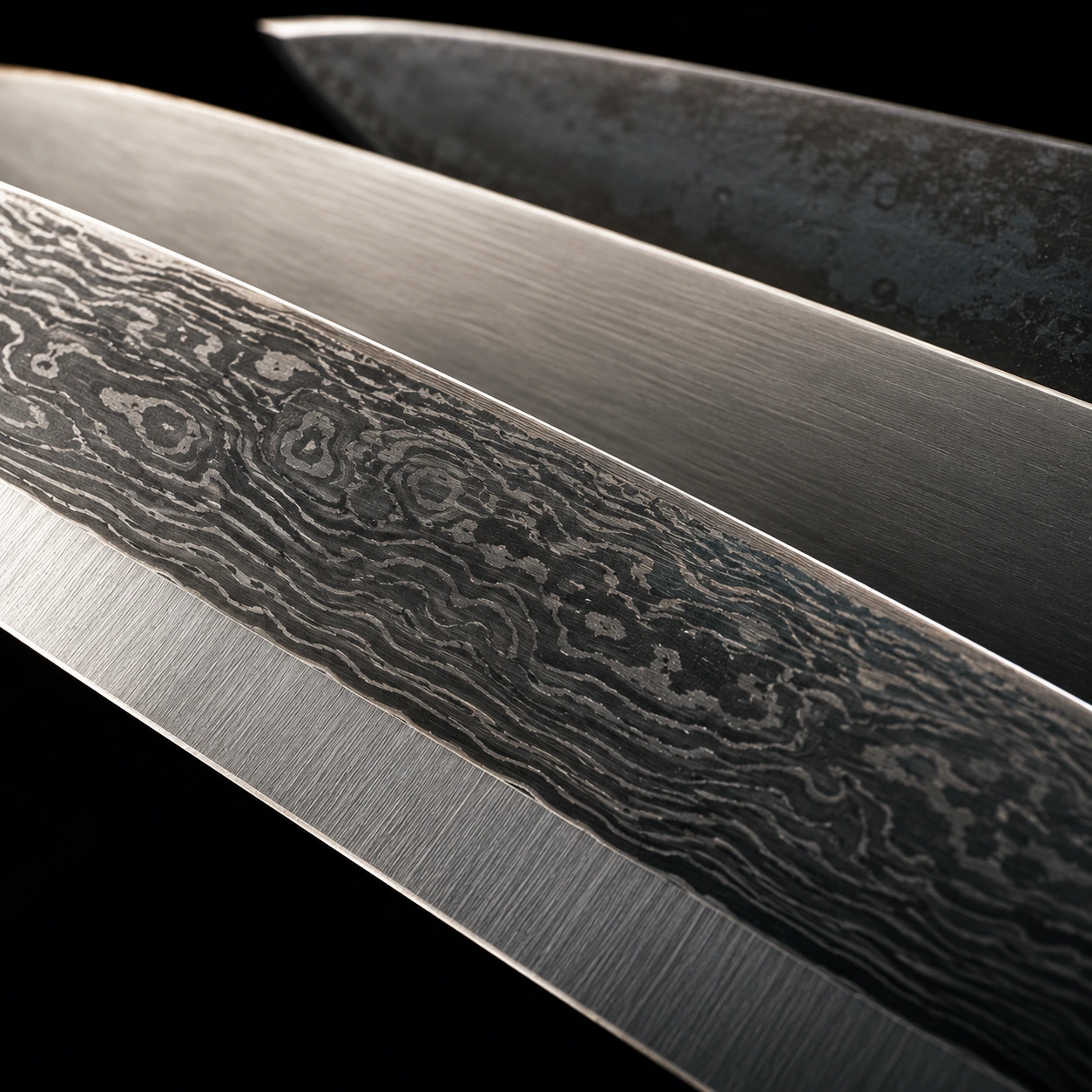
The rippling pattern on a Japanese Damascus knife is cladding — many layers of soft steel forge-welded around a hard core, then etched to reveal the pattern. It is largely aesthetic. Two things it does contribute:
- The soft outer layers absorb shock, so a brittle core is less likely to crack.
- The layered surface can reduce sticking slightly, though a hammered tsuchime finish does that better.
What it does not do is make the knife sharper. The edge is the core steel, and a plain knife with the same core cuts identically. If your budget is fixed, buy core quality over layer count.
How to read a listing
Four fields, in order of importance:
- Core steel name — this is the actual performance claim.
- HRC — if published. Absent HRC usually means an unremarkable number.
- Bevel — double (general use) or single (specialist, handed).
- Cladding/finish — Damascus, tsuchime, migaki. Cosmetic and comfort, not cutting.
Everything else — handle wood, bolster shape, packaging — is preference.
Frequently asked questions
Which steel should I buy first? Molybdenum vanadium stainless or an equivalent at 58–59 HRC. It is durable, cheap to replace, and easy to learn to sharpen on.
Is VG-10 worth the premium? If you sharpen properly, yes — the edge lasts noticeably longer. If your knife lives dull in a drawer, the money is wasted.
Will carbon steel rust in a normal kitchen? Yes, if left wet. Wiped dry after use it is entirely manageable, and the patina it develops is protective.
What is "powdered steel" (SG2/R2)? Steel made from metal powder rather than cast ingot, giving an extremely uniform fine grain. Very hard (63–64 HRC), stainless, expensive, and unforgiving of poor technique.
Does a higher HRC number mean a better knife? No — it means a harder one. Above 62 you are trading away chip resistance, and most home kitchens are hard on edges.
Can stainless knives be as sharp as carbon? At the moment of sharpening they are close. Carbon takes a finer edge more easily and refreshes faster on a stone; good stainless holds its edge longer against corrosion.
Steel decides how long the knife stays sharp. What decides how sharp it is right now is you — read the sharpening and care guide, and if you are still choosing a shape, start with the knife buying guide.