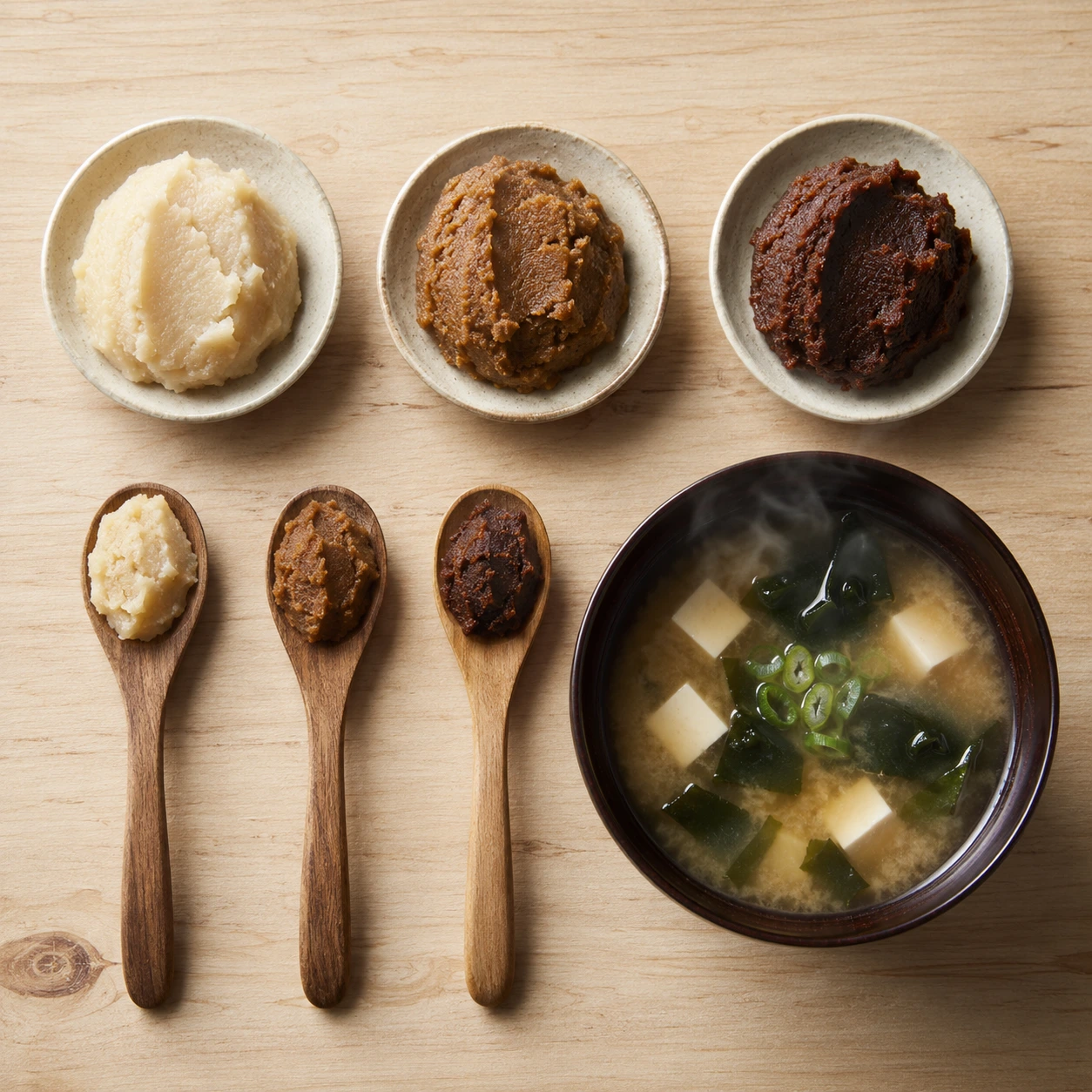
Miso Explained: White, Red, Awase — and How to Make Real Miso Soup
Which miso to buy for which dish, why you must never boil it, and how instant sachets compare to the tub. A practical guide to Japan's fermented backbone.
Miso is fermented soybean paste, and it is the most misunderstood staple in the Japanese pantry. People buy one tub, use it for one thing, boil it, and conclude that miso soup is a thin salty broth they can take or leave.
The paste is capable of far more than that. It is a marinade that tenderises fish, a glaze for aubergine, a dressing base, a butter enrichment, and — yes — a five-minute soup that should taste round and savoury rather than merely salty.
Two decisions get you there: which tub, and when you add it.
The colour tells you the fermentation
Miso is soybeans, salt, and a koji mould culture grown on rice, barley or more soybeans. What separates the types is which grain carries the koji, how much of it there is, and how long the paste ferments.
| Japanese | Reading | Colour | Ferment | Character |
|---|---|---|---|---|
| 白味噌 | shiro miso | Pale ivory | Weeks | Sweet, mild, high rice koji, lower salt |
| 合わせ味噌 | awase miso | Mid brown | Blend | Balanced all-rounder — the household default |
| 赤味噌 | aka miso | Red-brown | Months to years | Deep, salty, assertive, faintly bitter |
| 麦味噌 | mugi miso | Tan | Medium | Barley koji; earthy and rustic, common in Kyushu |
| 豆味噌 | mame miso | Very dark | Years | Soybean koji only; intense and tannic. Aichi's Hatcho style |
If you are buying one tub, buy awase. It is a blend of white and red and it does everything competently — this is what most Japanese households actually keep.
Individually portioned awase servings are the practical starting point if you are cooking for one, or want to know what a properly balanced bowl tastes like before committing to a tub.
For a tub, look for 無添加 (mutenka, additive-free) on the front. Cheaper industrial miso often contains alcohol as a preservative and dashi extract already blended in — fine for convenience, but it removes your control over the stock and flattens the aroma. An additive-free rice-koji miso is a noticeably better base for everything below.
The rule that fixes miso soup
Miso soup is dashi plus miso. Nothing more is required.
- Make or warm 400 ml of dashi.
- Add your solids — cubed tofu, rehydrated wakame, thin-sliced onion — and simmer until just cooked.
- Turn the heat off.
- Dissolve 2 tablespoons of miso (about 30 g) by pressing it through a ladle of the hot stock, then stir back in.
- Serve within a few minutes. Scatter sliced spring onion on top.
Step 3 is the whole technique. Miso's aroma is volatile and its live cultures die off with sustained heat — boiling it produces a flat, salty liquid that tastes of nothing in particular. Off the heat, the same soup smells sweet and yeasty and tastes twice as complex.
If you are not making dashi from scratch, granulated bonito stock is the shortcut every Japanese kitchen actually uses on a weeknight. Half a teaspoon per bowl.
Instant miso is better than it has any right to be
There are two kinds of instant miso soup, and the difference matters.
Fresh-paste type (生みそタイプ) ships a sachet of real miso paste plus a separate sachet of dried garnish. You add hot water. It is genuinely close to homemade, because it is miso paste — just pre-portioned with the dashi already blended in.
Freeze-dried type compresses the whole bowl into a block that dissolves. More convenient, slightly thinner in flavour.
The fresh-paste standard, and the benchmark most Japanese households measure instant soup against.
The three-way assortment covers the classic morning/noon/evening trio — a white-miso, a red-miso and a blended variety — which is the cheapest way to taste the difference between styles side by side.
Worth knowing that not every instant bowl is miso: clear osuimono soups are dashi-based with no paste at all, lighter and served alongside richer meals. A sachet also works as an instant seasoning — stir one into rice as it cooks, or into a simmered dish, in place of stock powder.
And the wakame-and-sesame soups sold in the same aisle are not miso at all — clear broths built on scallop dashi and roasted sesame, light enough to sit beside a rich main course and very good alongside fried rice.
What else to do with the tub
Miso soup uses maybe a fifth of what a tub is good for.
- Miso-marinated fish (saikyo-yaki). Mix white miso, mirin and sake roughly 3:1:1, coat a fillet of cod, salmon or black cod, and refrigerate 24–48 hours. Wipe off the excess and grill. This is the single most impressive thing you can do with miso.
- Nasu dengaku. Halve an aubergine, score it, roast until soft, spread with miso mixed with mirin and sugar, blister under a grill.
- Miso butter. Equal parts soft butter and miso. On corn, on grilled mushrooms, stirred through hot noodles.
- Dressing. Miso, rice vinegar, sesame oil and a little sugar makes a dressing that beats most bottled ones.
- Instead of salt. A teaspoon in a stew, a bolognese, or a braise adds depth without announcing itself as Japanese.
Adjacent but not miso: this concentrated seasoning paste is the Chinese-style umami base found in a great many Japanese home kitchens, and it is the fastest route to a decent bowl of ramen broth or fried rice.
Storing it
Miso is a preserved food and it will not spoil quickly, but it does age.
- Keep the tub refrigerated once opened, surface pressed flat, with the plastic sheet or a piece of cling film laid directly on the paste to keep air off.
- Colour will darken over time — that is continued fermentation, not spoilage. Flavour deepens and salt tastes sharper.
- White miso is the least stable because of its lower salt; use it within a few months. Red keeps for a very long time.
- A little liquid separating on top is normal. Stir it back in.
Frequently asked questions
Is miso healthy? It is a fermented food with live cultures, protein and minerals — and it is also salty, running from roughly 5–6% salt for sweet white miso to 12–13% for red. A bowl of soup contains around 1.5 g of salt. Sensible in daily amounts, not a health food to consume freely.
Does heating miso destroy the probiotics? Sustained boiling does. Dissolving it off the heat preserves far more, which is one reason for the technique.
Is miso gluten-free? Rice-koji and soybean misos usually are; barley (mugi) miso is not. Some brands process on shared lines — check the label if you are coeliac.
Is it vegan? The paste itself is. Instant sachets and pre-blended "dashi-iri" misos usually contain bonito extract. Kombu dashi plus plain miso gives you an entirely plant-based bowl.
How much miso per bowl? About one tablespoon per 200 ml of dashi. Adjust to the paste — red is saltier than white.
One tub, dissolved off the heat, and Japanese cooking gets its floor. Add dashi and decent rice and you have most of a meal already.