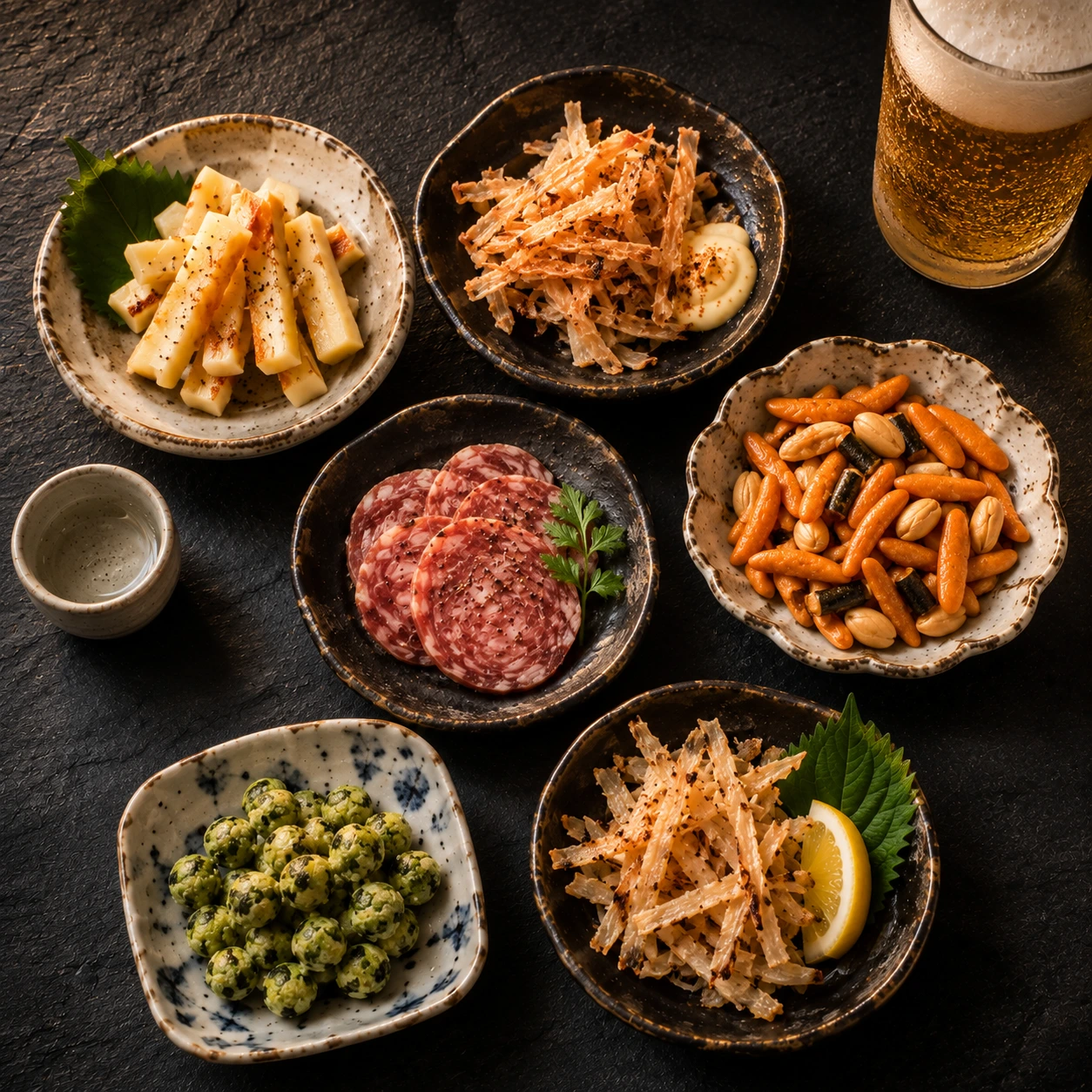
Otsumami: The Japanese Snacks Made for Beer and Sake
Japan has a whole snack category built specifically for drinking — dried squid, cheese-stuffed cod, chilli rice crackers. What to buy and what to drink it with.
Japan does not treat drinking snacks as an afterthought. Otsumami is its own category — food designed specifically to be eaten slowly, in small pieces, alongside alcohol, over a long conversation. The rules are different from snacking: intensely savoury rather than sweet, salty enough to keep you drinking, chewy enough to last, and portioned so that a bag survives an entire evening.
It is also, for the visitor, the most interesting shelf in the shop, because almost nothing on it has a Western equivalent.
What makes something otsumami
Three properties, in roughly this order:
- Umami density. Dried fish, cheese, cured meat, soy — concentrated savoury flavour that stands up to beer's bitterness and sake's sweetness.
- Resistance. Otsumami is chewy, dry or hard on purpose. Something that dissolves in three seconds is a snack; something you work at for a minute is otsumami.
- Salt. Deliberately high. The relationship between salt and the next drink is not accidental.
The category runs from convenience-store bags to genuine delicacies, and the convenience-store end is where most people should start.
The classics
Chī-tara — processed cheese sandwiched inside a sheet of dried cod, cut into sticks — is the definitive modern otsumami. It sounds unlikely and it works: the fish provides salt and umami, the cheese provides fat and richness, and the texture is chewy without being tough. If you buy one bag from this whole category, buy this one.
Atarime is dried, shredded squid, and it is the oldest drinking snack in Japan. It is also a linguistic curiosity: the ordinary word is surume, but suru also means "to lose money", so gamblers and merchants renamed it atarime — from ataru, "to hit" or "to win". Chewy, deeply savoury, and best with a squeeze of mayonnaise and a dash of shichimi, which is how it is served in izakaya.
Smoked cheese in small cubes is the gentlest entry point in the category — no fish involved, and it pairs as naturally with whisky as with beer.
Coarse-ground salami in resealable twin packs is the meat option, and Japan's version is noticeably less fatty and more peppery than most European snacking salami.
Kaki no tane — the small chilli-soy rice crackers, usually bagged with peanuts — is the most-eaten drinking snack in the country and the one you will be handed if you sit down with Japanese friends and a case of beer. More on the wider category in our rice cracker guide.
The bean and nut tier
Green mame — green peas in a crisp seasoned shell — is a fixture of the drinking table and a good example of how Japanese snack engineering works: a legume made shelf-stable, crunchy and salty without becoming a crisp.
Coated peanut mixes are the other staple — sweet, salty and soy-glazed shells over roasted nuts, in the format that has been sold in Japan for generations.
The cheap-and-strange end
There is a whole genre of single-sheet snacks — sold for coins, individually wrapped, aggressively flavoured. The wasabi-nori version is thin, hot, salty seaweed-and-fish sheet, and it is exactly as strange and as moreish as that sounds. These are children's snacks in origin and adult drinking snacks in practice.
The kabayaki version imitates grilled eel sauce — sweet, soy-heavy, smoky — on the same thin pressed-fish sheet. It is one of the most nostalgic flavours in Japan, and one of the cheapest things in this entire journal.
Novelty crossovers are constant in this category — the cheese-cod sticks in a potato-crisp flavour being a typical example of Japan's willingness to recombine any two successful products.
What to drink with what
The pairings are not formal, but there are strong conventions:
| Snack | Goes with | Why |
|---|---|---|
| Chī-tara, smoked cheese | Beer, whisky highball | Fat and salt against carbonation |
| Atarime, dried fish | Sake, especially warm | Both are built on marine umami |
| Kaki no tane | Beer | Chilli and salt, endlessly |
| Salami, cured meat | Beer, red wine | Straightforward |
| Green peas, coated nuts | Anything | The neutral option on a shared table |
The Japanese highball — whisky and soda over ice, very cold, very dry — is the drink most of this category was optimised for over the past fifteen years, and it pairs with essentially everything above.
Practical notes
- These are salty. A bag of dried squid can carry a significant proportion of a day's sodium. They are designed to be shared slowly, not eaten alone in a sitting.
- Reseal everything. Dried fish and cheese snacks absorb humidity and turn from chewy to unpleasantly soft. Most bags now include a zip for this reason.
- Smell is real. Dried squid and fish snacks have a powerful aroma that lingers in a room. This is normal, expected in Japan, and worth knowing before you open a bag in a shared office.
- Check for shellfish and fish allergens — much of this category is built on squid, cod, bonito and prawn.
Frequently asked questions
What does otsumami literally mean? From tsumamu, "to pick up with the fingers" — food you pinch while drinking. The polite prefix o- is standard.
Is otsumami the same as sakana? Sakana (肴, written differently from the word for fish) is the older, broader term for anything eaten with sake, including hot dishes. Otsumami usually implies packaged, room-temperature snacks.
Do I have to drink alcohol to enjoy these? No — they are eaten as ordinary snacks too, particularly the cheese and cracker varieties. The category simply evolved around drinking.
Are there vegetarian options? The bean, pea and nut snacks, and some seaweed ones. Most of the rest is fish, squid, cheese-and-fish or meat.
Why is dried squid so expensive relative to size? It is dehydrated, so a small bag represents a lot of raw squid, and the good ones are dried slowly rather than machine-processed.
Buy chī-tara, kaki no tane and one bag of atarime. That is a Japanese drinking table in three purchases — and if the beer needs a proper accompaniment on the plate too, look at the otsumami-adjacent snack aisle.