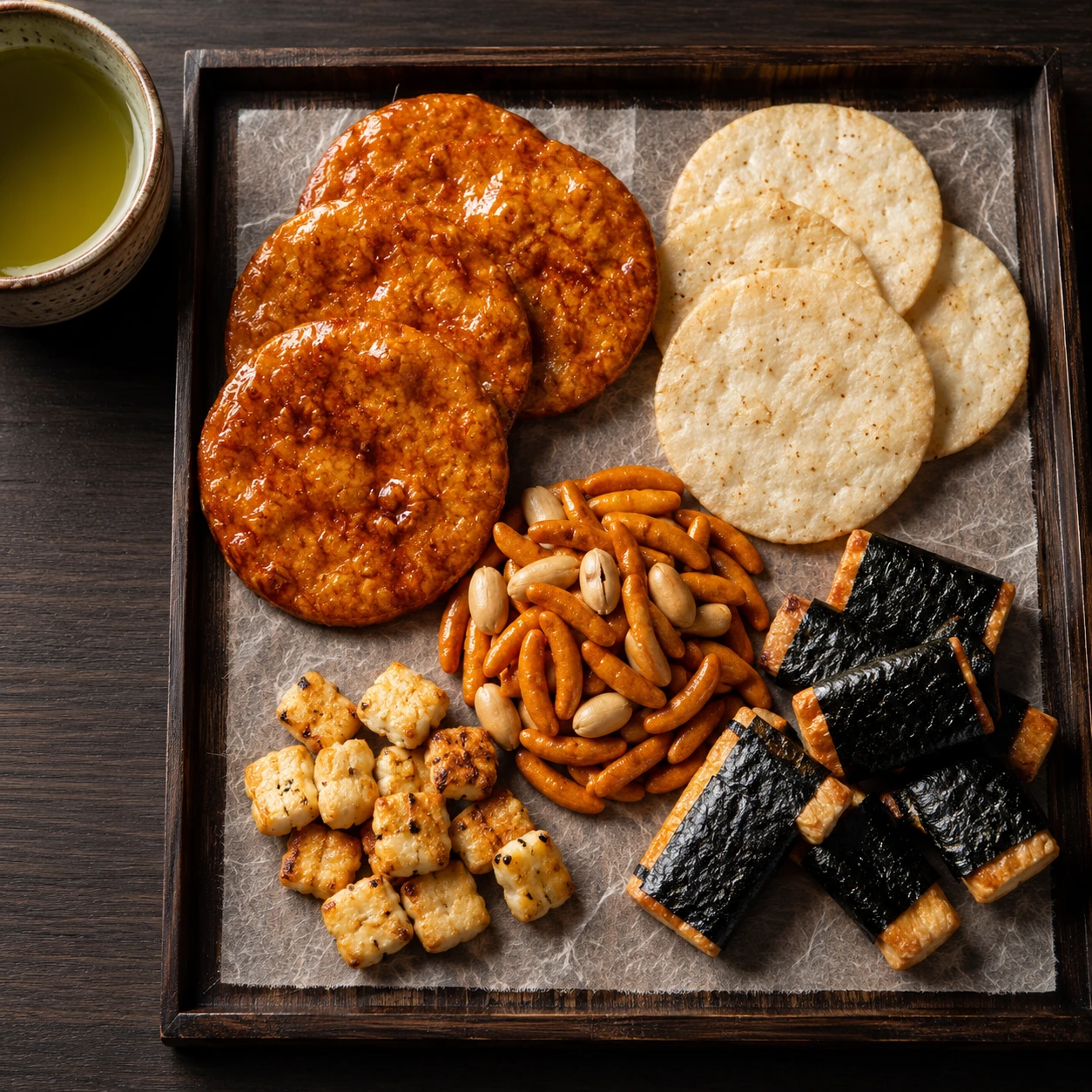
Senbei, Okaki and Arare: A Guide to Japanese Rice Crackers
The difference between senbei and okaki is the rice they're made from — and it changes everything. What to buy first from Japan's most quietly addictive snack aisle.
Japan gives rice crackers an aisle of their own, sitting apart from the crisps, and for a first-time buyer it is close to unreadable. Everything is beige-to-brown, everything is round or bar-shaped, and the packaging is uniformly enthusiastic in a language you may not read.
Underneath, there is a simple taxonomy — and once you know it, you can predict what a bag will taste like before you open it.
Senbei, okaki, arare: the same idea, different rice
The names are not marketing variants. They describe which rice went in and how big the result is.
| Japanese | Reading | Rice used | Result |
|---|---|---|---|
| 煎餅 | senbei | Uruchimai (ordinary short-grain) | Hard, crisp, snappy. Usually large and round |
| おかき | okaki | Mochigome (glutinous) | Lighter, puffier, airier bite |
| あられ | arare | Mochigome (glutinous) | The same as okaki, but small — cubes and pellets |
Senbei is dense and brittle; it shatters when you bite it. Okaki and arare puff, because glutinous rice expands when it hits heat. If you have ever wondered why one bag snaps and another crunches lightly and dissolves, that is the entire reason.
From there, the flavour families are short: soy-glazed (shoyu), salted (shio), nori-wrapped (isobe), sweet-salted, spicy, and the seafood ones built on prawn or squid.
Where to start
Kaki no tane — "persimmon seeds", named for the shape — is the single most-eaten rice cracker format in Japan. Small orange soy-and-chilli crescents, usually bagged with peanuts, in which case it is called kaki-pi. It is the default beer snack, the default train snack, and the correct first purchase. The six-pouch bag exists because the full bag disappears otherwise.
Plain salted senbei is the other end of the spectrum: no glaze, nothing but salt — Okinawan sea salt in this case — over a net-grilled cracker that is faintly sweet from the rice itself. This is the one to buy if you want to taste what rice crackers actually are, and it is the version children eat.
Happy Turn deserves separate mention. It is an okaki dusted with a sweet-savoury powder — informally known in Japan as "the magic powder" — and it is engineered to be difficult to stop eating. It tastes nothing like a traditional senbei and everyone buys it anyway.
Yuki no Yado works the same sweet-and-salty axis differently: a light salted cracker with a sweet white icing layer on one side. The combination sounds wrong and is the reason it has been a bestseller for decades.
Bakauke is the curved, ridged, savoury bar — the aonori-and-soy version is the flagship, and the format is closer to a crisp than a traditional cracker.
The traditional end
Not all senbei is a supermarket snack. Several regional makers operate at gift and confectionery level, and the difference in ingredient quality is obvious.
Prawn senbei from a long-established Aichi maker: real prawn meat pressed thin, then baked twice — once on an iron plate and again under far-infrared heat — which is what concentrates the flavour instead of frying it. This is a formal gift item in Japan.
Nori senbei from a Tokyo tea and nori house — a rice cracker with a full sheet of seaweed pressed onto it. The nori quality is doing the work here, which is why it comes from a company that has been selling nori since the Edo period.
At the other extreme, bite-sized fried senbei — crunchier and richer than the baked kind, finished in a mellow sweet soy — are the cheap, everyday, one-handed version, and priced accordingly.
How they are actually eaten
Rice crackers are not primarily a couch snack in Japan, which explains some of the flavour choices.
- With green tea, mid-afternoon. Salted or soy senbei with sencha or hojicha is the standard household break, and the reason so many are only lightly seasoned.
- With beer. Kaki no tane and anything with chilli or seafood belongs to the otsumami tradition.
- As a gift. Boxed regional senbei is a standard omiyage — souvenir — which is why individually wrapped, gift-boxed versions cost several times more than the bagged kind.
- Crushed over rice or salad. Kaki no tane broken over a bowl adds crunch and salt in the way croutons do.
Reading the bag
A few markings help:
- 枚 (mai) counts sheets or pieces — 20枚 means twenty crackers, useful because bag sizes vary wildly.
- 個包装 (kobōsō) means individually wrapped. Better for humidity and for sharing; more packaging.
- ぬれ煎餅 (nure senbei) is the deliberately soft, soy-soaked style — chewy rather than crisp. Excellent, but not what you want if you are expecting a snap.
- ざらめ (zarame) means coarse sugar crystals on top; sweet-savoury.
Storage is the same rule as nori: the enemy is humidity. Reseal tightly, keep the desiccant in the bag, and store away from the stove. A limp senbei can be restored with two minutes in a low oven or a few seconds in a toaster oven.
Frequently asked questions
Are rice crackers gluten-free? The rice is, but almost all soy-glazed varieties contain wheat via the soy sauce, and many contain wheat starch. Assume not unless the label says otherwise.
Are they healthier than potato crisps? Generally lower in fat, especially baked varieties — and often higher in sodium. Better, not virtuous.
What is the difference between kaki no tane and kaki-pi? Kaki-pi is kaki no tane with peanuts in the bag. That is the whole difference.
Do they contain fish? Frequently — prawn, squid and bonito appear as flavourings across the category, including in some that look plain. Check if it matters.
How long do they keep? Months sealed. Once open, days rather than weeks before they soften.
Why are some crackers wrapped individually inside a box? Humidity control and gifting convention. In Japan a box you can pass around, one wrapped piece at a time, is a different product from a bag you eat at home.
Start with kaki no tane and a bag of plain salted senbei. One will tell you why Japan snacks on rice; the other will disappear before you have finished deciding. For the wider aisle, see our Japanese snack guide.