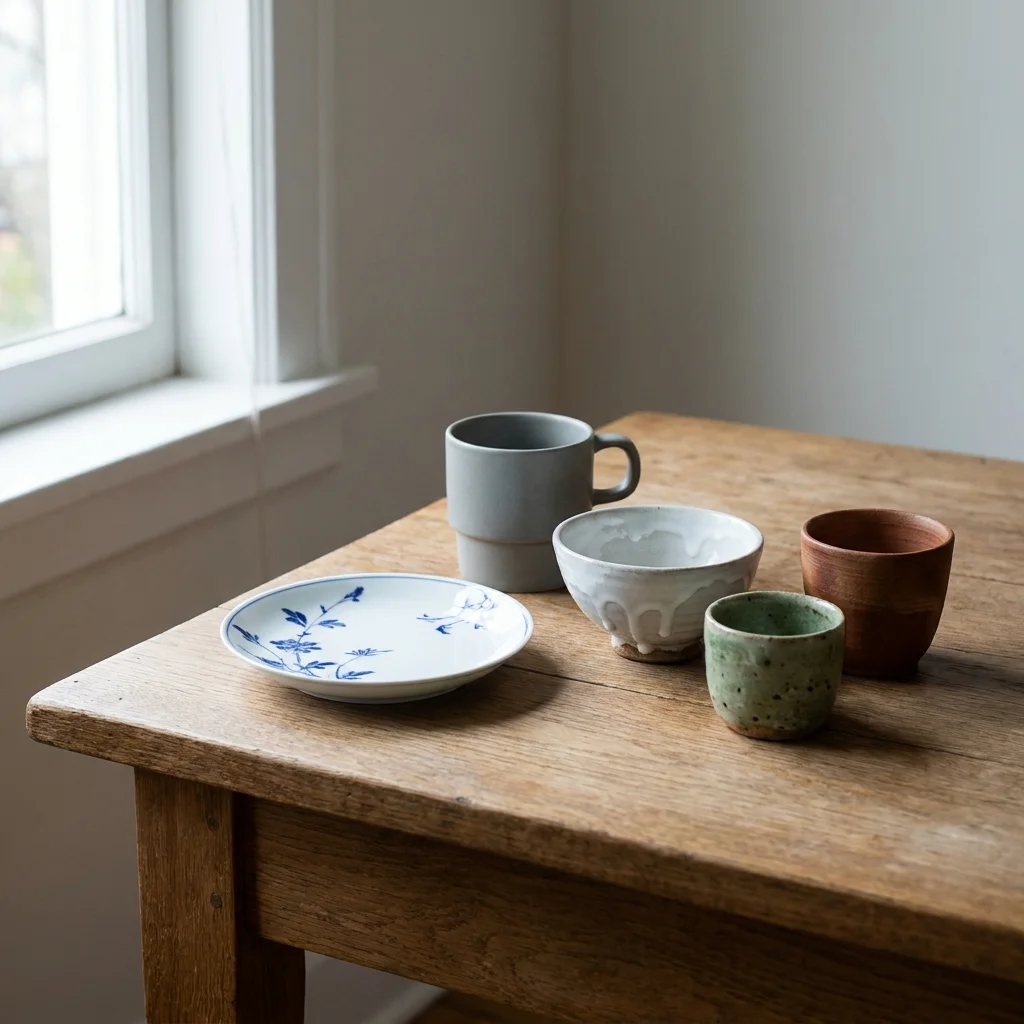
Japanese Pottery Styles: Arita, Mino, Hasami and Five More
A guide to Japanese pottery styles: porcelain from Arita, Hasami and Kutani, stoneware from Mino, Mashiko and Bizen, and how to choose and care for each.
Turn over a piece of Japanese tableware and there is often a small stamp on the foot naming the town it came from. In Japan, pottery is named after places: Arita, Mino, Hasami, Mashiko. Each name is shorthand for a clay, a glaze and a way of working that goes back centuries.
This guide to Japanese pottery styles explains the one distinction that matters most, porcelain versus stoneware, then walks through eight of the best-known wares, what they look like, and how to choose and care for them at home.
Tōki vs jiki: stoneware and porcelain
Japanese ceramics fall into two broad families.
Tōki (陶器) is pottery made from clay, sometimes called tsuchimono, "earth things". It is thicker, warmer in the hand, slightly porous, and tends to have visible texture and rich, uneven glazes. It chips more easily and can absorb liquid and smells.
Jiki (磁器) is porcelain, made from crushed porcelain stone and fired at higher temperatures. It is thin, hard, white, smooth and non-porous. Hold a fine piece to the light and the edge glows slightly.
A quick test: tap the rim gently with a fingernail. Porcelain rings clear and high; stoneware gives a duller knock. Porcelain is easier to live with; stoneware has more character. Most Japanese kitchens use both.
Eight Japanese pottery styles at a glance
| Ware | Prefecture | Type | Look | Best for |
|---|---|---|---|---|
| Arita (有田焼) | Saga | Porcelain | White with blue or bright overglaze | Plates, formal tableware |
| Hasami (波佐見焼) | Nagasaki | Porcelain | Simple, modern, often stackable | Everyday mugs and plates |
| Kutani (九谷焼) | Ishikawa | Porcelain | Bold overglaze in deep colours | Sake cups, statement pieces |
| Mino (美濃焼) | Gifu | Mostly stoneware, some porcelain | Wide range; Oribe green, Shino white | Rice bowls, everyday pieces |
| Mashiko (益子焼) | Tochigi | Stoneware | Thick, rustic folk-craft glazes | Mugs, serving bowls |
| Bizen (備前焼) | Okayama | Stoneware | Unglazed, wood-fired, earthy | Cups, vases |
| Shigaraki (信楽焼) | Shiga | Stoneware | Coarse clay, warm tones | Planters, cups, tanuki figures |
| Hagi (萩焼) | Yamaguchi | Stoneware | Soft, pale glaze that changes with use | Tea bowls, cups |
Porcelain for everyday: Arita and Hasami
Arita in Saga is where Japanese porcelain began, in the early 1600s. Much of it was shipped from the nearby port of Imari, which is why older export pieces are often called Imari ware. Classic Arita is white porcelain with blue underglaze painting or bright overglaze enamels, and it remains the benchmark for fine Japanese porcelain.
Hasami, just across the border in Nagasaki, has long made porcelain for everyday use rather than display. Modern Hasami ware is known for clean, practical shapes, many designed to stack, in matte and soft glazes. If you want Japanese porcelain you can use daily without worrying about it, start here.
Stoneware with character: Mino, Mashiko, Bizen and Shigaraki
Mino, in Gifu, produces a large share of the tableware used in Japanese homes, from mass-market pieces to fine craft. Two historic styles stand out: Oribe, with its deep copper-green glaze and playful shapes, and Shino, with a thick, milky-white glaze that pools and crackles.
Mashiko, in Tochigi, is tied to the mingei folk-craft movement through the potter Hamada Shōji, who worked there. Its pieces are sturdy, thick and generously glazed, made to be used rather than admired.
Bizen, from Okayama, is left unglazed and fired for days in wood kilns. Ash and flame mark the surface, so no two pieces are alike. Shigaraki, from Shiga, uses a coarse, sandy clay with warm orange tones, and is famous in Japan for its tanuki figures that stand outside restaurants.
Hagi, from Yamaguchi, is prized for tea bowls. Its soft glaze crazes finely, and over years of use tea seeps into the cracks and slowly changes the colour, something Japanese tea drinkers value rather than mind.
Kutani and the art of colour
Kutani, from Ishikawa, is the boldest of the porcelain styles: dense overglaze painting in deep greens, yellows, purples, blues and reds. Small pieces such as sake cups are the easiest way to own some, and they make striking gifts.
For cast-iron and clay pots that sit alongside these at the table, see our donabe guide and the Japanese kettles and tea drinkware guide.
How to care for Japanese ceramics
Porcelain is generally dishwasher- and microwave-safe, unless it has gold or silver decoration. Metallic rims and overglaze enamels should be washed by hand and kept out of the microwave.
Stoneware needs a little more thought:
- Some makers recommend medome (目止め) before first use: simmering the piece in starchy rice water to seal the pores. Follow the maker's instructions.
- Avoid long soaking; porous clay can absorb water and smells.
- Dry thoroughly before stacking away, to prevent damp and odour.
- Avoid sudden temperature changes, such as moving a cold bowl into a hot oven.
- Hand wash where possible, especially glazed pieces with crackle or unglazed surfaces.
When a beloved piece does break, the Japanese repair craft of kintsugi rejoins it with lacquer and gold. It is a reminder of how long these objects are meant to last.
Browse our porcelain and ceramic collections, or the full tableware range.
Frequently asked questions
What is the difference between Arita and Imari ware? They are largely the same porcelain. Arita is where it was made; Imari is the nearby port it was shipped from, so export pieces took the port's name.
Is Japanese pottery dishwasher-safe? Most plain porcelain is. Stoneware, hand-painted overglaze and anything with gold or silver should be washed by hand.
How can you tell porcelain from stoneware? Porcelain is thinner, whiter, smoother and rings when tapped. Stoneware is heavier, warmer to the touch and gives a duller sound.
Why do Japanese bowls have a foot ring? The raised ring, kōdai, lifts the bowl off the table and lets you hold a bowl of hot rice or soup comfortably in one hand.
Which Japanese pottery is best for everyday use? Hasami and everyday Mino ware: durable, practical and designed for daily meals.
Start with a Hasami mug or a Mino rice bowl for daily use, and add one piece of character stoneware for the table. Our porcelain collection is the easiest place to begin.