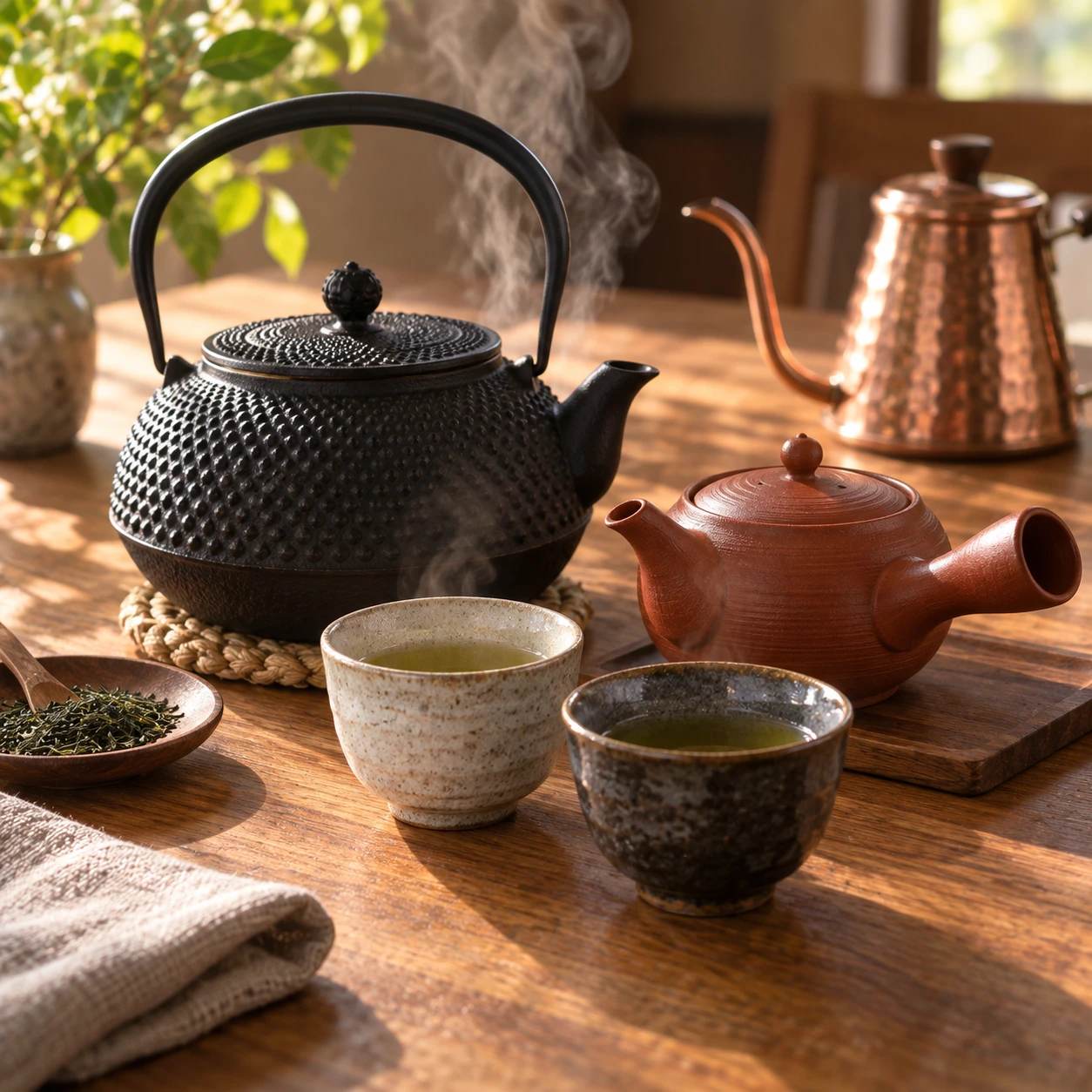
Kettles, Kyusu and Cups: A Guide to Japanese Tea and Coffee Drinkware
Gooseneck kettles for pour-over, side-handle kyusu teapots, the right water temperature for every green tea, and the cups and bowls that go with them, from Arita porcelain to unglazed Tokoname clay.
Japan takes hot water seriously. The temperature it is poured at, the speed and shape of the pour, and the vessel it lands in all change how tea and coffee taste, and the country's drinkware evolved to control each of those separately.
The result is a set of objects that look decorative and are in fact tools: a narrow-spouted kettle, a teapot with its handle on the side, and cups sized to the tea they hold.
Gooseneck and pouring kettles
A pour-over kettle, ドリップポット (dorippu potto), has a long, narrow spout that starts low on the body. The flow is thin, around 3 to 5 ml per second, and steady, so you can wet the grounds evenly and hold the water level in the dripper constant instead of flooding it.
Pour control is the whole reason the shape exists: coffee extracts evenly only when water lands gently and at the same rate everywhere. A standard kettle dumps a wide stream that channels through the bed and under-extracts.
A slim-spouted copper drip pot made in Tsubame, the metalworking town in Niigata, is the reference pouring kettle: copper conducts heat quickly, and the narrow nozzle gives fine control. Its 700 ml is sized for two cups of pour-over, not the day's water.
The technique it serves is in the pour-over coffee guide.
Iron kettles and teapots
The 鉄瓶 (tetsubin) is the cast iron kettle of Nambu ironware, for boiling water for tea. Water boiled in raw iron picks up a trace of iron, and tea made with it tastes rounder.
A 1 litre kettle in the traditional 霰 (arare, hailstone) pattern that works on gas and induction is the daily tetsubin: the slightly flattened body pours with a gentle tilt and the size covers a pot of tea and a refill.
At 0.55 litres the egg-shaped version is the single-person kettle, palm-sized, for one careful cup in the morning; small tetsubin heat quickly and are easier to keep dry.
A coloured iron teapot is a different object. It is lined for brewing and serving, needs no seasoning, and should not go on the hob.
A 0.4 litre iron teapot with its own trivet keeps tea hot far longer than ceramic, and in summer works just as well for chilled sake or cold-brewed tea.
The kyusu
急須 (kyūsu) is the Japanese teapot, and its defining feature is a handle set at a right angle to the spout. You hold it in one hand, thumb on the lid, and pour with a wrist turn. Capacity is 200 to 350 ml, because green tea is brewed for a minute or two and served at once.
| Filter | Japanese | Notes |
|---|---|---|
| Clay mesh | ささめ (sasame) | Fine holes cut in the clay; no metal, best flavour, hardest to clean |
| Band mesh | 帯網 (obi-ami) | Stainless band around the inside wall; suits fine deep-steamed leaf |
| Cup mesh | カップ網 (kappu-ami) | Removable basket; easiest to clean, restricts leaf expansion |
Tokoname in Aichi is the kyusu town, known for red clay 朱泥 (shudei) pots left unglazed so the clay softens the tea. Pour the pot out completely each time; the last drops are the strongest.
Water temperature by tea
Each green tea has a temperature at which its sweetness comes forward and its bitterness stays back, and most are well below boiling.
| Tea | Japanese | Water | Time |
|---|---|---|---|
| Gyokuro | 玉露 | 50–60°C | 2 min |
| Sencha | 煎茶 | 70–80°C | 1 min |
| Fukamushi sencha | 深蒸し煎茶 | 70–80°C | 30–45 sec |
| Kukicha | 茎茶 | 80–90°C | 1 min |
| Matcha | 抹茶 | 70–80°C | Whisk |
| Genmaicha | 玄米茶 | 90–100°C | 30 sec |
| Hojicha | ほうじ茶 | 95–100°C | 30 sec |
| Bancha | 番茶 | 100°C | 30 sec |
Without a thermometer, pour boiled water into the cups first, then into the pot, then over the leaves. Each transfer drops the temperature by roughly 10°C, so boiling water reaches sencha temperature after two moves. The green tea types guide explains what each tea is.
Cups and bowls
- 湯呑み (yunomi). The everyday tea cup: tall, cylindrical, no handle, 150 to 200 ml.
- 茶碗 (chawan). Means tea bowl and also rice bowl. The wide, low bowl for matcha is the tea one; the deeper bowl at every meal is the rice one.
- 煎茶碗 (senchawan). The small, shallow cup for sencha and gyokuro, 60 to 100 ml.
- ぐい呑み (guinomi) and お猪口 (ochoko). Sake cups. Ochoko is the small one, 30 to 50 ml, for sake poured by a companion; guinomi is larger, for a pour you chose yourself.
- マグ (magu). The Western mug, for coffee, hojicha and milk tea.
Hand-blown coloured glass sake cups from Aomori are the cold-sake choice: 75 ml sits between ochoko and guinomi, and glass shows the clarity of a chilled junmai in a way ceramic cannot.
A 400 ml porcelain mug from Japan's oldest Western-tableware maker is the desk cup: room for a drip-bag coffee or a milky hojicha.
Miso soup is drunk from a lacquered bowl, not spooned, so rim and weight are designed for the lips and the hand.
A lacquered wooden bowl modelled on a shape excavated from the sixteenth-century Asakura ruins, finished in a hardened Echizen lacquer that survives a dishwasher, is a form designed to be held and drunk from.
Ceramic regions in brief
- Arita (Saga). Japan's first porcelain, from the early 1600s; white, thin, often painted in blue.
- Hasami (Nagasaki). Arita's neighbour and the everyday porcelain; clean, modern, affordable.
- Mino (Gifu). The largest producer by volume; shino and oribe tea-ceremony glazes.
- Mashiko (Tochigi). Thick, earthy folk-craft stoneware.
- Tokoname (Aichi). Red clay teapots and the centre of kyusu making.
Caring for iron and unglazed clay
For a tetsubin, never leave water standing in it. Pour it out after every use and let residual heat dry the inside. A reddish tint is normal; do not scrub it, and never use detergent. If the water starts to taste of iron, boil used green tea leaves in it for twenty minutes to coat the inside with tannin. The routine is close to the one in the Nambu ironware guide.
For an unglazed kyusu or yunomi, use no detergent; the clay absorbs it and the next pot tastes of soap. Rinse with hot water, dry upside down with the lid off, and keep the pot for one kind of tea, because the clay takes on the flavour of what it brews. A dark interior after years is the pot maturing, not dirt.
Frequently asked questions
Can I boil water in a coloured iron teapot? No. Teapots are lined for brewing and serving; only an unlined tetsubin goes on the heat.
Does an iron kettle work on induction? Only models that say so; flat-based kettles designed for IH do.
Do I need a kyusu? A Western pot is usually too large for green tea and its filter does not let the leaf move; a small kyusu is a modest cost for a clear improvement in sencha.
Why are Japanese tea cups so small? Green tea is brewed strong and short and drunk at its best, and a second and third infusion follow from the same leaves, so the cup is refilled rather than filled once.
A kettle that pours the way you need, a pot sized for the tea, and a cup that suits your hand; the green tea guide is the place to decide what goes in the pot.