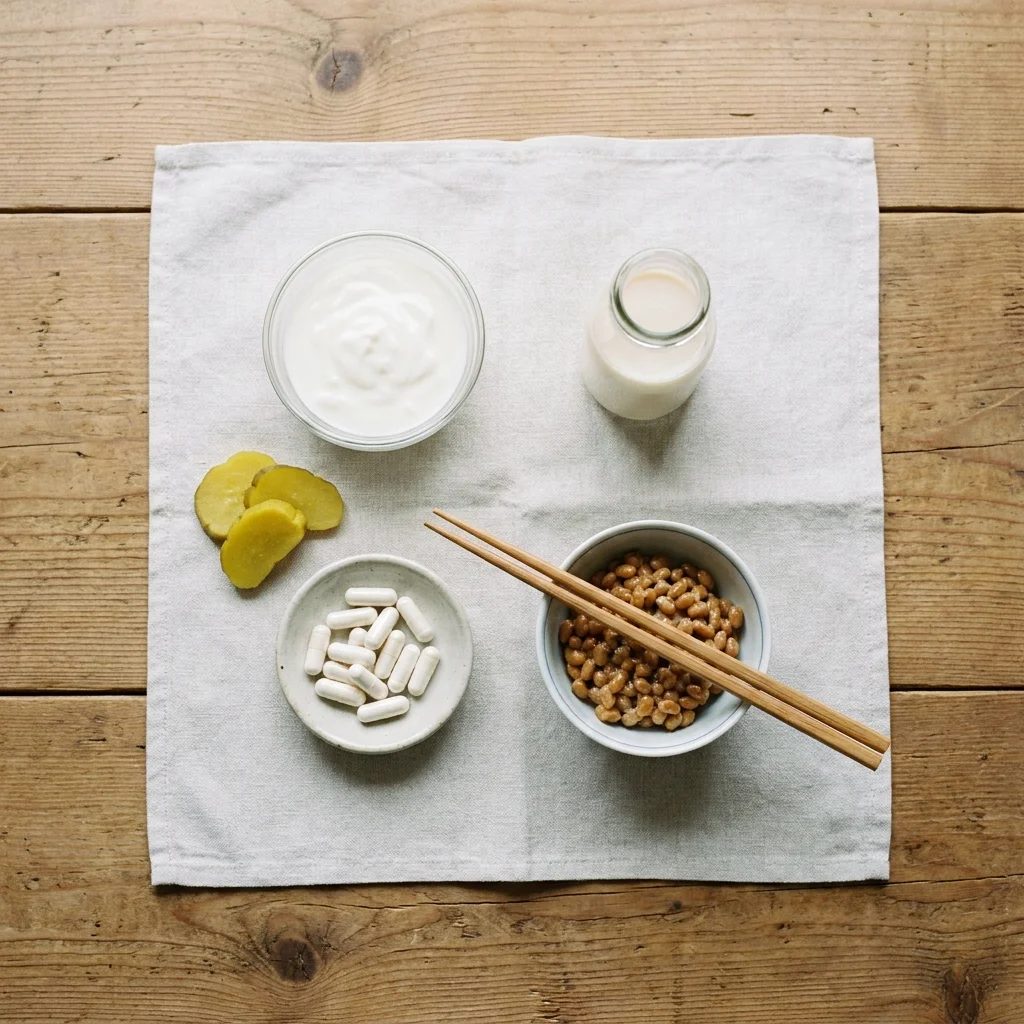
Japanese Probiotics: Why Japan Puts Nyusankin in Everything
Yakult, heat-killed bacteria in chocolate and strain names on every label: a clear guide to Japanese probiotics and lactic acid bacteria, and how to choose them.
In most countries, "probiotic" is a word you find on yoghurt. In Japan, nyūsankin (乳酸菌) — lactic acid bacteria — appears on yoghurt, tablets, chocolate, chewing gum, bottled water and soup. The country that gave the world Yakult has had nearly a century to get comfortable with the idea of putting bacteria in food.
That makes the Japanese probiotics aisle both rich and confusing. This guide explains what the labels mean, the difference between live and heat-killed bacteria, why the strain name matters more than the brand, and how to choose a product that suits you.
What does nyusankin mean on a label?
乳酸菌 literally means "lactic acid bacteria" — a broad group that ferments sugars into lactic acid. On Japanese packs you will also see:
- ビフィズス菌 (bifizusu-kin) — bifidobacteria. Technically a separate group, but sold alongside lactic acid bacteria and often combined with them.
- 有胞子性乳酸菌 — spore-forming lactic acid bacteria, which survive heat and storage well.
- 殺菌乳酸菌 or 死菌 — heat-killed bacteria, explained below.
The phrase on its own tells you little. The useful information is the strain name, usually printed in small type nearby.
A short history: from Shirota to the Yakult Lady
In 1930, Minoru Shirota, a medical researcher at Kyoto Imperial University, cultured a strain of lactic acid bacteria that survived the journey through the stomach. In 1935 he began selling it as a small fermented milk drink called Yakult. Doorstep delivery by "Yakult Ladies" followed in the 1960s, and the drink became one of the most recognisable Japanese products in the world.
That early start explains a great deal. Japanese consumers have grown up with the idea that a specific named strain does a specific job — and Japanese companies market their bacteria accordingly.
Live versus heat-killed: Japan's postbiotic habit
The biggest difference between Japanese probiotics and those sold elsewhere is how much of the market uses heat-killed bacteria. These are not alive, so strictly speaking they are not probiotics — the industry calls them paraprobiotics or postbiotics. They are added to tablets, drinks and even sweets in very large numbers.
| Live bacteria | Heat-killed bacteria | |
|---|---|---|
| Japanese label | 生菌 | 殺菌乳酸菌・死菌 |
| Typical products | Yoghurt, fermented milk drinks, some capsules | Tablets, chocolate, gum, ambient drinks |
| Storage | Often chilled; shelf life limited | Room temperature; long shelf life |
| What they rely on | Surviving digestion and reaching the gut | Components of the bacterial cells themselves |
| Travel well? | Chilled drinks do not | Yes |
Neither type is automatically better. They are different approaches, and the evidence for each depends on the specific strain studied.
Why the strain name matters
Research on probiotics is strain-specific: results for one strain say nothing about another, even within the same species. That is why Japanese labels often lead with a code or trademark rather than a generic species.
A few you will see:
- The Shirota strain — Yakult's original, now behind several of its products.
- LC-Plasma (Lactococcus lactis strain Plasma) — Kirin's heat-killed strain, sold in its iMUSE range. Some of its products are registered as Foods with Function Claims with claims relating to maintaining immune function in healthy people.
- R-1 — Meiji's strain, best known from a small yoghurt drink found in every Japanese supermarket chiller.
- BB536 — a bifidobacterium strain long used by Morinaga.
If a product is a Food with Function Claims, its filing — including the evidence for that strain — is public. Our guide to Foods with Function Claims and FOSHU shows how to look it up.
Food first: Japan's fermented kitchen
Supplements are a modern layer on an old habit. The Japanese table is full of fermented foods:
- Miso — fermented soybean paste, eaten daily as soup. See our Japanese miso guide.
- Nukazuke — vegetables pickled in fermented rice bran, one of the richest everyday sources of lactic acid bacteria.
- Natto — fermented soybeans. Made with Bacillus subtilis var. natto, not lactic acid bacteria, but very much part of the same tradition.
- Yoghurt and fermented milk drinks — a huge category in Japanese supermarkets.
How to choose a lactic acid bacteria supplement
- Find the strain name. If a product only says 乳酸菌 with no strain, you have no way to compare it with anything.
- Live or heat-killed? Choose between a living culture and the convenience of a stable, room-temperature product.
- Check the daily intake guide (1日摂取目安量) and how many bacteria a daily serving provides.
- Check the format. Acid-resistant capsules are designed to protect live bacteria through the stomach.
- Check allergens. Some cultures are grown on milk.
Consistency matters more than any single brand: daily use for several weeks is how these products are designed to be taken. For fitting them into a wider routine, see building a daily supplement routine.
Safety notes
Lactic acid bacteria supplements are foods, designed for healthy adults. If you have a weakened immune system, a serious illness, or are pregnant or taking medication, talk to a doctor first. Products registered as Foods with Function Claims are not aimed at children or people who are pregnant or breastfeeding.
Frequently asked questions
What is the difference between lactic acid bacteria and probiotics? Lactic acid bacteria are a group of microbes. Probiotics are live microbes shown to have a benefit. Many probiotics are lactic acid bacteria, but not all lactic acid bacteria products are probiotics — heat-killed ones, for example.
Do heat-killed lactic acid bacteria work? Some heat-killed strains have been studied for specific effects, and a few Japanese products carry registered claims. As with live bacteria, it depends on the strain.
Is Yakult a probiotic? Yakult contains the live Shirota strain and is one of the oldest probiotic drinks on sale.
Do I need to refrigerate Japanese probiotic tablets? Most heat-killed and many capsule products are stored at room temperature. The pack will say if refrigeration is required.
What does nyusankin mean? 乳酸菌 means lactic acid bacteria — the general term printed on Japanese yoghurts, drinks and supplements.
Start by picking one named strain in a format you will take daily, and give it a few weeks. Browse the range in our probiotics collection or the wider digestive support shelf.