Japanese Retort Curry: The Pouch That Feeds the Country in Five Minutes
Bon Curry invented the shelf-stable curry pouch in 1968. How to heat one properly, read the spice levels, choose between budget and hotel-style, and what to put on top.
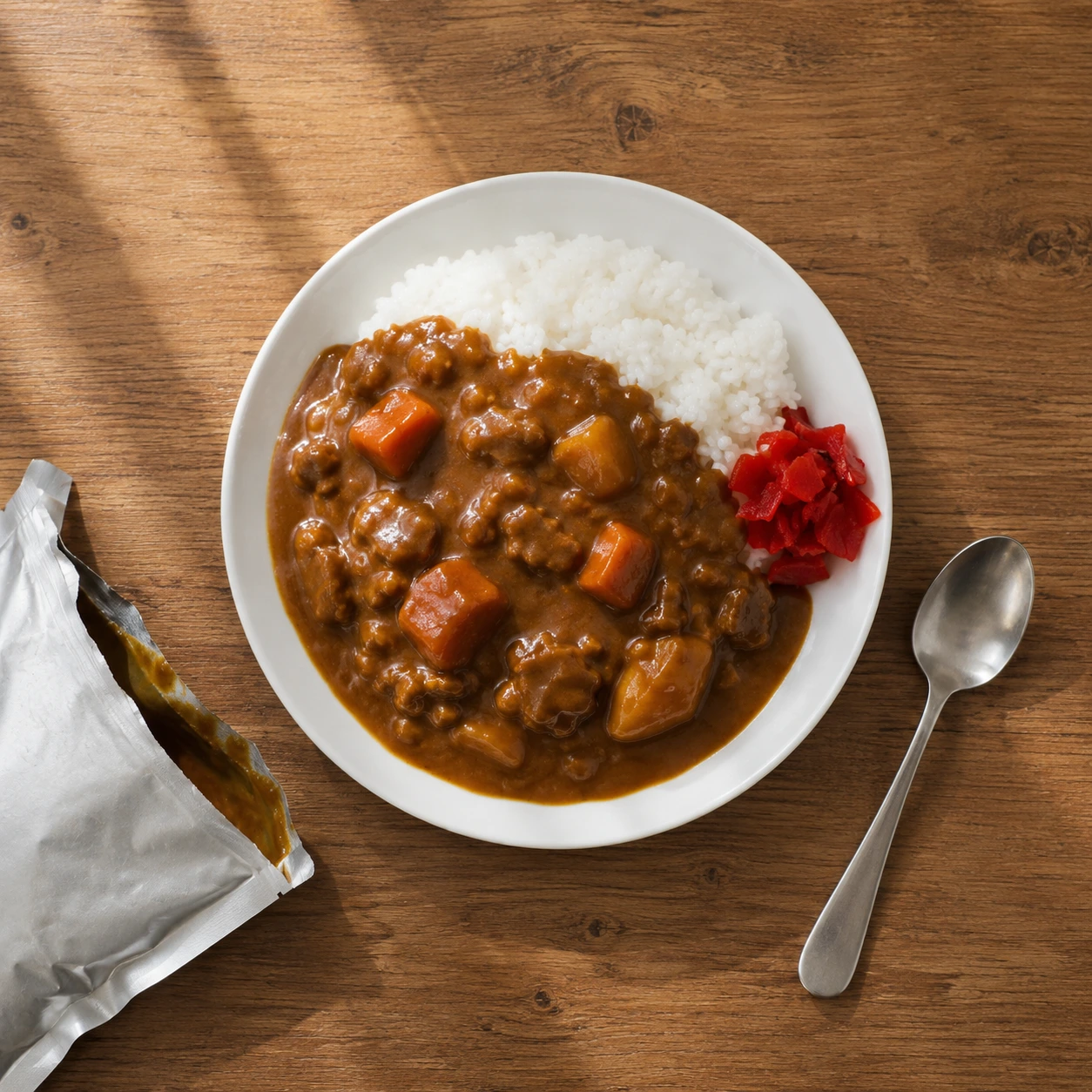
Every Japanese kitchen has a few of these in the cupboard: a flat foil pouch, roughly 180 g, holding a full portion of curry that has already been cooked, sealed and sterilised. Drop it in boiling water for a few minutes, pour it over rice, and dinner exists.
Retort curry is not a compromise. The best pouches are simmered for longer than most people would bother at home, and the category runs from a 100-yen weeknight staple to hotel-branded beef curry.
Here is what the pouch is, how to heat it without ruining it, how to read the spice scale, and how to turn it into a meal.
What a retort pouch is
レトルト (retoruto) comes from the English word retort, the pressure vessel in which the sealed pouch is heated to around 120°C for several minutes. That kills spores as well as bacteria, so the contents keep at room temperature for one to two years with no preservatives. The pouch is a laminate of polyester, aluminium foil and polypropylene: the foil blocks light and oxygen.
Otsuka Foods launched Bon Curry in 1968, the first commercial retort food anywhere, adapting a technology developed for military rations. It made the format a Japanese habit before the rest of the world had heard of it.
Bon Curry's current Gold version is the direct descendant: domestic potato, carrot and onion, a caramelised-onion base and beef umami, in a box that goes straight into the microwave.
Two ways to heat it
In water, the traditional method:
- Bring a pan of water to a rolling boil, enough to submerge the pouch.
- Drop the unopened pouch in and keep the water at a simmer.
- Heat for 3 to 5 minutes; the box states the exact time.
- Lift out with tongs, tear along the notch, and pour.
In the microwave: only if the box says so. Foil pouches spark; microwave types have no aluminium layer, and box-in types stand up in the oven with the top opened. Typical timings are 2 minutes at 500 W or 1 minute 30 seconds at 600 W. Let it rest 30 seconds before opening, because the sauce is hotter than it looks.
The extra-spicy Bon Curry uses the same box format, with habanero puree and red chilli over the beef base: the fastest route from cupboard to something that will make you sweat.
Never open the pouch before it goes in the water. A half-opened pouch fills with water and the sauce thins.
Reading the spice level
The grade is printed large on the front, and the words are consistent across brands, though one maker's 辛口 will not match another's exactly.
| Japanese | Reading | Meaning | What to expect |
|---|---|---|---|
| 甘口 | amakuchi | Mild | Sweet, fruity, children's level; barely any chilli |
| 中辛 | chūkara | Medium | The household default; warmth without heat |
| 辛口 | karakuchi | Hot | Noticeable chilli and pepper, still balanced |
| 大辛 | ōkara | Extra hot | Chilli-forward, often with habanero or Sichuan pepper |
| 激辛 | gekikara | Very hot | Novelty tier; not made by every brand |
If in doubt buy 中辛. It is what most of Japan eats and it is where each brand's recipe is calibrated; the hotter versions are that recipe with more chilli, not a different curry.
House Foods' Curry-ya line is the budget benchmark, and this medium-hot pouch, with cardamom leading a 29-spice blend, is what a great many Japanese lunches actually consist of.
The extra-spicy Curry-ya swaps the cardamom for black pepper and chilli on the same vegetable-and-bouillon base, and is a fair test of whether you actually want 大辛.
Retort versus roux
Home curry is usually built from a roux block: meat and vegetables browned and simmered, the block dissolved in at the end. A roux curry has bigger pieces, a fresher onion sweetness and a sauce you control; a retort curry is smoother, its vegetables softer from the sterilising heat, its flavour more concentrated from hours in a factory kettle.
The two are not competitors. Roux is for Sunday; retort is for the Tuesday you did not plan. The roux guide covers blocks, and the mildest of them is worth knowing if you are feeding children.
This is a roux block rather than a pouch, included because there is no gentler Japanese curry for a small child: apple paste and honey sweeten it well below the level of most retort 甘口.
Beef, keema and the hotel tier
Above the budget lines sits a premium tier that names its bouillon, its beef and often a hotel. These pouches contain identifiable meat rather than fragments and cost three to five times a Curry-ya.
Ginza Curry is the classic of the tier: a two-stage bouillon, amber-fried onion and sliced beef, in the European-influenced Tokyo style the name refers to.
Regional pouches are a hobby in themselves: Hokkaido soup curry, Yokosuka navy curry, Hiroshima oyster curry. Keema, a dry minced-meat curry borrowed from Indian cooking, is now mainstream too.
The keema Curry-ya is drier and ginger-led, and works better with a fried egg on top than the standard version does.
What goes on top
The Japanese additions that make a pouch over rice a good meal:
- Fukujinzuke (福神漬け). The sweet, red, crunchy pickle served with curry everywhere in Japan. Non-negotiable.
- Rakkyo (らっきょう). Pickled shallot bulbs, sharper and sweeter than the pickle; the other standard side.
- A fried or soft-boiled egg. Break the yolk into the sauce.
- Katsu. A fried pork cutlet turns any pouch into katsu curry.
- Cheese or a knob of butter stirred through the hot sauce.
- Leftover sauce over udon with a splash of dashi makes カレーうどん (karē udon), which is a different and equally good dish.
Rice matters more than any topping: short-grain Japanese rice holds the sauce, long-grain runs away from it. The rice guide covers instant pack rice, the honest partner to a pouch.
Shelf life and storage
- Unopened pouches keep 12 to 24 months at room temperature, away from sun. The date is a best-before, not a use-by.
- Do not refrigerate unopened pouches; the fat sets and heating takes longer.
- Once opened, treat it as cooked food: eat it, or refrigerate for a day at most.
- A bloated pouch means the seal failed. Discard it.
Frequently asked questions
Is retort curry the same as canned curry? Same principle, different container. The pouch is thinner, so it sterilises faster and the vegetables survive with more texture.
Can I heat it in a pan? Yes. Empty it into a small pan and warm over low heat, stirring; useful if you want to add meat or vegetables.
Why is the sauce watery on the plate? Under-heating. The pouch needs the full time in properly boiling water so the fat re-emulsifies.
Is it halal or vegetarian? Most contain beef or pork extract, including some vegetable-looking ones. Halal-certified and plant-based pouches exist but are the exception; check the ingredient panel.
A pouch, a bowl of proper rice and a spoonful of red pickle is a dinner half of Japan ate this week. Once you know the spice scale and the water method, the rest is choosing a brand, and the roux guide is where to go when you have time to do it slowly.