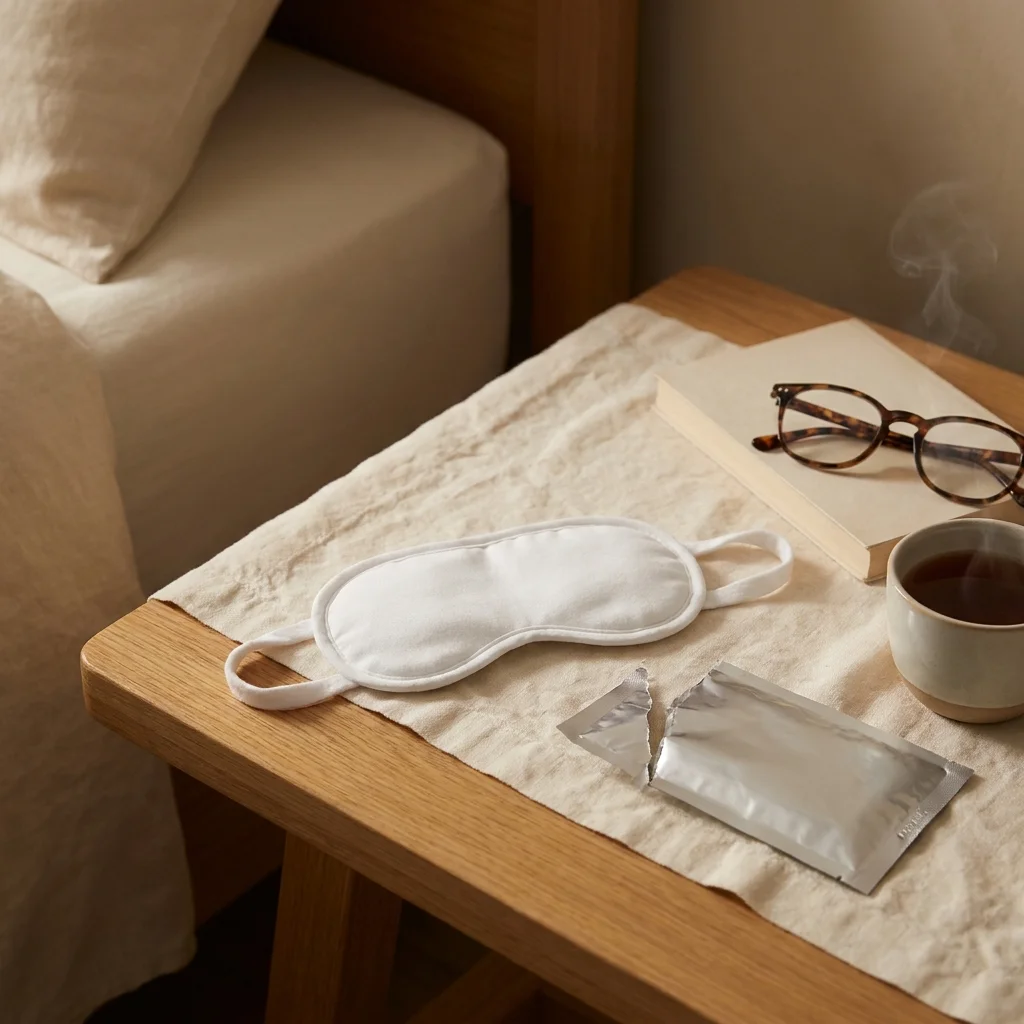
MegRhythm Steam Eye Mask: The Japanese Habit Worth Stealing
The MegRhythm steam eye mask heats itself and lives in carry-on bags all over Japan. How it works, which scent to pick, and when it really earns its place.
Somewhere in Japan right now, a commuter on a late train, an office worker on a lunch break and a passenger on a long-haul flight are all lying back with the same small white mask over their eyes, warm and faintly damp. It is Kao's Megurizumu (めぐりズム) — sold abroad as MegRhythm — and the MegRhythm steam eye mask is one of the most quietly ubiquitous products in the Japanese drugstore.
It is a single-use, self-heating eye mask that releases gentle steam for a short session and then cools down. This guide explains how it works, which scent to choose, when it is worth using, and who should skip it.
What is a MegRhythm steam eye mask?
It looks like a sleep mask made of soft non-woven fabric, with loops that go over your ears. Inside is a thin heating layer. Open the sachet, unfold the mask, put it on, and within a minute or so it begins to warm — not hot, but noticeably warmer than your skin, with a light moist steam you feel more than see.
After a short session — roughly ten to twenty minutes depending on the version — it cools to nothing. Then it goes in the bin. There is no switch, no battery, no microwave and no washing.
How does a self-heating eye mask work?
It runs on the same chemistry as a kairo heat pack: iron powder reacting with oxygen and releasing heat as it oxidises. The difference is control. The reaction in the mask is tuned to a much lower, gentler temperature — around 40°C — and it is paired with moisture, so the warmth arrives as steam rather than dry heat.
That steam is the point. Moist warmth feels softer on the delicate skin around the eyes than a dry heat pad, and it is why the mask feels like a hot towel at a Japanese hair salon rather than a hot-water bottle.
Which MegRhythm scent should you choose?
The core range comes unscented and in several fragrances; the exact line-up rotates, with limited and seasonal editions appearing regularly.
Unscented is the default and the one to buy first. It is the right choice for flights, offices and shared rooms, and for anyone sensitive to fragrance.
Lavender is the evening classic: it turns the mask into a wind-down cue before bed, which is how a great many people in Japan use it.
Chamomile is softer and slightly sweeter, and yuzu — when available — is brighter and citrus-led, better suited to a mid-afternoon reset than to bedtime.
When to use a steam eye mask
| When | Why it works | Version |
|---|---|---|
| Screen break at your desk | Ten minutes with your eyes closed and warm, away from the monitor | Unscented |
| Before bed | A fixed, pleasant routine that signals the end of the day | Lavender or chamomile |
| On a flight | Blocks light, adds warmth in dry cabin air, fits in a pocket | Unscented |
| After a long drive or study session | A reset before the next thing | Any |
| Sunday evening | A small ritual alongside a bath and an early night | Any scented |
The common thread is rest. The mask does not do anything dramatic; it gives you a reason to lie still with your eyes closed for ten minutes, and makes that ten minutes feel good. For many people, that is exactly what was missing.
How to use it properly
- Remove contact lenses and, ideally, eye makeup.
- Tear open the sachet and unfold the mask. It starts warming on contact with air, so open it when you are ready to use it.
- Hook the loops over your ears with the soft side towards your eyes.
- Lie back or lean back, close your eyes, and leave it on until it has cooled.
- Throw it away. Do not reheat, microwave or reuse it.
Follow the instructions on the box for your version, including the usage time.
Who should skip it
Do not use a steam eye mask on eyes that are red, sore, infected or itchy, after eye surgery, or on irritated or broken skin around the eyes. If you notice discomfort or redness, take it off. Use with care on children and people with sensitive skin, and check with a doctor first if you are being treated for an eye condition.
It is also worth being clear about what it is not: it is a comfort product, not a treatment for any eye condition.
Building a small evening routine
The mask works best as one part of a routine rather than a one-off gadget. Japan's version of that routine is a warm bath, a caffeine-free drink, phone face-down, mask on, lights off. If you want to go further, our guides to Japanese eye creams and lutein and eye health supplements cover the rest of the eye-care shelf, and our sleep and stress collection gathers the products people pair with it.
Frequently asked questions
How long does a MegRhythm steam eye mask last? A single session of roughly ten to twenty minutes, depending on the version. The box lists the exact time.
Can you reuse a steam eye mask? No. The heating reaction runs once. Reheating or microwaving it is unsafe and will not restart the steam.
Is MegRhythm safe with contact lenses? Remove your lenses first, as the instructions advise — warm, moist air over lenses is uncomfortable anyway.
Can I use a steam eye mask on a plane? Yes, it is one of the most popular uses. It is self-contained and needs no power — check your airline's rules if in doubt.
Does a steam eye mask help you sleep? It is not a sleep aid, but many people find it a relaxing pre-bed ritual that makes winding down easier.
Do steam eye masks expire? Unopened sachets keep for a long time; check the date printed on the box and store them at room temperature.
Buy a box of unscented for your bag and a box of lavender for the bedside table. That covers flights, desks and evenings, which is where the mask earns its keep.