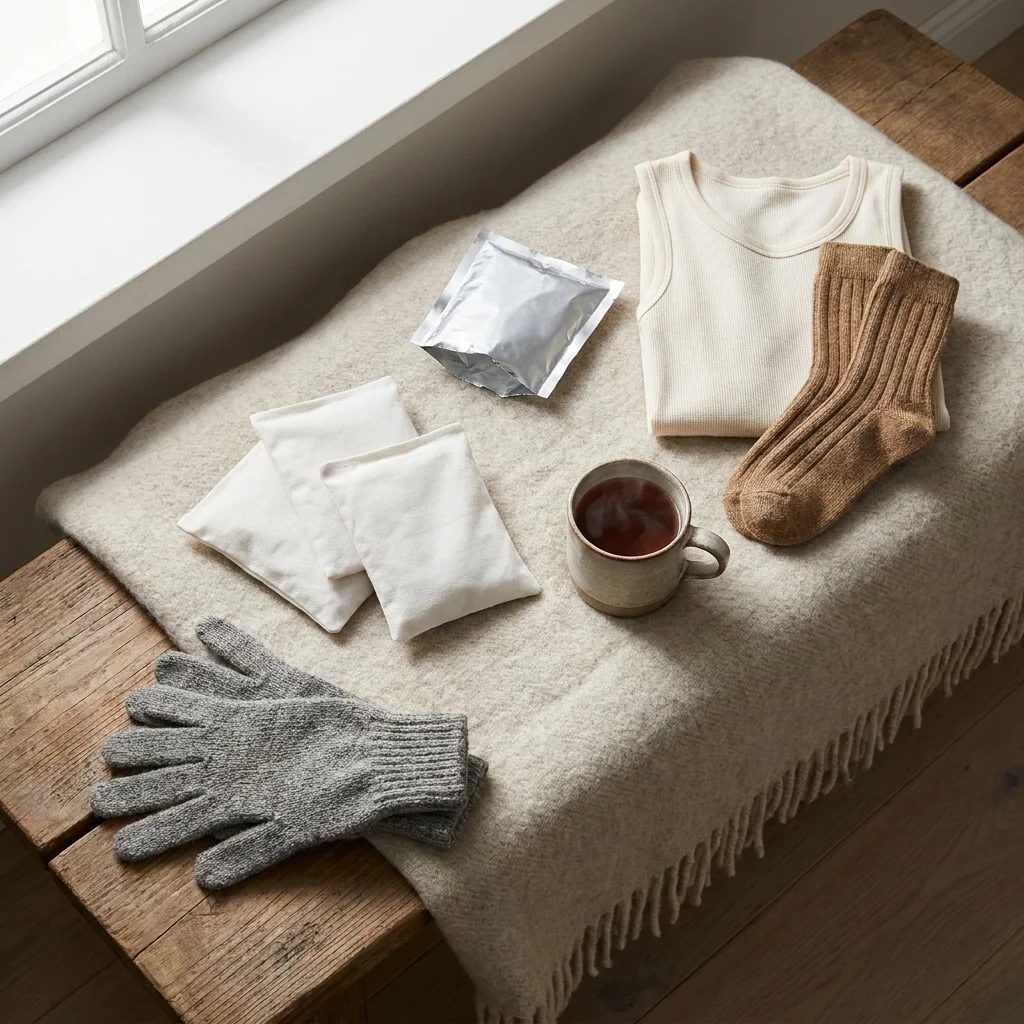
Japanese Heat Packs: How Kairo Work and How to Use Them Safely
Japanese heat packs run on rusting iron and can last most of a day. How kairo work, which type to buy, where to stick them, and the burn nobody warns you about.
Every winter, Japanese convenience stores stack a small flat pouch by the till that first-time visitors tend to mistake for a tea bag. It is a kairo (懐炉) — a disposable heat pack — and once you have spent a cold day with one stuck inside your coat, you understand why Japanese households buy them in boxes of thirty.
Japanese heat packs are cheap, silent, battery-free and surprisingly hot. This guide covers how they work, the four types worth knowing, where to put them, how long they last, and the one safety rule that matters more than all the others.
What is a kairo?
The word translates loosely as "pocket stove": 懐 is the fold at the front of a kimono, 炉 a hearth. The idea is centuries old. In the Edo period people carried onjaku (温石) — stones warmed by the fire and wrapped in cloth. In the 1920s came the catalytic hakukin (白金, "platinum") warmer, which burns benzine slowly over a platinum catalyst and is still sold to anglers and campers today.
The disposable iron-powder kairo arrived in the late 1970s, and Lotte's Hokaron is widely credited as the first on the market. Within a few years it was part of every Japanese winter.
How do Japanese heat packs work?
There is no battery, no fuel tank and nothing to switch on. A kairo is a controlled rusting reaction.
Inside the breathable inner pouch is a mix of:
- Iron powder — the fuel.
- Water — held in an absorbent material, which is why the contents feel dry.
- Salt — speeds up oxidation.
- Activated carbon — holds air against the iron and spreads the heat.
- Vermiculite — a mineral that keeps the water and powder evenly mixed.
The outer wrapper is airtight. Tear it open, and oxygen reaches the iron, which oxidises — rusts — and gives off heat as it does. The fabric of the inner pouch is engineered to let in just enough air to keep the reaction steady rather than flaring. When the iron is spent, the pack cools and is finished. It cannot be recharged, and sealing a half-used pack in an airtight bag only slows the reaction down.
The four types of kairo
| Type | Japanese | Where it goes | Good to know |
|---|---|---|---|
| Non-adhesive | 貼らない (haranai) | Pocket, glove, held in the hand | The classic hand warmer |
| Adhesive | 貼る (haru) | Stuck to the inside of a clothing layer | Back, waist or stomach — always over fabric |
| Foot / toe | 足用・くつ下用 | On socks or shoe insoles | Formulated to keep working in low-oxygen shoes |
| Mini | ミニ | Small pockets, gloves | Smaller, cooler, shorter-lived |
The pocket pack is the one most people picture, but the adhesive kind is what Japan actually wears: stuck to a vest, it heats your core for hours, unseen.
Foot warmers deserve their own mention because a regular pack put in a shoe goes cold almost at once: there is not enough air inside a boot. Toe-specific packs are formulated for that environment, and the adhesive side keeps them on top of the sock rather than balled up under your foot.
Where to put a heat pack
Japanese packaging and pharmacy advice focus on a few places where a single pack feels like it warms far more than its own few square centimetres:
- Lower back. The default spot for an adhesive pack, stuck to a vest or shirt just above the waistband.
- Between the shoulder blades. Popular with commuters and anyone standing still outdoors.
- The stomach. Over clothing, around the navel — common for long cold days.
- Hands. A non-adhesive pack in a coat pocket, held when needed.
- Toes. Foot-specific packs only, on top of the sock.
Avoid putting packs where a belt, strap or tight waistband presses them firmly against you. Pressure concentrates heat in one spot, which is exactly how burns happen.
How long do Japanese heat packs last?
Regular-size packs are typically rated for somewhere between half a day and a full day; minis and foot warmers for fewer hours. The printed duration is measured under standardised test conditions, so real use varies: a pack inside a coat outlasts one in a windy pocket.
Most modern packs need no shaking; if the contents clump, knead gently. Warm-up takes a few minutes, so open the wrapper before you leave the house rather than at the bus stop.
The safety rule: low-temperature burns
This is the part most first-time users never hear about. Japanese packaging warns at length about teion yakedo (低温やけど), the low-temperature burn. It happens when skin stays in contact with something only moderately hot — a temperature that feels comfortable — for a long time. Because it never feels painful, it can go unnoticed, and it can be deeper than it looks.
The rules are simple:
- Never stick a pack directly on skin. Always at least one layer of fabric between you and it.
- Never use one while sleeping, including in bed or on a long nap.
- Never combine with other heat — electric blankets, hot-water bottles, heated seats.
- Move it occasionally so the same patch of skin is not heated for hours.
- Take extra care with children, older people, anyone with reduced sensation (diabetes, for example), and after drinking.
If skin turns red, stings or blisters, remove the pack. A burn from a heat pack is still a burn: get it looked at rather than waiting.
Heat packs are also not for fresh injuries, swellings or broken skin. Never open the inner pouch, and once a used pack has cooled completely, dispose of it under your local household waste rules.
For winter comfort beyond the pocket, a long soak warms the whole body at once — see our guides to Japanese bath salts and Japanese bathing rituals. For the rest of the winter cabinet, there is Japanese cold and throat remedies.
Frequently asked questions
Are Japanese heat packs reusable? No. The reaction runs once, until the iron is fully oxidised. Sealing a pack in an airtight bag slows it down but rarely saves much.
Can you put a heat pack directly on your skin? No. Adhesive packs are designed to stick to clothing, not skin, and direct contact over hours risks a low-temperature burn.
Do regular hand warmers work in shoes? Not well. A shoe has too little air for a standard pack; use toe warmers made for footwear.
How hot do kairo get? Warm enough to burn over time, but not hot to the touch in the way a radiator is. Each pack lists its average and maximum temperature on the box.
Is it safe to sleep with a heat pack? No. Every Japanese manufacturer warns against it, because you cannot move the pack or notice your skin overheating while asleep.
Start with a box of adhesive packs for your back and a few pairs of toe warmers for the coldest days; the full range is in our heat pack and thermal sheet aisle.