Japanese Bath Salts Explained: Carbonated Tablets, Onsen Powders and Milky Bath Essences
Nyuyokuzai turn a plain tub into something closer to a hot spring. Which of the four types to buy, why carbonated baths feel warmer, and the temperature, timing and dosing rules that make a Japanese soak work anywhere.
Japan is a nation of bathers, and the bathroom aisle of any drugstore shows it: a wall of boxes, tablets and sachets designed to turn an ordinary tub of hot water into something closer to a hot spring. The category is called 入浴剤 (nyūyokuzai, bath additives), and it is much broader than the novelty bath bomb sold elsewhere.
Almost everything on that wall does one of three things: warms you more deeply than plain water, softens and moisturises the skin, or simply makes the bath smell and look pleasant. The good products say plainly which, and this guide covers the four types, the science behind the carbonated ones, and the rules of temperature, timing and dosing.
The four types of nyuyokuzai
| Japanese | Reading | Form | What it does |
|---|---|---|---|
| 炭酸ガス系 | tansan-gasu-kei | Fizzing tablet | Releases carbon dioxide for a warming, circulation-boosting soak |
| 無機塩類系 | muki-enrui-kei | Powder or granules | Mineral salts that mimic onsen water and hold heat on the skin |
| 保湿系 | hoshitsu-kei | Milky liquid or oil | Emollient emulsions for dry, tight or atopic-prone skin |
| アロマ・清涼系 | aroma / seiryō-kei | Sachet or tablet | Colour, fragrance, sometimes menthol for summer |
Many products straddle two categories. The phrase 医薬部外品 (iyakubugaihin, quasi-drug) on the box means the warming or skin claim has been registered with the ministry rather than simply asserted.
If you only try one type, make it a carbonated tablet. It is the format that feels most obviously different from a plain hot bath.
The ginger-and-carbonation formula is the archetype of the warming tablet, aimed at people who feel the cold and go to bed tired, with sweating and circulation as the stated purpose rather than fragrance.
Why a carbonated bath feels warmer than it is
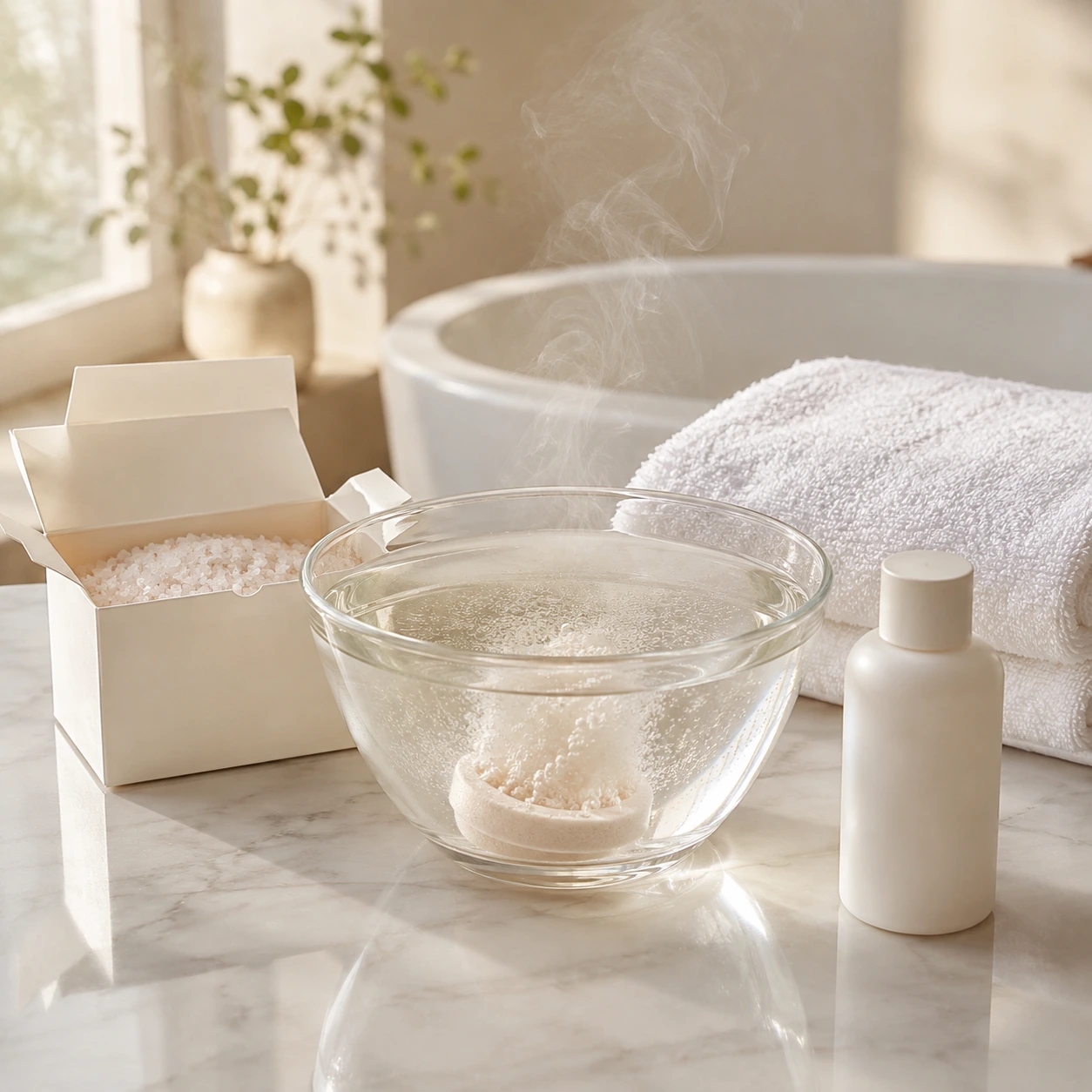
The tablet is essentially sodium bicarbonate and an organic acid such as fumaric acid. In water they react and release carbon dioxide. The fizzing is over in a few minutes, but a meaningful amount of gas stays dissolved for an hour or more, and that is the part that matters.
Dissolved carbon dioxide passes through the skin and widens the small blood vessels beneath it. Blood flow to the skin rises, the skin warms, and the body reads the water as hotter than the thermometer says. That is why carbonated baths are recommended slightly cooler than plain water: the same sense of heat with less strain on the heart, and warmth that lingers after you step out.
Let the tablet dissolve fully before you get in, and do not run jets, which strip the gas out within minutes.
The salt-carbonated version pairs the fizz with mineral granules and a cloudy sea-green water, which is as close as a home bath gets to a coastal hot spring without the sulphur.
Onsen minerals and the hot spring at home
Powdered products lean on a different mechanism. Sodium sulphate, chloride and bicarbonate form a thin film on the skin that slows evaporation, so heat is not lost as quickly once you leave the water.
Bicarbonate, known in Japan as 重曹 (jūsō), has a second job. It is mildly alkaline and emulsifies sebum and dead surface cells, which is why springs rich in it are called 美人の湯 (bijin no yu, the bath of beauties): the water feels slippery and the skin comes out smoother.
The V tablet carries a processed vitamin C derivative into a milky yellow bicarbonate bath scented with herbs, which makes it the more skin-focused of the pair.
The CO tablet is the bedtime one: the same bicarbonate warming, a milky white bath and a collagen-based moisturiser so the skin does not feel tight afterwards.
A 30 g sachet can only approximate real spring water, but it reliably reproduces the heat retention and the feel, which for a home tub is most of the point.
Milky essences for dry and atopic-prone skin
Hot water removes lipids from the skin barrier, and a long soak can leave dry skin tighter than before. The 保湿系 essences disperse emollients through the bath so a fine film is deposited as you sit in it.
Curél's bath essence is the reference product in this class: a fragrance-free, colourant-free, alcohol-free quasi-drug built for ceramide-poor skin and explicitly suitable for babies, which is the most reassuring sensitivity test a bath product can pass.
The Japanese convention after a moisturising bath is not to rinse. Pat the skin dry and apply body lotion within a few minutes while the surface is still damp. The tub will be slippery, so hold the rail.
Temperature, time and the wash-first rule
Japanese bathing is a fixed sequence, and the additive only works properly inside it. The ofuro, onsen and sento guide covers the full ritual; the short version follows.
- Fill the tub to 38–40 °C. Above 42 °C the body shifts into alert mode and the bath should be short.
- Add the product to the full tub and let it dissolve. Japanese dosing assumes 200 L of water, roughly a full domestic tub: one tablet, one 30 g sachet or one capful of essence. Halve it for a small European tub.
- Wash first, then soak. Shower outside the tub, rinse, then get in. The water stays clean and the skin is already warm when the minerals reach it.
- Soak for 10–15 minutes. Sweat on the forehead is the usual signal to stop.
- Drink around 200 ml of water afterwards. If sleep is the goal, finish about 90 minutes before bed so the drop in core temperature coincides with lying down.
Sensitivity, colourants and the shower-only flat
Most colourants in nyuyokuzai are food-grade dyes at very low concentration and wash away without staining acrylic or enamel. Sulphur-type products are the exception: they discolour metal fittings and are usually forbidden in tubs with a reheating loop, so read the line about 追い焚き (oidaki, reheating) on the box.
If you have reactive skin, start with an unscented essence, and try any fragranced tablet in a foot bath first.
A foot bath is also the honest answer for a flat with no tub. A basin holding 5–8 L of water at around 42 °C, feet in for 15 minutes, warms the whole body through the legs. Use a quarter of a tablet or a teaspoon of powder, and top up with hot water as it cools.
Frequently asked questions
Can I combine two products in one bath? A carbonated tablet with a moisturising essence is a common pairing. Do not combine two carbonated products, and never mix a sulphur product with anything.
Are bath tablets safe for children? Essences that state they suit babies are. For fizzing tablets, keep the water at 38 °C and the soak to 10 minutes, and keep the tablet out of small hands.
Should I rinse off afterwards? Not after a moisturising essence, which is meant to stay on the skin. After a fragranced tablet a quick rinse is fine if the scent bothers you.
Why does the water go cloudy? Milky types contain emulsified oils or fine mineral particles that scatter light. It is deliberate.
Fill it to 40 °C, wash first, and give the tablet time to dissolve; the rest is the fifteen minutes you allow it. Follow the soak with something from the body lotion and body wash guide, and see the winter dry skin routine if your skin tightens after bathing.