Japanese Body Wash and Body Lotion Explained: Foam, Ceramides, Urea and the Three-Minute Rule
Why Japan lathers body wash on a towel, the difference between a body milk and a cream, what ceramide, urea and heparinoid formulas each target, and why the lotion has to go on within minutes of the bath.
Japanese body care is organised around the bath. The wash happens seated, before getting into the tub; the moisturiser happens in the three minutes after getting out, while the skin is still warm and damp. Every product in the aisle is designed around that sequence.
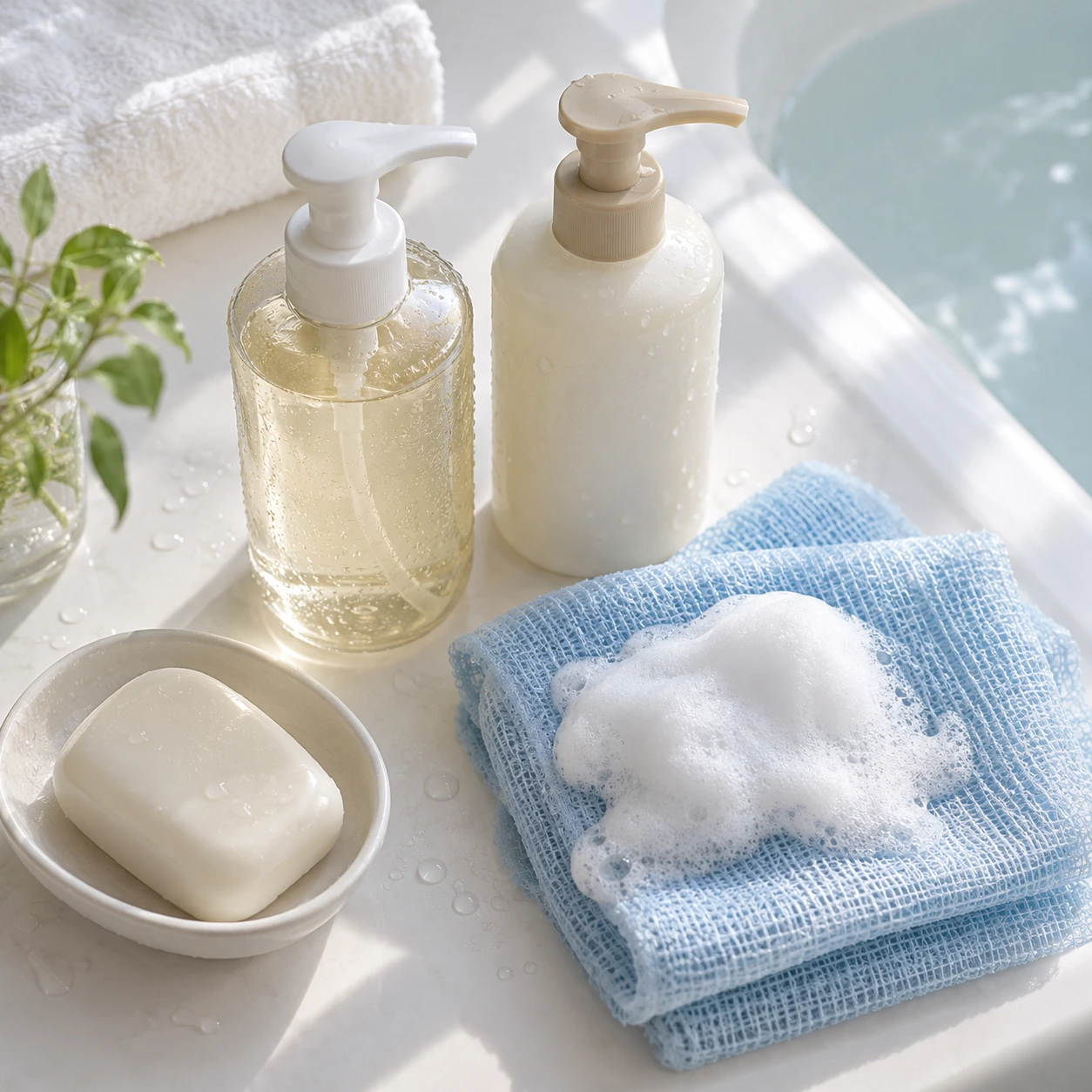
Two habits stand out. The first is that body wash is never applied directly to the skin: it is worked into foam on a towel or net first. The second is that the moisturiser is usually a light, fast-absorbing milk rather than a cream, because it has to cover the whole body quickly in a warm bathroom.
Lather on a towel, not on the skin
The Japanese bath towel (ボディタオル, bodi taoru) is a long strip of nylon or cotton, roughly 100 cm by 25 cm, sold in grades from soft to firm, and its job is to turn a little wash into a lot of foam.
- Wet the towel and wring it once.
- Add one pump of body wash — about 3 ml — to the middle of the towel.
- Fold it over and rub the two halves together for ten seconds until the foam is thick and white.
- Wash with the foam, using the towel with light pressure or the hands alone for the face, chest and anywhere dry.
- Rinse thoroughly, including under the arms and behind the knees, then rinse and hang the towel.
Cow Brand's Bouncia made creamy lather a selling point on its own: the foam is dense enough to hold, and its white-soap scent is the one most Japanese people associate with being clean.
Which wash: amino acid, soap, or both
Soap-based formulas (石けん系, sekken-kei) lather hardest and rinse cleanest, and suit resilient skin. Amino-acid formulas (アミノ酸系, aminosan-kei) are milder, keep the skin's mildly acidic surface (弱酸性, jakusansei) intact, and are what dermatology-adjacent brands use.
If the skin is ever itchy after a bath, switch to an amino-acid wash before changing anything else. It is the single change that resolves the most complaints.
Curél's body wash is the reference amino-acid formula for dry skin: quasi-drug registered, fragrance-free and built to clean without stripping ceramides from the stratum corneum.
Minon's full-body shampoo does the same job for a household that wants one bottle for hair, face and body, including for babies.
The fragrance question
Japan's dominant body-care scent is not floral or fruity but soap itself. The category is called 石けんの香り (sekken no kaori, "soap scent") or シャボン (shabon), and it describes the clean, faintly powdery smell of a plain white bar. It is deliberately unassertive; a body wash is not expected to compete with perfume or the person next to you on the train.
Fragrance-free (無香料, mukōryō) is the other major category and is standard for anything sold for dry or sensitive skin.
Milk, cream, oil or gel
| Japanese | Reading | Texture | Best for |
|---|---|---|---|
| ボディミルク / 乳液 | bodi miruku / nyūeki | Light emulsion, pump bottle | Daily all-over use, warm months, normal to dry skin |
| ボディクリーム | bodi kurīmu | Thick, jar or tube | Winter, shins, elbows, very dry skin |
| ボディオイル | bodi oiru | Oil, applied to damp skin | Sealing after milk, massage |
| ジェルローション | jeru rōshon | Water-based gel | Summer, oily or acne-prone backs, babies |
The Japanese default is the milk, dispensed from a 300–400 ml pump. It covers the whole body in under a minute while the skin is still damp; a cream is too slow.
Reihaku's hatomugi milk is the archetype of the daily pump: light, fast, non-sticky, and sized at 400 ml so that daily use does not feel extravagant.
Curél's body emulsion is the milk to move to once dryness is persistent: a quasi-drug formula that still goes on fast enough for the whole body.
Ceramide, urea, heparinoid: what each one targets
| Japanese | Reading | Ingredient | Targets |
|---|---|---|---|
| セラミド | seramido | Ceramides | Barrier repair, roughness, itching, eczema-prone skin |
| 尿素 | nyōso | Urea | Rough, scaly skin; 10% moisturises, 20% softens hard heels |
| ヘパリン類似物質 | heparin ruiji busshitsu | Heparinoid | Deep dryness and cracking; a medical moisturiser at 0.3% |
Ceramides are the lipids that hold the stratum corneum together, and skin that flakes or itches is nearly always short of them. Urea is a humectant that also loosens dead cells, which is why it can sting on broken skin. Heparinoid is the ingredient in the Japanese pharmacy's medical moisturisers, and the answer when ceramides alone are not enough.
Rohto's CareCera emulsion carries eight natural ceramides and is the one to reach for when the problem is roughness and reaction rather than simple dryness.
A urea milk like Fine Today's suits the shins, upper arms and anywhere the skin has gone scaly; keep it off freshly shaved or broken skin.
Atopita's whole-family milk is formulated for repeatedly dry, flaky skin and is usable from newborn age.
The three-minute rule
Japanese body-care advice repeats one number: お風呂上がり3分以内 (ofuro-agari sanpun inai), within three minutes of leaving the bath. Warm, damp skin loses water fast, and moisturiser applied after it has dried out has less to seal in.
- Pat dry, do not rub. Leave the skin slightly damp.
- Milk first, shins and forearms before the torso, since they dry fastest.
- Cream or oil over the milk on any area that is still rough after a week.
Dry winters and hard water
Japanese winters are dry indoors, and the domestic advice translates to any heated home.
- Keep the bath at 38–40°C and under fifteen minutes. Hotter water strips lipids faster than any wash.
- Do not wash the whole body with the towel daily in winter; shins and forearms often need only water.
- Hard water leaves soap residue. Soap-based washes react with the calcium in hard water and leave a film that itches. Amino-acid washes do not.
- Switch milk to cream on the shins from December to March.
Frequently asked questions
Can I use body milk on my face? Several Japanese products are labelled 顔・からだ用 (face and body), and those are fine. Ordinary body milks are not tested for the face and may clog.
Is a bath towel too harsh? The soft nylon grades are not, used with foam and light pressure. Firm grades exfoliate and should not be used daily.
Do I need body lotion if my skin is not dry? Not necessarily. Japanese practice is to moisturise the areas that dry first — shins, elbows, hands — and leave the rest.
What about babies and children? Amino-acid washes and fragrance-free ceramide milks marked for newborn use are the standard.
Foam on a towel, rinse, three minutes, milk. The bath itself is in the bathing rituals guide, the salts in the bath salts guide, and the face in the winter dry skin routine.