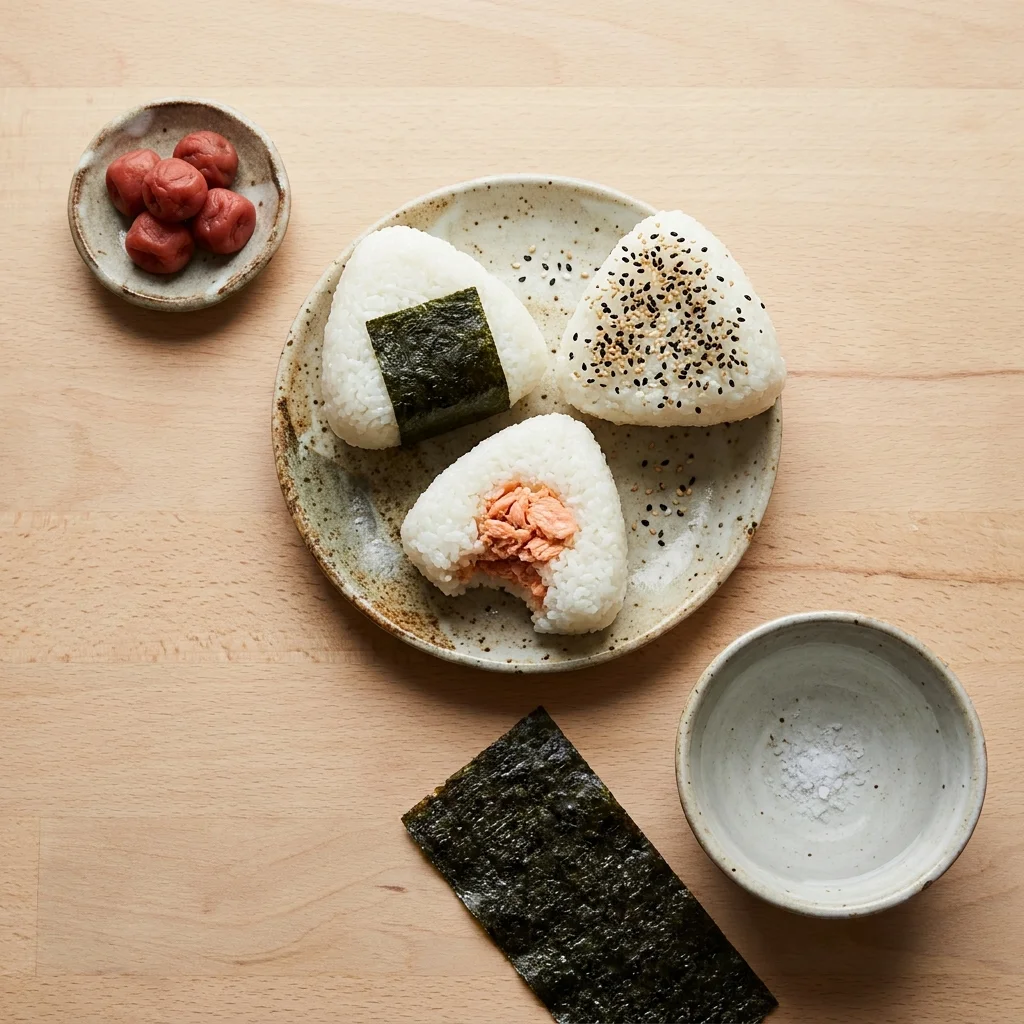
How to Make Onigiri: Japanese Rice Balls, Fillings and Folds
How to make onigiri the way Japanese home cooks do: the right rice, salted hands, six classic fillings, and the nori trick that keeps every rice ball crisp.
Every Japanese convenience store has a wall of onigiri, and almost every Japanese home cook can make one without thinking. It is the country's default portable meal: rice, salt, a filling, sometimes a strip of seaweed, shaped by hand in under a minute.
It also looks easier than it is. Learning how to make onigiri properly comes down to three things: the right rice at the right temperature, wet and salted hands, and pressure that is firm on the outside and loose in the middle. Here is the method, the classic fillings, and the details that separate a rice ball from a rice brick.
What is onigiri, and is it sushi?
Onigiri (おにぎり), also called omusubi, is a ball of plain cooked rice shaped by hand. It is not sushi. Sushi rice is seasoned with vinegar, sugar and salt; onigiri rice is seasoned only with salt, usually from the cook's hands. The filling sits in the centre, and a sheet of nori is often wrapped around the outside.
Onigiri exist because cooked rice that has been salted and pressed travels well. They have been packed for journeys, school and work for centuries, and they remain the backbone of the Japanese bento.
Start with the right rice
The rice matters more than anything else. Use Japanese short-grain rice. Its stickiness is what holds the ball together without vinegar, and long-grain rice will simply fall apart.
Cook it slightly firmer than usual and shape it while warm. Hot rice burns your hands and turns gummy; cold rice will not stick. Spread freshly cooked rice in a bowl for a few minutes to let the steam escape, then start shaping while it is still comfortably warm.
As a guide, two rice-cooker cups (2 gō, about 360 ml) of uncooked rice gives roughly six onigiri of 100–110 g each. If you do not cook rice every day, a microwave pack is a perfectly good shortcut.
Heat it, let it stand for a minute so it is warm rather than scalding, and shape as below. More on rice varieties in our Japanese rice guide.
How to make onigiri, step by step
- Set up. A bowl of cold water, a small dish of fine salt, your fillings, and nori cut into strips or half-sheets.
- Wet and salt your hands. Dip your hands in the water, shake off the excess, and rub a small pinch of salt across both palms. The water stops sticking; the salt seasons the outside of the rice.
- Take about 100 g of warm rice into one palm and flatten it slightly.
- Make a dent in the middle with your fingers and add about a teaspoon of filling.
- Close it up with a little more rice on top, so the filling is fully enclosed.
- Shape. Cup your hands, the top hand bent into a "V", and press firmly two or three times. Rotate the ball a third of a turn and repeat until you have a triangle. Do not knead: the outside should hold, the inside should stay loose.
- Wrap with nori now for a soft wrapper, or just before eating for a crisp one.
The classic shape is the triangle (sankaku), but round and barrel shapes (tawara) are just as traditional. Barrels fit neatly into a lunch box.
The classic onigiri fillings
| Filling | Japanese name | Taste | Packs well? |
|---|---|---|---|
| Pickled plum | Umeboshi | Sharp, salty, sour | Very well |
| Salted salmon | Shake | Savoury, mild | Well, eat same day |
| Tuna mayonnaise | Tsuna mayo | Rich, creamy | Keep cool |
| Bonito and soy | Okaka | Smoky, savoury | Well |
| Simmered kelp | Kombu | Sweet-salty | Very well |
| Salted kelp, mixed in | Shio kombu | Salty, umami | Well |
Umeboshi is the traditional choice, and the one most associated with packed lunches. A whole small plum or a few torn pieces is enough; remove the stone first.
Tuna mayo is the convenience-store favourite: canned tuna, drained well, mixed with Japanese mayonnaise and a dash of soy sauce. Japanese mayo is richer and tangier than most Western versions, and it is the reason the filling tastes the way it does.
For okaka, toss bonito flakes with a few drops of soy sauce. For salmon, grill a salted fillet, flake it and pick out the bones.
Some fillings work better mixed through the rice than hidden inside. Shio kombu, salted kelp strands, is the easiest: fold a tablespoon through a bowl of warm rice and shape as usual. Furikake works the same way. See our furikake and rice toppings guide for more.
Nori: crisp or soft?
This is a matter of taste, and Japan is split. Convenience-store onigiri use a clever plastic wrapper that keeps the nori separate until you open it, so it stays crisp. Home-made onigiri for a lunch box are usually wrapped straight away, and by lunchtime the nori has softened and clings to the rice. Both are correct.
For crisp nori at home, pack the nori separately and wrap just before eating. Pre-cut onigiri sheets remove the only fiddly part.
Moulds, grilled onigiri and onigirazu
If shaping by hand is not working, a plastic onigiri mould gives a neat triangle every time. Wet it first so the rice releases cleanly.
Two variations are worth knowing. Yaki onigiri are plain onigiri brushed with soy sauce or miso and grilled until crisp and browned, a favourite at izakaya and barbecues. Onigirazu skip the shaping altogether: rice and fillings are laid on a full sheet of nori, folded like an envelope and cut in half. The style was popularised by a cooking manga and works well with bulky fillings.
You will find shaping tools in our sushi and onigiri tools section.
How to store onigiri
Onigiri are best eaten the day they are made. Refrigeration makes cooked rice hard and dry, so keep them wrapped in cling film somewhere cool and eat within the day. If they have to go in the fridge because of a perishable filling such as tuna mayo, warm them briefly in the microwave before eating.
Frequently asked questions
Can you make onigiri with leftover rice? Yes, but reheat it first until it is warm and steamy. Cold rice will not stick together, however hard you press.
Why do my onigiri fall apart? Usually the rice is too cold, the wrong variety, or not pressed firmly enough on the outside. Use warm Japanese short-grain rice and press with cupped hands, not your fingertips.
Do you put vinegar in onigiri rice? No. Onigiri use plain cooked rice seasoned with salt. Vinegared rice is for sushi.
How long do onigiri last? They are best within a day, kept cool. Fillings like umeboshi and kombu travel better than mayonnaise-based ones.
Can you freeze onigiri? Plain or salted onigiri without nori freeze reasonably well wrapped individually. Reheat in the microwave until hot through, then add the nori.
Start with salt, warm rice and an umeboshi in the middle. Once that shape comes easily, everything in our bento box guide gets simpler.