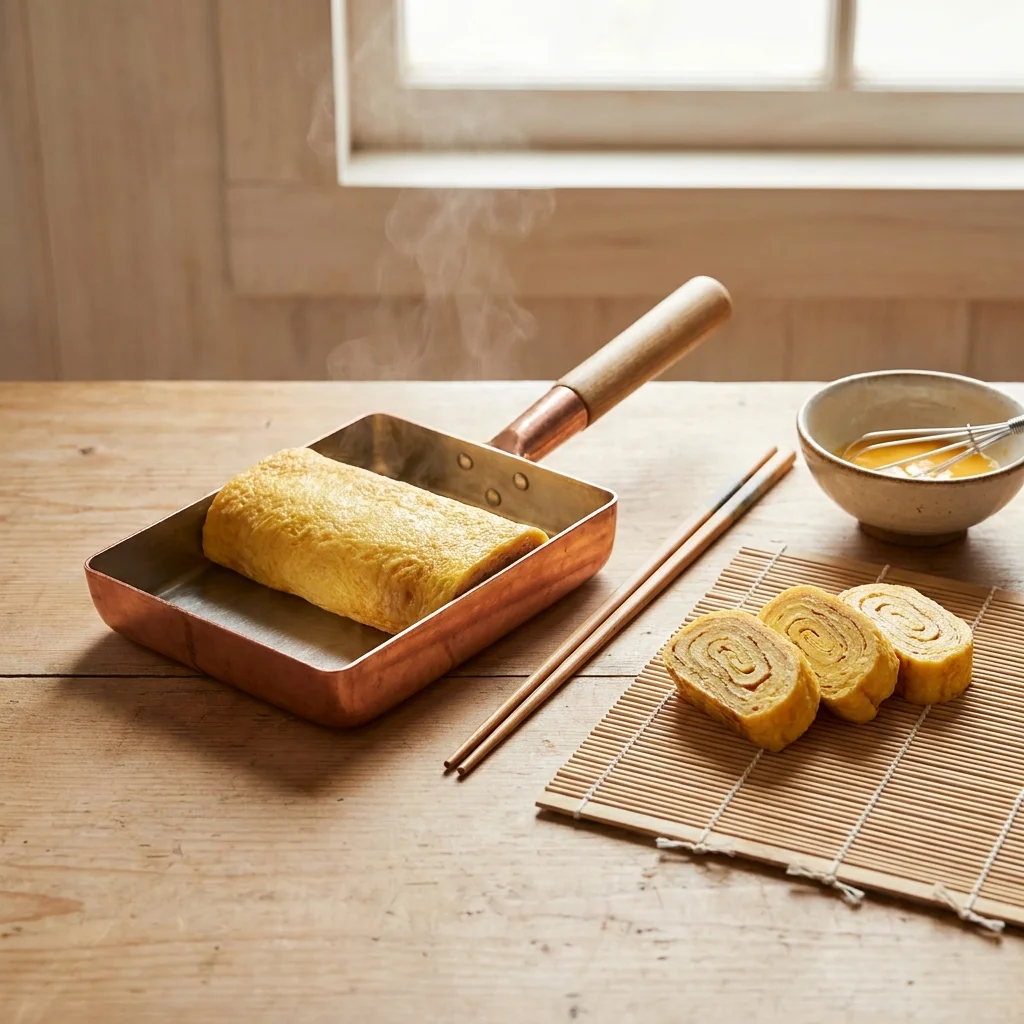
How to Make Tamagoyaki: Japan's Rolled Omelette, Done Right
How to make tamagoyaki at home: sweet Tokyo-style or dashi-rich dashimaki, the right pan for you, and the rolling technique that turns thin layers into a block.
Tamagoyaki looks like a trick. A neat golden block of egg, cut to reveal a spiral of fine layers, sitting in a lunch box or on top of sushi rice. It is not a trick, though. It is a technique, and like most Japanese kitchen techniques it rewards ten minutes of attention more than any special talent.
This guide covers how to make tamagoyaki at home: the two regional styles, which pan to buy, a recipe for each, and the step-by-step rolling method, plus the mistakes that turn a layered omelette into scrambled egg.
What is tamagoyaki?
Tamagoyaki (卵焼き) means "grilled egg". It is a rolled omelette built from several thin layers of seasoned egg, each one cooked and rolled around the last in a rectangular pan. Sliced, it shows a spiral cross-section.
It is a fixture of Japanese home cooking. It appears in bento lunch boxes, at breakfast, on the conveyor belt at sushi bars as tamago nigiri, and on the side of almost any set meal.
Sweet or savoury: Kantō tamagoyaki vs Kansai dashimaki
Japan's two great culinary regions disagree about egg, as they do about most things.
| Kantō style (Tokyo) | Kansai style (Osaka, Kyoto) | |
|---|---|---|
| Name | Tamagoyaki | Dashimaki tamago |
| Seasoning | Sugar and soy sauce | Dashi and light soy sauce |
| Texture | Firmer, slightly caramelised | Soft, juicy, wobbly |
| Colour | Golden, often with light browning | Pale yellow |
| Typical use | Bento, sushi | Served warm, with grated daikon |
Sweet tamagoyaki is easier to roll, because sugar helps the egg set. Dashimaki carries more liquid, which makes it juicier and harder to handle. Start with the sweet version.
Which tamagoyaki pan should you buy?
A rectangular pan is not strictly necessary, but it makes the job much easier. The straight sides give you a neat block without trimming. Shapes vary by region: Kantō pans are close to square, while Kansai pans are a longer rectangle.
| Material | Pros | Cons |
|---|---|---|
| Tin-lined copper | Fast, even heat; the traditional choice of sushi chefs | Needs care; not induction-compatible |
| Iron | Durable, improves with seasoning, induction-friendly | Heavy; must be dried and oiled |
| Non-stick aluminium | Light, forgiving, easiest for beginners | Coating wears over time |
Copper is the professional's pan. It reacts instantly to the heat, which gives you control over each layer.
Iron is the long-life option. Once seasoned, it releases egg well and will outlast you.
Non-stick is where to start if you are learning. The technique is the hard part; there is no reason to fight the pan as well.
You will find the full range in our tamagoyaki pans section, and more on materials in the Japanese pots and frying pans guide.
Tamagoyaki recipes: sweet and dashimaki
Both recipes use three eggs and fill a standard tamagoyaki pan.
Sweet tamagoyaki (Kantō)
- 3 eggs
- 1 tbsp sugar
- 1 tsp soy sauce
- 1 tbsp water
- A pinch of salt
Dashimaki tamago (Kansai)
- 3 eggs
- 60 ml dashi
- 1 tsp light (usukuchi) soy sauce
- 1 tsp mirin
- A pinch of salt
For the dashi, use home-made stock or dissolve a little instant dashi in hot water and let it cool before adding. See Japanese dashi explained for the difference it makes.
How to roll tamagoyaki, step by step
- Beat the eggs gently. Use chopsticks in a side-to-side cutting motion to break up the whites without whisking in air. Bubbles make holes. Stir in the seasoning until the sugar dissolves.
- Heat and oil the pan. Medium heat. Fold a piece of kitchen paper, soak it in neutral oil and wipe the whole pan, corners included. Keep the paper for later.
- Test the heat. A drop of egg should sizzle and set at once.
- Pour the first layer. About a quarter of the mixture, tilted to cover the base. Pop any large bubbles with chopsticks.
- Roll while the top is still wet. When the egg is set underneath but still slightly runny on top, roll it from the far end towards you in three or four folds.
- Push the roll back to the far end of the pan. Wipe oil over the empty part, and lift the roll to oil underneath it too.
- Pour the next layer and lift the roll so raw egg flows underneath. This is what glues the layers together.
- Repeat until the mixture is used up. Each layer rolls around the last.
- Shape it. Turn the omelette onto a bamboo rolling mat (makisu), wrap it firmly and leave it for five minutes to set. Slice into 2 cm pieces.
Common tamagoyaki mistakes
- Pan too cool: the egg sticks, stays pale and will not set fast enough to roll.
- Pan too hot: the egg bubbles, browns and turns rubbery before you can move it.
- Layers too thick: the roll will not close and the spiral disappears.
- Waiting too long: a fully set top will not bond to the next layer. Roll while it is still wet.
For dashimaki, keep the heat slightly higher and the layers thinner. The extra liquid makes it softer and more fragile, so expect your first attempts to look rustic.
Caring for copper and iron tamagoyaki pans
Copper. Never heat a tin-lined copper pan empty on high heat; tin has a low melting point. Use wooden or silicone tools, wash by hand in hot water, and dry straight away. See our copper collection for more.
Iron. Follow the maker's first-use instructions; many new iron pans need seasoning or a protective coating burned off. After cooking, wash with hot water and a brush, dry it on the stove, and wipe on a thin film of oil before storing.
Non-stick. Low to medium heat only, soft tools, no metal scourers.
Frequently asked questions
Can you make tamagoyaki without a tamagoyaki pan? Yes. Use a small round frying pan, roll the layers the same way, and square off the shape in a bamboo mat. Trim the rounded ends if you want neat slices.
Why is my tamagoyaki full of holes? Air bubbles. Beat the eggs gently with chopsticks rather than a whisk, and pop large bubbles in the pan as each layer cooks.
Is tamagoyaki eaten hot or cold? Both. Dashimaki is best warm. Sweet tamagoyaki is often eaten cold, especially in bento.
What is the difference between tamagoyaki and dashimaki? Tamagoyaki is the general name and, in Tokyo, usually the sweet version. Dashimaki is the Kansai style made with plenty of dashi, softer and more savoury.
How long does tamagoyaki keep? Wrapped in the fridge, a day or two. Pack it cool in bento and eat it the same day.
Start with the sweet recipe and a non-stick pan, then graduate to copper and dashimaki once the roll comes easily. For the lunch box it belongs in, see our bento box guide.