Yukihira, Iron and the Tamagoyaki Pan: A Guide to Japanese Pots and Frying Pans
Why every Japanese kitchen has a yukihira pan, how iron, stainless, aluminium and non-stick compare, and how to roll a tamagoyaki. Sizes for one or two people, induction, and what to buy first.
A Japanese home kitchen is usually small, with a two-burner hob and very little storage, and the cookware reflects that. A few pans do everything, each chosen for a specific job, with a strong preference for materials that last decades over coatings that last three years.
Three pieces turn up in almost every household: a light lidded saucepan called a yukihira, a frying pan, and a rectangular egg pan for rolled omelettes. Add a clay donabe for rice and hotpot, and that is the whole kit.
The yukihira pan
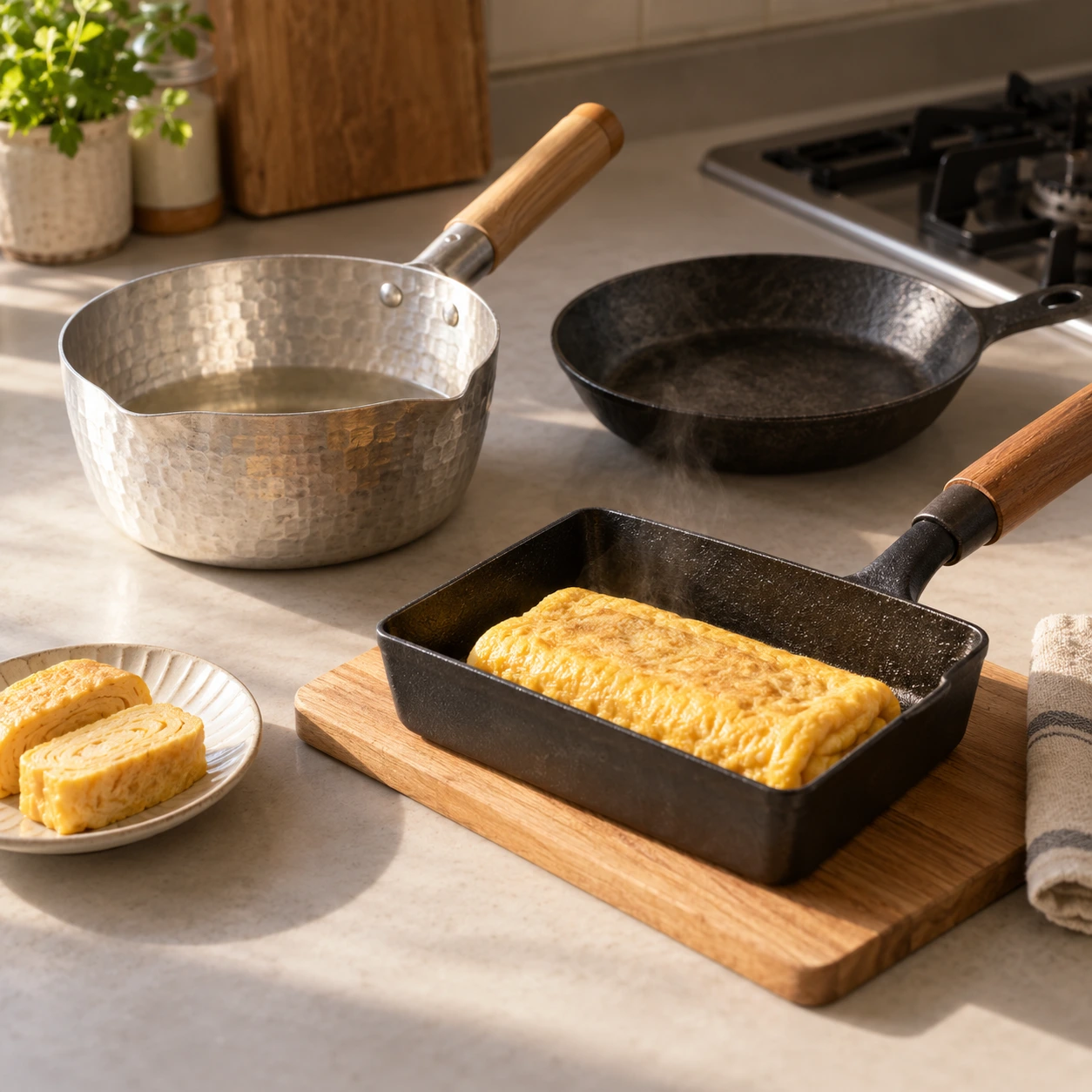
行平鍋 (yukihira-nabe) is the saucepan of Japan: a shallow, flared pan with a pouring lip on one or both sides, a single wooden handle and, traditionally, a hammered aluminium body. The dimples add strength and surface area, the pan weighs almost nothing, and aluminium heats faster than any other common cookware metal.
It handles everything liquid: blanching, dashi and miso soup, simmering fish, boiling noodles. The lip is why it replaces a saucepan rather than joining it; you decant stock one-handed without a ladle.
If you buy one Japanese pan, buy an 18 cm yukihira; it covers more of the daily cooking than anything else in the kitchen.
The catch is induction. Bare aluminium does not work on an IH hob, so modern yukihira are made in stainless or multi-layer clad metal that keeps the shape and lip on any heat source.
A seven-layer clad yukihira is the modern answer: the outer steel makes it IH-compatible and the inner layers give the fast, even heat that made aluminium the original choice. It also goes in the oven, which a wooden-handled original never could.
Stainless, aluminium, iron or non-stick
| Material | Heat | Induction | Lifetime | Best for |
|---|---|---|---|---|
| Aluminium | Very fast | No, unless clad | Decades | Boiling, simmering |
| Stainless or clad | Even, holds well | Yes | Decades | All-round saucepans |
| Iron | Slow to heat, holds very well | Yes | Generations | Searing, frying, rice |
| Fluororesin non-stick | Fast | Depends on base | 2–4 years | Eggs, fish skin, gyoza |
Japanese cooks split the frying-pan job in two. A coated pan, フッ素樹脂加工 (fusso jushi kakō, fluororesin coated), is the everyday tool for gyoza, fish and anything sticky, and is treated as a consumable. An iron pan is the permanent one, for anything that wants high, stable heat: steak, stir-fry, roasted vegetables.
Cast iron in Japan mostly means Nambu ironware from Iwate, cast thinner than Western foundries manage and finished with an oil bake so it arrives partly seasoned. The Nambu ironware guide covers the tradition.
An uncoated 20 cm cast iron pan with high sides and 1.3 litres of capacity is the right first iron pan for two people: deep enough to stir-fry without spilling, small enough to heat quickly and lift with one hand.
At 24 cm the same material becomes the family frying pan, with handle angle and depth worked out for daily use. This is the size for three or four portions of anything seared.
The tamagoyaki pan
玉子焼き器 (tamagoyaki-ki) is the small rectangular pan for 卵焼き (tamagoyaki), the rolled omelette in every bento. Straight sides and square corners let the egg set as a sheet and roll into a neat block. Copper is the professional material, iron the durable home one, coated aluminium the beginner's.
A cast iron tamagoyaki pan with deep sides and sharp corners takes up to four eggs and cooks them evenly to the edges, which is the whole difficulty of the dish.
How to roll one, for three eggs:
- Beat 3 eggs with 1 tablespoon of sugar and 1 teaspoon of soy sauce, or 45 ml of dashi for the softer dashimaki style. Leave a few streaks of white.
- Heat the pan over medium heat and oil it with a folded paper towel; keep the towel beside the hob.
- Pour in a third of the egg. When set underneath but still wet on top, roll it from the far end toward you.
- Push the roll to the far end, re-oil the empty pan, pour the next third, lifting the roll so egg flows underneath.
- Roll again toward you. Repeat with the last third.
- Tip onto a bamboo mat, shape gently while hot, rest 2 minutes, slice.
The first attempt will be untidy; the third will not. Browning means the heat was too high.
Sizes for one or two people
- Yukihira: 16 cm for one, 18 cm for two; 20 cm for noodles and batch stock.
- Frying pan: 20 cm for one or two, 24 to 26 cm for three or more.
- Iron pot: 18 cm covers two people.
- Tamagoyaki pan: one size, about 13 by 18 cm.
- Donabe: size 6 for one, size 8 or 9 for three or four.
An 18 cm shallow iron pot with two handles is the two-person all-rounder: it stir-fries, steams, simmers and bakes, and its wooden base means the pot is the serving dish.
If rice is the priority, a Nambu iron rice pot goes from heating to steamed in about 30 minutes with better texture than a machine. For the clay version of the same result, see the donabe guide.
Induction compatibility
Check for IH対応 (IH taiō, induction compatible). Iron always works; stainless and clad work if the outer layer is magnetic, which most Japanese cookware steel is; aluminium, copper and clay do not unless a steel plate or disc is built in. A hammered aluminium yukihira on an induction hob is the most common mistake; the hob simply will not switch on.
Seasoning and caring for iron
- First use. Wash in hot water without detergent, dry over heat until every trace of water is gone, then heat with a thin film of oil and wipe it out. Oil-baked Japanese pans need only this.
- Every use. Heat the pan before the oil, and the oil before the food. Iron releases only when hot.
- After cooking. Rinse in hot water while warm, scrub with a brush, no detergent. Dry on the hob for a minute, then wipe a few drops of oil over the inside.
- Storage. Somewhere dry, uncovered. A lid traps moisture and moisture is rust.
- Rust. Scrub it off, rinse, dry over heat, re-oil.
What to buy first
An 18 cm yukihira or clad saucepan, a 20 cm iron frying pan, and a tamagoyaki pan: three induction-safe pans that between them handle soup, noodles, rice, searing and eggs. A coated pan is a reasonable fourth if you cook fish daily; the donabe comes last.
Frequently asked questions
Is a yukihira just a saucepan? Functionally yes, but the lip, the light weight and the wide shallow shape change how you use it. It replaces a saucepan, a small stockpot and a jug.
Can I use metal utensils in an iron pan? Yes. That is one of the reasons to own one.
Do I need a tamagoyaki pan to make tamagoyaki? No, but a round pan produces a tapered roll with wasted edges. The rectangular pan is inexpensive and takes almost no space.
Iron or non-stick for the first frying pan? Iron if you want it to last and mostly cook meat and vegetables; non-stick if you cook fish and eggs daily and would rather replace a pan every few years than maintain one.
One light pan for liquids, one heavy pan for heat, one small pan for eggs. The knife guide covers what goes in the other hand.