Japanese Kit Kat Flavours: Why Japan Made Hundreds of Them
Japanese Kit Kat flavours run from matcha to wasabi to sake. How a chocolate bar became an exam-season lucky charm, and which flavours are worth finding first.
Most countries have one Kit Kat, possibly two. Japan has had hundreds: matcha, wasabi, sake, purple sweet potato, strawberry cheesecake, and a rotating parade of regional editions that exist mainly to be carried home from a holiday in a suitcase.
None of this is a novelty that got out of hand. Japanese Kit Kat flavours are the product of a lucky pun, a gifting culture built on local specialities, and a confectioner willing to treat a wafer bar as a blank canvas. Here is how the range came about, how it is organised, and which flavours to buy first.
Why does Japan have so many Kit Kat flavours?
Start with the name. Said aloud in Japanese, Kit Kat sounds close to kitto katsu (きっと勝つ), "you will surely win". That coincidence turned an ordinary chocolate bar into a good-luck charm, and students began receiving it before entrance exams. Nestlé Japan leaned into it, and the bar became a standard gift for exam season, which peaks in January and February.
The second reason is omiyage (お土産): the expectation that you bring back a small edible souvenir for colleagues and family after any trip. Omiyage are supposed to be local, a speciality of the place you visited, and individually wrapped so they can be passed around an office. A regional Kit Kat fits the brief exactly. A flavour sold only in one prefecture becomes a reason to buy; a limited run becomes a reason to buy now.
Put the two together and you get a product line where novelty is the point. Since around 2000, Japan has released hundreds of flavours. A handful are permanent. Most are seasonal or regional, and many disappear within months.
The Japanese Kit Kat flavour families
Individual flavours come and go, but they fall into a few recognisable families.
| Family | Examples that have appeared | What to expect |
|---|---|---|
| Tea | Matcha, rich matcha, hojicha | Bitter, grassy, the most distinctly Japanese |
| Fruit | Strawberry, citrus, melon | Tart and fresh rather than candied |
| Regional | Wasabi (Shizuoka), purple sweet potato (Okinawa), momiji manjū (Hiroshima) | Sold by area, usually limited |
| Dessert | Cheesecake, pudding, baked sweet potato | Rich, patisserie-style |
| Grown-up | Sake, Otona no Amasa | Less sweet, more aromatic |
The useful rule: tea and grown-up flavours are the ones Japan does better than anywhere else, fruit is reliably good, and regional editions are for collectors and gift-givers.
Matcha: the flavour that stopped being a novelty
Matcha is where to start, and it is the one that outgrew its limited-edition origins to become a permanent line. The matcha range uses real powdered green tea, and the richer, darker versions are bitter enough to taste like tea rather than green-coloured sugar.
That bitterness is the quality signal across all Japanese matcha confectionery. If a matcha sweet tastes only sweet, you are mostly paying for colour. Eat it with a cup of plain green tea and the logic of the flavour becomes obvious. For the wider aisle, see our guide to matcha drinks and sweets.
Otona no Amasa: Kit Kat for adults
Otona no Amasa (大人の甘さ) means "adult sweetness", and it is the everyday line many Japanese households actually buy. It is a standard Kit Kat with the sugar turned down and the cocoa turned up, closer to a dark milk chocolate than the sweeter versions sold abroad. If the regular bar has always tasted too sweet to you, this is the fix.
Like most Japanese Kit Kats, it is sold as minis: small two-finger bars, individually wrapped, packed into multi-bar bags. The format is the omiyage logic again. Share-sized, office-friendly, easy to hand out one at a time.
Strawberry and the fruit flavours
Strawberry is the other pillar. Japanese strawberry confectionery tends to be tarter and lighter than its Western equivalents, closer to fresh fruit than to jam, and the strawberry Kit Kat follows the pattern. It is also the friendliest choice for anyone wary of wasabi.
Seasonal fruit editions appear throughout the year, and spring brings cherry-blossom themes. Treat any seasonal flavour as limited: once the season ends, it may not come back.
Regional editions and the souvenir economy
Regional editions are the heart of the legend. Over the years, Shizuoka wasabi, Okinawa purple sweet potato and Hiroshima momiji manjū (a maple-leaf-shaped cake) have all appeared, each tied to a local speciality. They are sold in train stations, airports and souvenir shops, often in gift boxes designed to be given rather than eaten alone on the platform.
Two practical points. Regional flavours are by definition the hardest to find outside Japan and the most likely to vanish, so buy them when you see them. And the boxed versions cost more per bar than everyday bags, because you are paying for the packaging and the occasion.
At the top of the range, Nestlé Japan has also developed a premium line with the pâtissier Yasumasa Takagi: thicker, more carefully finished bars that sit closer to a patisserie than a snack aisle.
How to read the bag, and the paper crane
Two labels are worth knowing. 期間限定 (kikan gentei) means "limited period", and 地域限定 (chiiki gentei) means "limited to a region". Either one tells you the flavour may not be around for long.
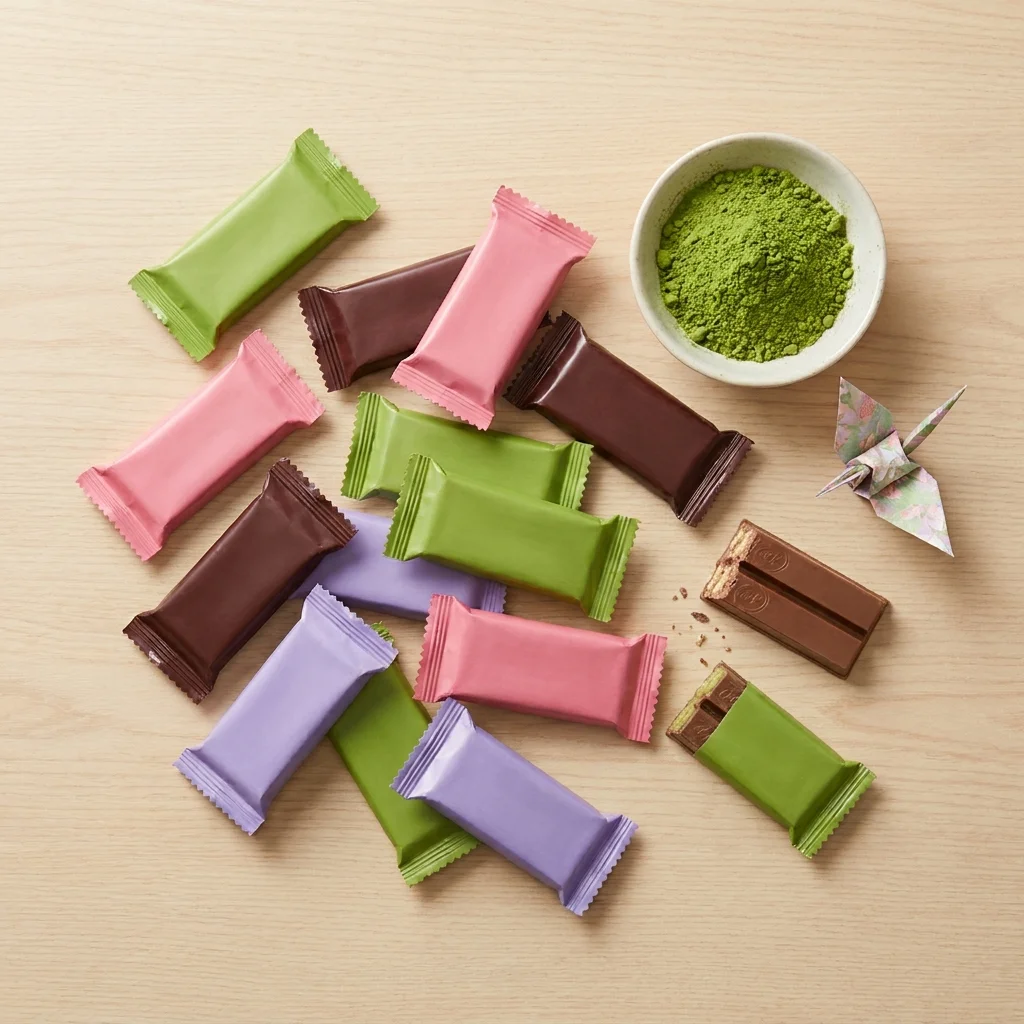
Around 2019, Nestlé Japan began switching the outer bags of its mini bars from plastic to paper, with instructions printed on the inside for folding the paper into an origami crane. It is the most Japanese possible answer to packaging waste.
On storage: chocolate is the one item in any Japanese snack order that dislikes heat. In hot months, and in southern-hemisphere summers, plan around it and check our delivery information. Keep bars somewhere cool and dry, and if you chill them during a heatwave, let them come back to room temperature inside the wrapper so condensation does not form on the chocolate.
Frequently asked questions
Are Japanese Kit Kats different from Kit Kats elsewhere? Yes. The Japanese range is produced by Nestlé Japan for the domestic market, with its own flavours, sweetness levels and packaging. Even the standard milk chocolate version can taste different from the one you know.
How many Kit Kat flavours does Japan have? Hundreds have been released since around 2000, but only a small number are on sale at any one time. Most are seasonal, regional or one-off.
What is the best Japanese Kit Kat flavour to try first? Matcha. It is the best known abroad, it is a permanent line, and it tastes of something you cannot easily find elsewhere. Add Otona no Amasa if you prefer darker chocolate.
Why is Kit Kat a good-luck gift in Japan? Because the name sounds like kitto katsu, "you will surely win". Students receive it before exams, and the habit spread to other occasions where a little luck helps.
Will chocolate survive shipping from Japan? Usually, but heat is the risk. Order chocolate in cooler months where you can, and see the delivery page for how parcels travel.
Start with matcha and a bag of Otona no Amasa, then let a regional edition find you. For the rest of the shelf, see our Japanese chocolate and biscuits guide, the Japanese snack guide, or browse Japanese snacks and food.