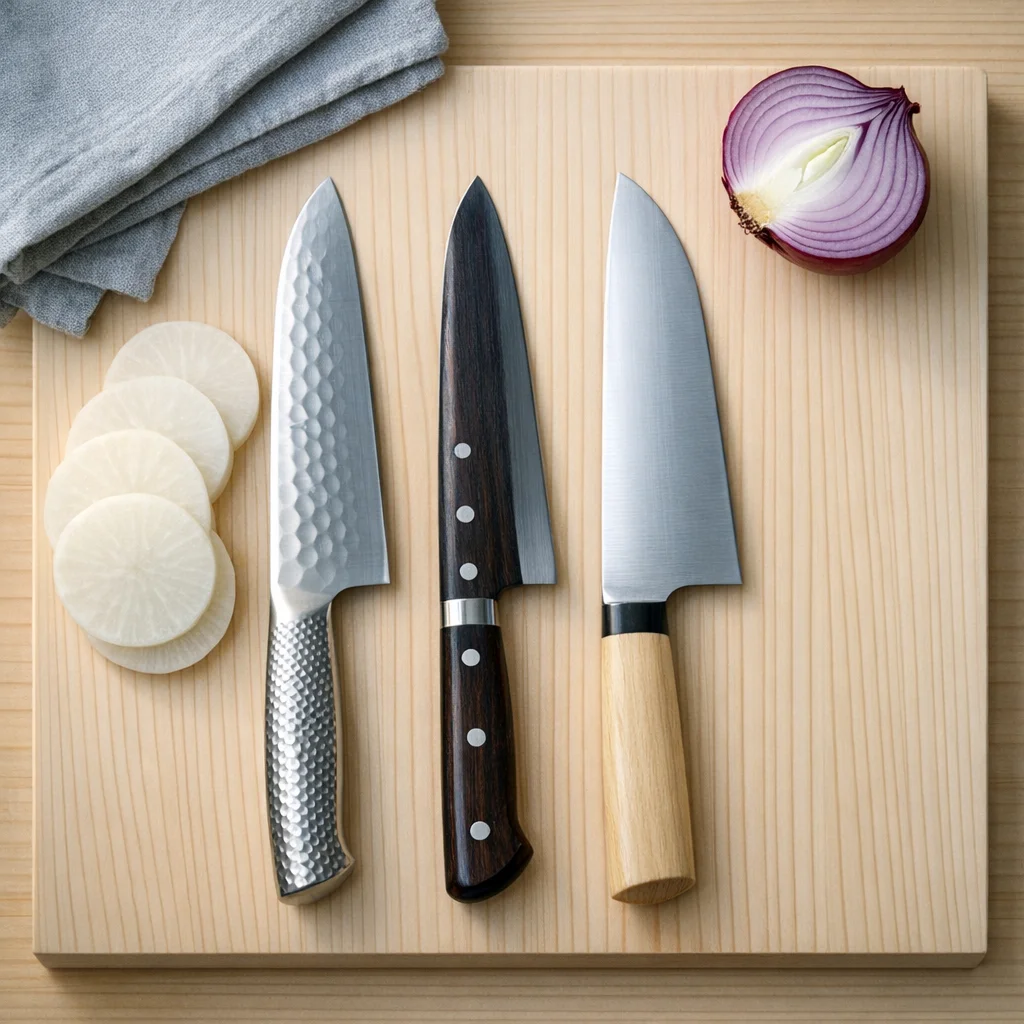
Japanese Knife Brands Compared: Tojiro vs Global vs Seki Magoroku
Three Japanese knife brands compared: Tojiro, Global and Seki Magoroku. Steel, handles, feel, upkeep and which suits which cook, from first knife to upgrade.
The three Japanese knife brands most people compare first are Tojiro, Global and Seki Magoroku. Tojiro makes traditional-looking Western-style knives with hard VG-10 steel cores and wooden handles, Global makes light all-stainless knives with a distinctive dimpled steel handle, and Seki Magoroku is Kai's home-kitchen range, running from simple stainless santoku knives to layered blades. All three are good; the right one depends on how a knife feels in your hand and how much care you want to give it.
This comparison covers where each brand comes from, the steel and construction, how the handles feel, upkeep, and which cook each one suits. If you have not yet chosen a blade shape, start with our guide to santoku, gyuto, nakiri and petty knives.
Tojiro, Global and Seki Magoroku at a glance
| Tojiro | Global | Seki Magoroku (Kai) | |
|---|---|---|---|
| Home town | Tsubame, Niigata | Niigata | Seki, Gifu |
| Signature look | Western-style blade, riveted wooden handle | One-piece stainless, dimpled steel handle | Japanese home-kitchen styling, wood or resin handle |
| Typical steel | VG-10 core clad in softer stainless | CROMOVA 18 stainless throughout | Single-layer stainless to three-layer clad blades |
| Feel | Classic, solid, familiar to Western cooks | Light and nimble | Light, everyday |
| Upkeep | Hand wash, dry, hone; easy to sharpen | Hand wash, dry; seamless handle | Hand wash, dry; entry lines very forgiving |
| Relative tier | Entry to upper-middle | Middle | Entry to middle |
Tojiro: VG-10 cores at a sensible level
藤次郎 (Tojiro) is a knife maker from Tsubame in Niigata, a region with a long metalworking history. It is best known abroad for its Western-shaped gyuto and santoku knives with a hard core of VG-10, a cobalt-containing stainless steel, clad on both sides with softer stainless. That three-layer construction is called 割込 (warikomi) in Japanese: the hard core takes and holds a fine edge, while the outer layers add toughness and resistance to rust.
The ranges you will see most often:
- CLASSIC. The line that was sold for years as Tojiro DP. A VG-10 core, three-layer blade with a full tang and a riveted composite-wood handle. It is the default recommendation for a first serious Japanese knife.
- BASIC. A simpler home-kitchen range, also with a VG-10 core, and a lighter, plainer handle.
- PRO. A professional-oriented range with VG-10 core blades and seamless stainless handles, in shapes that go beyond the home kitchen, such as honesuki, sujihiki and yo-deba.
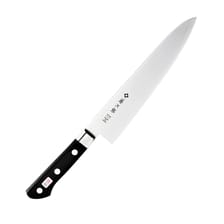
TOJIRO
Tojiro CLASSIC Gyuto Chef Knife 210mm
A versatile knife (Gyuto) featuring a VG10 core and 13 chrome stainless steel outer layers. Equipped with an aging-resistant laminated reinforced wood handle and a hygienic bolster, making it suitable for long-term use. Double-edged design for both right- and left-handed users.
From 168 USD
If you are used to German knives, Tojiro CLASSIC feels the most familiar of the three brands: a similar handle shape and bolster, but a thinner, harder blade.
Global: the all-steel design classic
Global knives are made by Yoshikin in Niigata. The industrial designer Komin Yamada was asked to design a new kind of kitchen knife in the early 1980s, and the first Global knives appeared in 1985. They still look unlike anything else in a knife block.
What sets Global apart:
- One material. Blade and handle are both made from CROMOVA 18, Yoshikin's own stainless steel containing chromium, molybdenum and vanadium.
- A hollow handle. The handle is formed from stamped steel welded together, then filled with a measured amount of sand to balance the knife.
- Dimples for grip. The black dots on the handle are there so wet fingers do not slip.
- No seams. With no join between wood and steel, there is nowhere for food to collect.
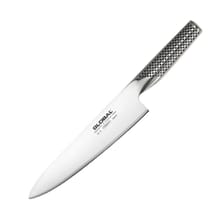
GLOBAL
GLOBAL G-2 Chef's Knife 20cm
A widely used versatile chef's knife. The narrow blade is suitable for cutting various ingredients such as meat, fish, and vegetables, and the 20cm blade length makes it easy to handle larger ingredients.
From 155 USD
Global knives feel light and quick in the hand, and many cooks love that. Others find the slim metal handle too narrow, or cold and slippery compared with wood. If you have large hands, try holding one before you commit.
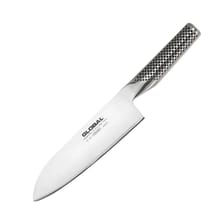
GLOBAL
GLOBAL G-46 Santoku Knife 18cm
A highly versatile Santoku knife from the GLOBAL series, perfect for any ingredient. The long 18cm blade makes it easy to cut larger items like cabbage.
From 162 USD
Seki Magoroku: Kai's home-kitchen range
関孫六 (Seki Magoroku) is a brand of 貝印 (Kai), a cutlery company founded in Seki, Gifu, in 1908. Seki has been a blade-making town for centuries, and the brand name honours Magoroku Kanemoto, one of the most famous swordsmiths in the town's history. Kai also makes the premium Shun line, but Seki Magoroku is the range you find in Japanese home kitchens.
The range is wide:
- Wakatake. An entry-level santoku with a single-layer stainless blade and a resin handle. Light, rust-resistant and very easy to live with.
- 10000CL. A three-layer blade with a high-carbon stainless core and a laminated wood handle, a clear step up in edge quality.
- Specialist and upper lines. Kai sells further Seki Magoroku ranges with different steels, finishes and shapes, including gyuto knives.
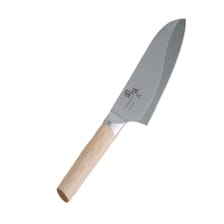
KAI Seki Magoroku
Seki Magoroku 10000CL Santoku Knife 165mm
A Santoku knife from the Seki Magoroku "10000CL" series. Suitable for daily use as a versatile knife for various ingredients such as meat, fish, and vegetables. The blade length is 165mm, and the handle is made of water-resistant laminated wood.
From 168 USD
Seki Magoroku santoku knives are often a little shorter and lighter than Western chef's knives, which suits small cutting boards and everyday vegetable prep.
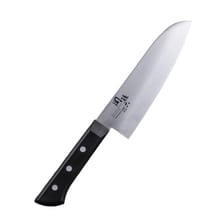
KAI Seki Magoroku
Kai Seki Magoroku Wakatake Santoku Knife 165mm
A santoku knife made of rust-resistant and easy-to-care-for stainless steel. It can be used for a wide range of purposes, such as cutting meat, fish, and vegetables. Dishwasher safe.
From 33 USD
How do the steels and edges compare?
Steel decides how sharp a knife gets, how long it stays that way, and how much care it needs. Our Japanese knife steel guide explains the grades in detail. In short:
- VG-10 core blades (Tojiro CLASSIC, BASIC and PRO) take a very fine edge and hold it well. Seki Magoroku's layered 10000CL blades work on the same hard-core principle. The hard core can chip if you twist the blade through bone or frozen food.
- CROMOVA 18 (Global) is a stainless steel designed for a good balance of sharpness, toughness and easy care.
- Single-layer stainless (Seki Magoroku Wakatake) is softer and more forgiving. It dulls sooner but is easy to bring back.
All of these are stainless steels, so none of them need the oiling and drying ritual of carbon steel. They will still stain or pit if left wet with salty or acidic food.
Which Japanese knife brand should you choose?
| If you... | Consider |
|---|---|
| Want a first serious Japanese knife that feels familiar | Tojiro CLASSIC gyuto or santoku |
| Like light knives and modern design | Global G-2 or G-46 |
| Want an easy, low-maintenance everyday santoku | Seki Magoroku Wakatake |
| Want a step up in edge quality at home | Seki Magoroku 10000CL or Tojiro BASIC |
| Cook a lot of meat and fish and want specialist shapes | Tojiro PRO |
There is no wrong choice among these. The biggest difference most people notice is the handle, so think about whether you prefer wood or steel, a full grip or a slim one.
How do you care for these knives?
The same habits keep all three brands sharp:
- Hand wash and dry straight away. Dishwashers knock edges against other items and can damage handles.
- Use a wooden or soft synthetic board. Glass, stone and ceramic boards dull an edge quickly.
- Do not twist through bone or frozen food. Hard Japanese edges are thin and can chip.
- Sharpen on a whetstone. A #1000 stone does most of the work; a finer stone polishes the edge. Our guide to sharpening Japanese knives walks through it step by step.
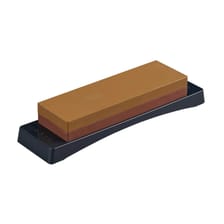
TOJIRO
Tojiro Home Combination Whetstone <#1000/#3000>
A slim-sized #1000/#3000 combination whetstone for home use. It is used to condition the knife edge and provide a fine finish.
From 84 USD
Frequently asked questions
Is Tojiro or Global better? Neither is better overall. Tojiro CLASSIC has a hard VG-10 core and a wooden handle that feels familiar; Global is lighter, all steel, and has a slimmer handle. Choose by feel.
Is Seki Magoroku a good knife brand? Yes. It is Kai's long-established home-kitchen range from Seki, Japan's best-known blade-making town. Entry lines are simple and forgiving, and the layered lines are a real step up.
What is the difference between Tojiro CLASSIC and Tojiro DP? They are the same range. Tojiro renamed DP to CLASSIC, keeping the VG-10 core, three-layer construction.
Are Global knives hard to sharpen? No. They sharpen on an ordinary whetstone. Because the edge is thin and acute, use light, even pressure.
Which Japanese knife brand is best for beginners? Tojiro CLASSIC or BASIC if you want a solid, sharp knife, and Seki Magoroku Wakatake if you want the easiest one to live with.
Browse the full ranges on our Tojiro, Global and Seki Magoroku brand pages.