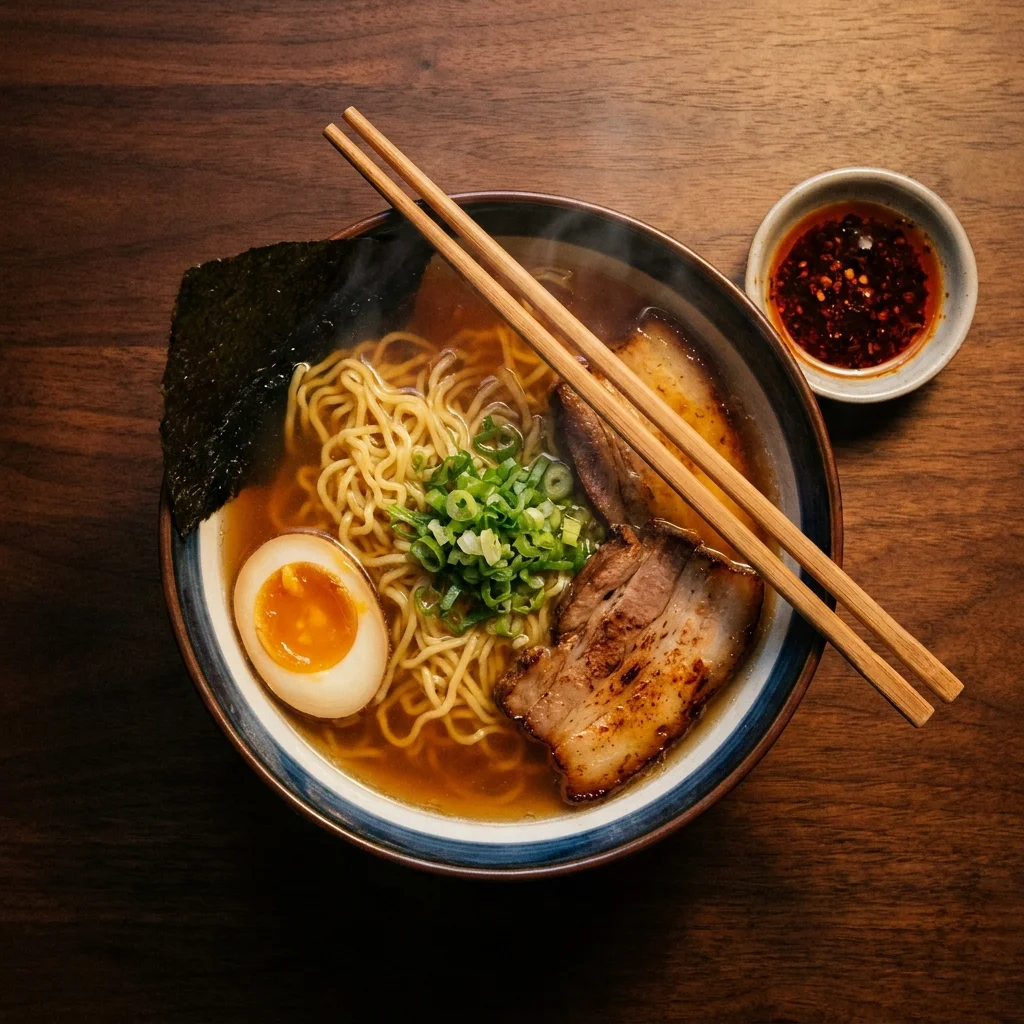
How to Make Ramen at Home: Tare, Broth and the Perfect Egg
How to make ramen at home without a twelve-hour stock: the five-part bowl, a shoyu tare, a weeknight broth, jammy ajitama eggs and a better instant pack.
Restaurant ramen takes a twelve-hour stock and a kitchen nobody has at home. Good ramen at home takes about forty minutes, a jar of tare in the fridge and one trick with eggs. The difference between a sad bowl and a great one is not really the broth; it is the structure.
This guide shows how to make ramen at home the way Japanese ramen cooks think about it — in five separate parts — with recipes for a shoyu tare, a weeknight broth, marinated eggs and quick pork, plus how to upgrade an instant pack when there is no time at all.
The five parts of a bowl of ramen
Every bowl is assembled, not cooked in one pot:
| Part | What it does | At home |
|---|---|---|
| Tare (タレ) | The seasoning concentrate; it decides the style | A jar of soy, salt or miso base |
| Broth | Body and depth | Chicken stock with dashi |
| Aroma oil | Fragrance and gloss on top | Spring-onion oil, sesame oil or chilli oil |
| Noodles | Spring and chew | Fresh, dried or instant alkaline noodles |
| Toppings | Contrast | Egg, pork, menma, negi, nori |
Tare goes into the empty bowl, hot broth on top, then noodles, toppings and a spoonful of oil. Keep the parts separate until the last minute and you can make one bowl or six without anything going soggy.
Shoyu, shio, miso, tonkotsu: the four bases
Ramen styles are named for their tare or their broth:
- Shoyu (醤油) — soy sauce tare in a clear chicken or pork broth. The Tokyo classic, and the easiest place to start.
- Shio (塩) — salt tare, the lightest and clearest. Hakodate, in Hokkaido, is the town most associated with it.
- Miso (味噌) — a rich miso tare, famously from Sapporo, often topped with sweetcorn and a knob of butter.
- Tonkotsu (豚骨) — a cloudy, creamy broth of pork bones boiled hard for many hours, the speciality of Hakata in Fukuoka, usually with thin straight noodles.
Leave tonkotsu to restaurants; its broth needs hours at a rolling boil. The other three are weeknight-friendly.
A shoyu tare to keep in the fridge
Makes enough for about six bowls.
- 120 ml soy sauce
- 2 tbsp mirin
- 1 tbsp sake (optional)
- 1 tsp sugar
- A 5 cm piece of kombu
- A small handful of katsuobushi (bonito flakes)
- Put the soy sauce, mirin, sake, sugar and kombu in a small pan and warm gently until it just steams. Do not let it boil.
- Take it off the heat, add the bonito flakes and leave for 10 minutes.
- Strain into a clean jar. It keeps in the fridge for about two weeks.
Use 2–3 tablespoons per bowl and adjust to taste. If the bottles themselves are a mystery, our soy sauce, mirin and vinegar guide sorts them out.
A weeknight broth in twenty minutes
Per bowl, start with 350 ml of low-salt chicken stock. Add a slice of ginger, a crushed garlic clove and the green tops of a spring onion, and simmer for 15 minutes. Stir in ½ teaspoon of dashi granules and ½ teaspoon of concentrated chūka seasoning paste, then strain.
The dashi brings the seafood depth that Japanese broths have and stock alone lacks; more on that in Japanese dashi, explained.
The chūka paste is the shortcut to a rounder, meatier base — the same jar behind the dishes in our chūka cooking guide.
Aroma oil: warm 3 tablespoons of neutral oil with a sliced spring onion and a sliced garlic clove over a low heat until golden, then strain. A teaspoon on each bowl makes the kitchen smell like a ramen shop.
For miso ramen, replace the shoyu tare with 1½ tablespoons of miso loosened with a little broth, plus a few drops of sesame oil.
Ajitama eggs and quick pork
Ajitama (味玉), the marinated egg with a jammy yolk, is the topping people remember.
- Lower fridge-cold eggs into boiling water and cook for 6½ minutes.
- Move them straight into iced water for 5 minutes, then peel.
- Put them in a bag or small container with 50 ml soy sauce, 50 ml mirin and 100 ml water.
- Refrigerate overnight, and eat within two to three days.
Quick pork stands in for chashu, which is rolled and braised for hours. Cut 300 g of pork belly into 1 cm slices and sear in a dry pan until golden on both sides. Pour off most of the fat, add 2 tablespoons each of soy sauce, mirin and water and 1 tablespoon of sugar, and let it bubble down to a sticky glaze.
Noodles and toppings
Ramen noodles get their springy bite and yellow colour from kansui (かん水), an alkaline mineral solution. Fresh noodles are best, dried ramen noodles are the sensible pantry option, and an instant block works in a pinch.
No ramen noodles at all? Bake baking soda on a tray at about 120°C for an hour to make it more alkaline, then add roughly a tablespoon to 1.5 litres of boiling water and cook spaghetti in it. The pasta firms up and takes on a surprisingly ramen-like chew. Baked soda is harsher than the original, so handle it carefully and keep the jar labelled.
Two rules whatever the noodle:
- Cook the noodles in a separate pan of plenty of water, never in the broth. Their starch clouds the soup.
- Warm the bowl first with boiling water. A cold bowl drains the heat out of everything.
For toppings, think menma (seasoned bamboo shoots), finely sliced negi or spring onion, a sheet of nori tucked against the rim and, on miso ramen, sweetcorn with a knob of butter.
Seasoned nori works as well as plain: a little sweeter and saltier, and good for dipping into the broth.
How to upgrade instant ramen
Instant ramen was practically designed to be improved:
- Use a little less water than the packet says, for a richer soup.
- Add an egg, either dropped in for the last minute or as a ready-made ajitama.
- Stir-fry vegetables first — cabbage, bean sprouts, carrot — and pile them on top.
- Finish with fat and fragrance: butter and corn on miso, sesame oil on shoyu, chilli oil on anything.
- Taste before adding the whole sachet. Once toppings go in, it is often saltier than you need.
Our Japanese instant noodles guide covers which packs to start with.
Frequently asked questions
What is tare in ramen? The concentrated seasoning that goes in the bottom of the bowl. It sets the style — soy, salt or miso — while the broth provides body.
How long do you boil eggs for ramen? About 6½ minutes from fridge-cold in boiling water, then straight into iced water. That gives a set white and a jammy yolk.
Can I make ramen with spaghetti? Yes, if you boil it in water with baked baking soda. The extra alkalinity gives it a firmer, springier, more ramen-like texture.
What is the difference between shoyu, shio and miso ramen? The tare: soy sauce, salt or miso. Shoyu is balanced and savoury, shio is the lightest, miso is the richest.
Why does my homemade ramen taste flat? Usually too little tare or no aroma oil. Add tare a spoonful at a time, and finish every bowl with a teaspoon of fragrant oil.
Make a jar of tare and a batch of ajitama on Sunday, and ramen becomes a fifteen-minute dinner for the rest of the week. Browse ramen and noodles to stock the cupboard.