How to Wrap Furoshiki: 5 Japanese Gift Folds, Step by Step
How to wrap furoshiki, step by step: the basic box wrap, one- and two-bottle wraps, a book carry and a quick bag, plus the knot, the sizes and fabric care.
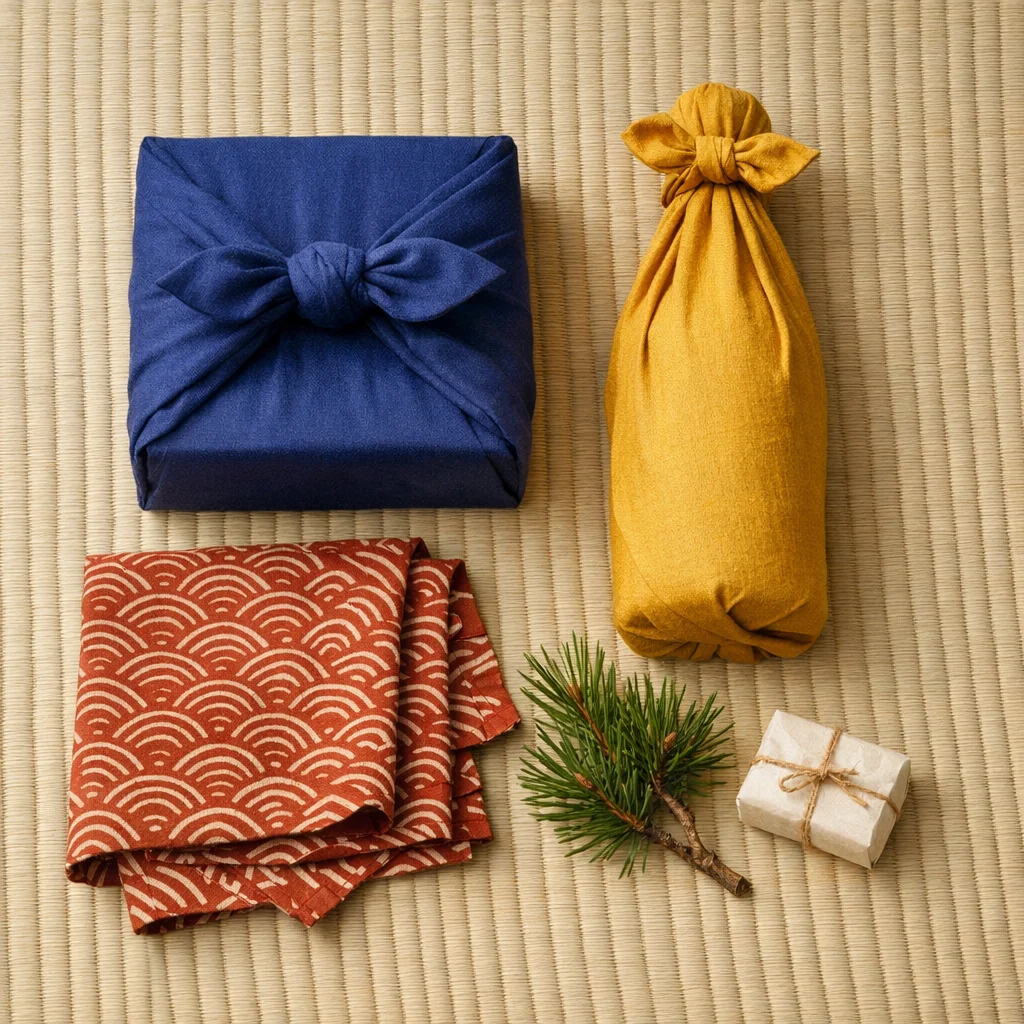
To wrap a gift with furoshiki, lay the square cloth flat as a diamond, put the gift in the centre, fold two opposite corners over it and tie the other two in a square knot on top. That single method covers most boxes, and four more folds handle bottles, books and bags.
This guide walks through five folds step by step, explains the one knot that all of them use, helps you pick a cloth size, and covers fabric and care. A furoshiki (風呂敷) can be untied and used again, which is the whole point.
What is a furoshiki?
A furoshiki is a square of cloth used to wrap, carry and present things. Wrapping cloths are very old in Japan, but the name, literally "bath spread", comes from the bathhouses of the Edo period, where people bundled their clothes in a cloth and stood on it while they changed.
For most of the twentieth century it was simply how Japanese people carried things: lunch boxes, books, gifts, a change of clothes. Paper and plastic bags pushed it aside, and then it came back. In 2006, Japan's Ministry of the Environment promoted furoshiki as an alternative to shopping and gift bags, with a cloth designed by the minister and printed on fabric made from recycled bottles, and an illustrated leaflet of folds.
Today it is used both ways: as everyday reusable wrapping and as the most elegant way to hand over a gift. In a formal setting, the giver traditionally unwraps the gift in front of the recipient, hands it over and takes the cloth home again.
The one knot you need: ma-musubi
Almost every fold ends with a ma-musubi (真結び), the square knot. It is flat, secure and easy to undo.
- Take one corner in each hand. Cross the right corner over the left and tuck it under, as if starting to tie a shoelace.
- Now cross the corner that is pointing right over the other one, tuck it under and pull through.
- Pull both ends evenly. A correct square knot sits flat, with the ends pointing out sideways.
If the ends stand upright, crossing the cloth, you have tied a granny knot. Undo it and repeat step 2 the other way.
To untie it without a struggle, hold one end and pull it straight so it becomes a line through the knot, then slide the knot off along it.
What size furoshiki do you need?
Furoshiki are measured along one side. Traditional width names vary between shops, so it is easiest to think in centimetres.
| Approximate size | Traditional name | Good for |
|---|---|---|
| About 45 cm | 中幅 (chūhaba) | Small boxes, gift envelopes, a lunch box |
| About 68–75 cm | 二幅 / 二尺幅 | Boxes of sweets, one bottle, a book |
| About 90 cm | 二四幅 (nishihaba) | Two bottles, larger boxes, a simple bag |
| About 100–105 cm | 三幅 (mihaba) | Shopping, bulky gifts, a tote-style bag |
If you buy only one, a cloth of around 90 to 100 cm is the most versatile. It is large enough for two bottles or a bag, and it can still be folded small for a compact box.
Musubi, a Kyoto furoshiki specialist, makes 100 cm cloths with a water-repellent finish, which makes them practical as a shopping bag in the rain as well as a gift wrap.
Musubi
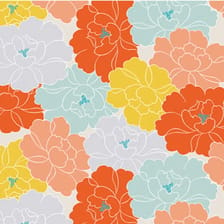
Musubi 100 Aqua Drop Re-Free Furoshiki, Adeline Klam Peony Orange
A 100 cm furoshiki featuring an environmentally friendly, fluorine-free (PFAS-free) water-repellent finish. The thin and lightweight fabric securely repels water, making it widely useful as an eco-bag or a cover for sudden rain.
From 2,284.2 TWD
How to wrap a box: otsukai tsutsumi
The otsukai tsutsumi (お使い包み, "errand wrap") is the basic fold. Use it first, because the others build on it.
- Lay the cloth as a diamond, pattern side down, and place the box in the centre.
- Fold the corner nearest you over the box. If it is long, tuck the excess under the box.
- Fold the far corner over the top, on top of the first.
- Bring the left and right corners up and tie them in a square knot on top of the box.
- Tidy the knot by spreading the ends into neat "ears".
For a more formal look with no knot, the hira tsutsumi (平包み, flat wrap) folds all four corners over the box in turn and tucks the last one in. It is used for ceremonial gifts that the giver will unwrap in front of the recipient.
How to wrap one bottle: bin tsutsumi
The single-bottle wrap turns the cloth into its own carrying handle.
- Stand the bottle in the centre of the cloth.
- Lift two opposite corners and tie them in a square knot just above the top of the bottle.
- Take the two remaining corners, wrap them around the bottle in opposite directions so they cross at the back.
- Bring them to the front and tie a square knot.
- Carry it by the top knot.
This works best with a cloth of about 70 cm for a wine or sake bottle.
How to wrap two bottles together
The two-bottle wrap is the one that impresses people, and it is easier than it looks.
- Lay the cloth as a diamond and place two bottles on their sides across the middle, bases facing each other with a gap of a few centimetres.
- Fold the corner nearest you over the bottles.
- Roll the bottles away from you until they are completely wrapped.
- Hold both ends and stand the bottles up so their bases meet in the middle.
- Tie the two loose corners in a square knot above the bottles to make a handle.
Use a cloth of around 90 cm or larger for standard wine bottles. The gap between the bases matters: too small and the bottles will not stand together, too large and they wobble.
How to wrap books: hon tsutsumi
The two-book carry uses the same rolling idea with flat objects.
- Place two books side by side in the centre of the diamond, with a small gap between them.
- Fold the near corner over both books, then the far corner.
- Close the books together like a book closing on its spine, so they stand back to back.
- Tie the left and right corners in a square knot on top as a handle.
For a single book, the basic box wrap is enough; flatten the knot so the parcel can lie in a bag.
How to turn a furoshiki into a bag: shizuku tsutsumi
The shizuku tsutsumi (しずく包み, "drop wrap") makes a soft bag in under a minute.
- Fold the cloth in half into a triangle, pattern side out.
- Tie a single knot at each of the two ends of the folded edge.
- Turn it inside out so the knots are hidden inside and a pouch forms.
- Tie the two remaining corners together in a square knot. That is the handle.
A 90 to 100 cm cloth gives a bag big enough for a few small gifts or groceries.
Choosing a fabric and caring for it
- Cotton is easy to tie, grips well and is the everyday choice.
- Polyester, including recycled polyester, is light, quick-drying and often water-repellent.
- Silk and chirimen (縮緬, crêpe) look formal and drape beautifully, but slip more and need gentler care.
- Double-sided cloths show a different colour on each face, so the knot ears contrast with the wrap.

Musubi
Musubi 100 Aqua Drop Recycle Double Face Furoshiki, Masaru Suzuki Sun Flower Green Mix
A large furoshiki wrapping cloth with a water-repellent finish. The reversible double-face design allows you to enjoy different patterns on the front and back. It can be used for a wide range of purposes, such as an eco-bag or a picnic mat.
From 2,858.4 TWD
Wash cotton and polyester by hand or on a gentle cycle and iron at the setting the label allows. Silk is better spot-cleaned or professionally cleaned.
A furoshiki makes a gift twice: the wrapped gift, and the cloth itself. Try it on anything from our Japanese stocking stuffers or Japanese gifts for men, on a box from our Japanese food gifts for foodies, on a set from the Japanese tea gift guide, or around a lunch box from our bento box guide.
Frequently asked questions
What size furoshiki is best for wrapping gifts? Around 70 cm suits boxes of sweets and single bottles. A 90 to 100 cm cloth is the most versatile and also makes two-bottle wraps and bags.
Which side of the furoshiki faces out? The pattern side faces down when you lay the cloth flat, so it ends up on the outside of the wrap.
How do you stop a furoshiki knot from coming undone? Use a true square knot, with the ends pointing sideways, and pull both ends evenly. Silk slips more than cotton, so tie it slightly tighter.
Do you give the furoshiki away with the gift? You can, as part of the present. In formal Japanese etiquette, the giver unwraps the gift when handing it over and keeps the cloth.
Can you wash a furoshiki? Cotton and polyester can be washed gently and ironed. Silk and crêpe are better spot-cleaned.
Browse our furoshiki collection or the full Musubi range.