Six Japanese Kitchen Tools That Earn Their Drawer Space
Japan's kitchens are small, so its tools have to justify themselves. The hand chopper, the hinoki board, the enamel stocker and three more worth importing.
The average Japanese kitchen is small, and that constraint shows up in its tools. There is very little room for single-purpose gadgets, so the ones that survive in Japanese homes tend to be the ones that genuinely save time every day rather than once a year.
Here are six that travel well — chosen because each one replaces something slower, not because they look good on a shelf.
1. The hand chopper
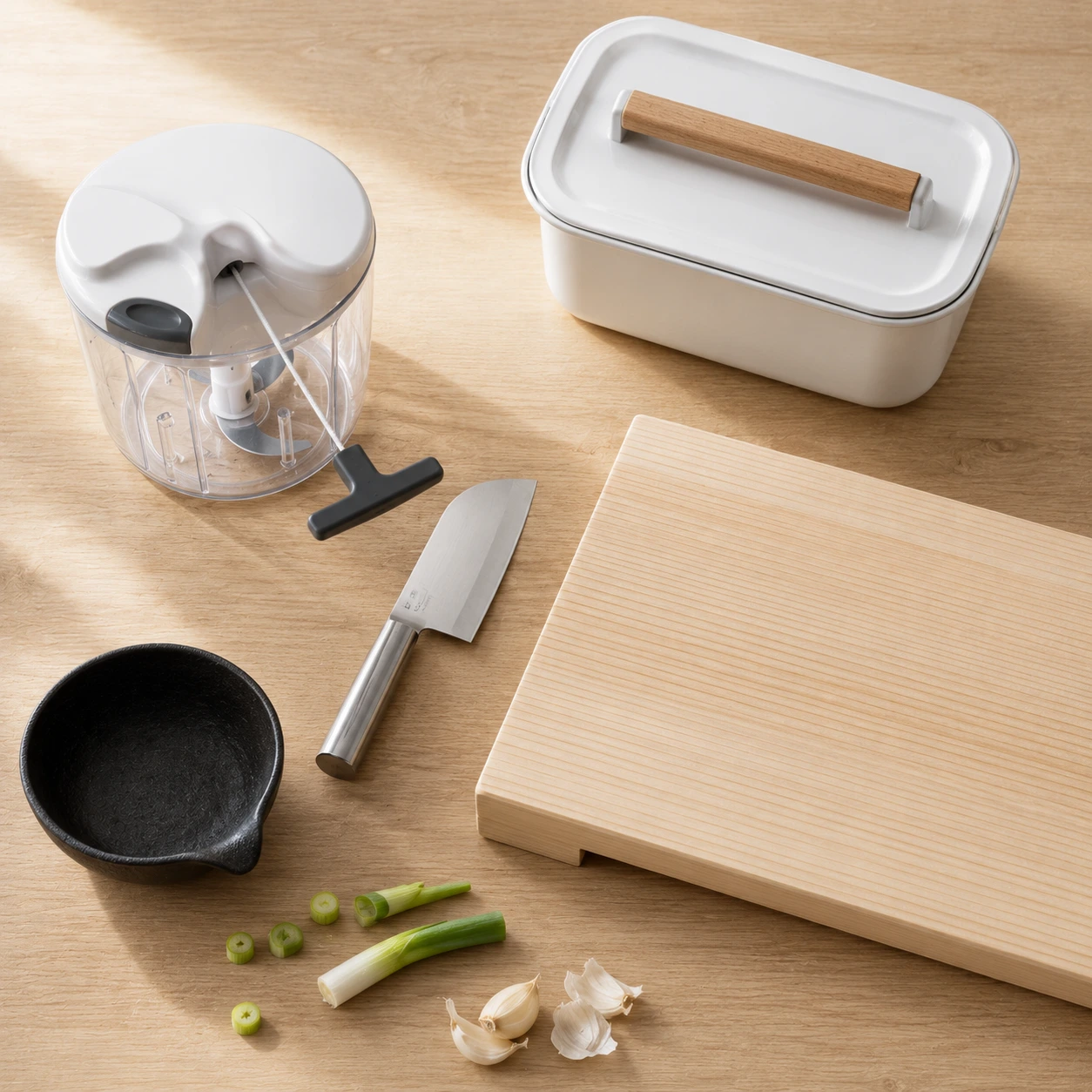
A manual chopper is a small bowl with a blade assembly and a crank handle on the lid. A few turns and onion, garlic, carrot, herbs or nuts go from whole to finely chopped, with no electricity and no motor housing to keep dry. This one also ships with a draining basket, which turns the same bowl into a salad spinner for herbs and shredded vegetables.
It solves the specific problem that makes people avoid cooking on weeknights: the ten minutes of onion prep before anything interesting starts. It also handles the jobs a food processor over-processes — a few turns gives you texture, whereas a machine gives you purée.
Two practical notes: turn steadily rather than fast, and cut ingredients into rough 2 cm chunks first. Everything comes apart for washing.
2. A short, wide chopping blade
A 10 cm mini chopper is not a paring knife — it is a small, tall-bladed cleaver for mincing. Garlic, ginger, shallots, herbs and small quantities of meat go under it, and the wide flat face then crushes and scrapes them off the board, which is the part a narrow knife cannot do.
The one-piece stainless construction matters more here than on a full-sized knife: there is no seam between blade and handle, so nothing traps food, and it can be washed and dried in seconds. It is the knife that stays on the counter rather than going into a block.
For where it sits in the wider set, see the Japanese knife guide.
3. A hinoki cutting board
Japanese hinoki (cypress) is the traditional board material and it is genuinely better for knives than the alternatives. It is soft enough that the edge sinks slightly instead of rebounding, it is naturally water-resistant, and hinoki's aromatic oils are the reason it has been used in bathhouses and food preparation for centuries.
The comparison that matters: bamboo boards are harder than most people realise and dull edges quickly; glass, ceramic and granite boards damage them immediately. Plastic is fine and hygienic but feels dead under a good knife.
Hinoki needs a little care in return — wash and dry standing on edge, never soak it, never put it in a dishwasher, and scrape rather than scour. It will grey slightly over years; a light sanding brings it back.
4. Enamel storage
Enamelware — steel with a fused glass surface — is the Japanese answer to plastic containers, and it wins on every axis except weight. It is completely non-reactive, so it holds miso, pickles, kimchi, marinades and citrus without absorbing odour or staining, and it does not scratch into a haze after a year. Dry goods work just as well: sugar and salt keep better in enamel than in plastic. The steel body handles freezer and oven temperatures — lids generally do not, so take them off first.
The Japanese use for it that has no Western equivalent: storing miso, and maintaining a nukadoko rice-bran pickling bed. Any container that holds a fermenting culture for months needs to be inert, and enamel is the traditional choice for good reason. Our miso guide covers what goes in it.
Its one rule: don't drop it. Chipped enamel exposes the steel underneath, which then rusts.
5. Cast iron that goes to the table
A small cast iron bowl or dish is one of those items that seems redundant until you use it. Preheated, it keeps a portion of stew, curry or rice properly hot from the first mouthful to the last — an ordinary bowl loses that heat within minutes.
It is cookware and serveware at once, which is exactly the kind of double duty a small kitchen requires. Care is the same as any Nambu ironware: dry it over heat, don't soak it, don't store food in it.
6. Steak knives that are actually sharp
Table knives are the most neglected blades in most homes — usually dull, serrated, and left to saw at the meat. A properly sharp Japanese-steel steak knife cuts cleanly with no pressure, without tearing the fibres, which changes how a meal feels far more than the cost suggests. They are sold as a set of four, which is the number a table actually needs.
They can be sharpened on a whetstone like any other knife, unlike the serrated ones they replace. The care guide applies here too.
The ones you can skip
In the interest of not selling you a drawer full of things:
- Rice paddles, sushi mats, ginger graters — useful only if you make the specific dish. A spoon and a fine grater cover most of it.
- Egg-roll (tamagoyaki) pans — genuinely better for rolled omelette and useless for anything else. Buy it if you make tamagoyaki weekly, not if you might try it once.
- Electric anything, from Japan — voltage and plug type are 100 V, Type A. Appliances need a transformer to work safely outside Japan and often are not worth the trouble. Everything in this article is manual for that reason.
Frequently asked questions
Do Japanese kitchen tools need special care? Wood and cast iron do — dry immediately, no dishwasher, no soaking. Enamel and stainless are as easy as anything else you own.
Is hinoki really more hygienic than plastic? Both are safe when cleaned properly. Wood dries faster than most people expect and cypress oils have antibacterial properties, but the meaningful difference for most cooks is that wood protects the knife edge and plastic does not.
Can I put any of these in a dishwasher? Stainless yes; enamel usually yes but chipping risk rises; wood and cast iron never.
Are Japanese electrical appliances usable abroad? Only with a step-down transformer to 100 V, and even then warranty and service are domestic-only. Prefer manual tools.
What single tool should I buy first? The hand chopper if you cook on weeknights, or the hinoki board if you have just bought a good knife and are cutting on bamboo.
Small kitchens make good editors. Everything above survived that edit in the country that invented the constraint — and if you are building the set from scratch, start with the knife guide and work outward.